49 works in this view — arrow keys or swipe to move between them.
Dance in Art
Polka-mazurka sur L'étoile du nord de G. Meyerbeer
Unknown artist
- Collection:
- Prints depicting dance
- Source:
- New York Public Library
- Rights:
- Public domain — free to use, share and adapt.
- Recorded as:
- Public Domain
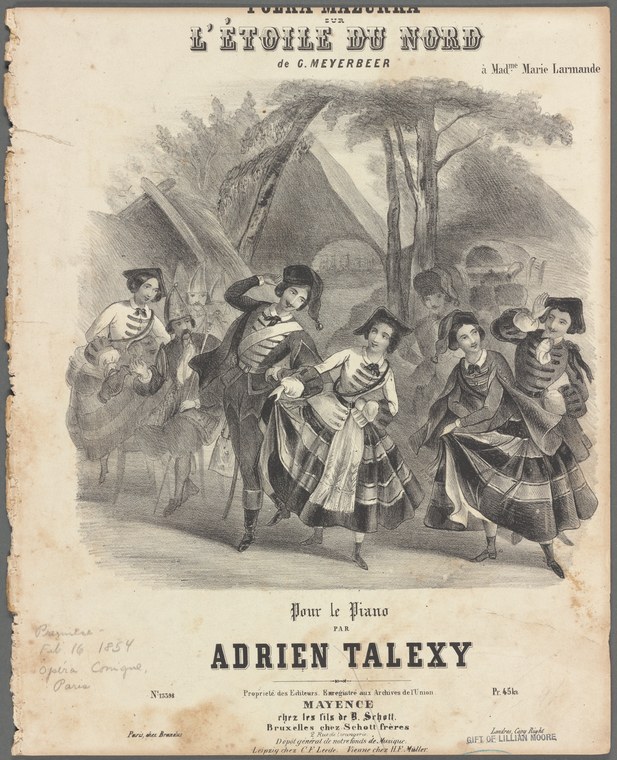
This is one of the few surviving images that documents the actual performance of a named nineteenth-century social dance—the polka-mazurka—in a theatrical context, showing how professional dancers executed this popular form for opera audiences. The engraving is also evidence of the close alliance between opera, dance, and printmaking in the mid-nineteenth century, and of the appetite for images of theatrical performance among educated European audiences. For dance historians, it provides visual testimony to the energy and technical sophistication of stage dancing during the Romantic period.
What you are looking at
A theatrical scene engraved in the romantic style, depicting a group of six dancers in mid-performance beneath draped fabric or stage drapery. The figures occupy a shallow stage space defined by classical architectural elements—columns or pillars visible in the background. Five women in full skirts dominate the composition; they wear corseted waists and their skirts are caught in motion, lifted and swirling. A male figure in military dress—plumed hat, decorated jacket, white breeches—stands at left, and another uniformed man appears at right. The lighting is dramatic, rendered through fine cross-hatching, with strong shadows defining the fabric folds and the musculature beneath the dancers' garments. The women's costumes suggest Scandinavian or Northern European dress, consistent with the opera's setting. The print is densely worked, with minute detail in the fabric textures and the interplay of light and shadow creating an almost sculptural quality to the dancers' bodies.
The dancing
The dancers display a vivacious, bouncing physicality. Their bodies lean slightly forward, with arms raised or extended in open positions. The women's skirts are dramatically lifted, suggesting rapid turns or jumps—their legs visible beneath the swinging fabric. The poses suggest the dancers are caught mid-leap or in rapid rotational movement. The stance is upright and springy rather than heavy, with weight distributed through the balls of the feet. The male figures stand more steadily, framing the action, their presence military and formal in counterpoint to the liveliness of the female dancers. The spatial relationship suggests a promenade or processional movement, with the figures arranged in a loose diagonal across the shallow stage depth.
The dance depicted
This is a scene from *L'Étoile du Nord* (The Star of the North), Meyerbeer's 1854 opera set in Russia during the time of Peter the Great. The title indicates this is a polka-mazurka, a hybrid social dance popular in mid-nineteenth-century Europe, combining the 3/4 time signature and turning motion of the mazurka with the energetic bounce and social accessibility of the polka. The image shows dancers performing this hybrid form in theatrical costume and context. Meyerbeer's opera was celebrated for its incorporation of national and folk elements, and the dance depicted here would have been a spectacular moment of stage choreography for the era, showcasing the technical precision and vivacity expected of professional dancers while evoking the Russian setting.
How it was made
This is an engraving, identified as such by its fine parallel lines, controlled cross-hatching, and the precision of its linear technique. The engraving technique allowed for wide distribution through printing and reproduction, making opera scenes and theatrical moments available to a broad public who could not attend live performance. The delicate stippling and parallel hatching create a tonal range from deep shadow to white paper, giving the dancers' forms strong three-dimensionality. The medium's capacity for fine detail is fully exploited: individual fingers are articulated, fabric folds are meticulously rendered, and the expressions and features of the dancers are clearly readable. This suggests a print of high quality intended for an educated, affluent audience with access to fine printed materials.
About this work
This is a theatrical scene engraving commemorating a moment from Meyerbeer's 1854 opera *L'Étoile du Nord*. The print documents a polka-mazurka, a fashionable hybrid dance of the mid-nineteenth century, as performed in the context of opera and stage spectacle. The engraving captures the energetic, bouncing physicality of the dance, with five female dancers in full skirts caught in rapid rotational movement, framed by uniformed male figures. The work is a product of the mature Romantic era in both art and music, when national and folk elements were prized in serious art forms and when opera was a central cultural institution.
The print belongs to a genre of theatrical documentation through engraving, recording not just the plot and characters of opera but the actual movement and spectacle of performance. For a gallery of dance in art, it provides rare evidence of how a specific, named social dance was translated into theatrical choreography and how it was visualized and disseminated to a wide public through the medium of reproductive prints.
How to look at it
Attend to the moment the engraver has chosen: not a static pose but a moment of rapid motion, with the women's skirts caught mid-swirl and their bodies in the midst of turning. The engraver has conveyed movement through the lifting and swinging of the fabric, the forward lean of the torsos, and the upward trajectory suggested by the raised arms and lifted heels. Notice how the artist uses light and shadow to create a sense of three-dimensional form and of the dancers' solidity and musculature beneath the clothing—this is not a mere silhouette but an anatomically coherent rendering of bodies in motion. The precision of the engraving technique itself—the fine parallel lines and careful modeling—gives the scene a quality of careful observation and documentation, as if this were a record of an actual performance.
The artist
The engraving is not attributed to a named artist in the catalogue, which was common for reproductive theatrical prints of the period. However, the quality of execution and the precision of the detail suggest work by a professional engraver of considerable skill, likely working in Paris (the publication line identifies Mayence/Mainz as the printer, but the artistic tradition and style are Parisian). The print would have been commissioned by the opera house, the composer, or a music publisher to circulate knowledge of the work and its theatrical spectacle.
The period
The print dates to the mid-nineteenth century, the height of the Romantic era in both music and visual art. Meyerbeer's operas were among the most celebrated works of their time, and *L'Étoile du Nord* was a major success across Europe. The polka and mazurka were fashionable social dances of the era, and their appearance in opera was a way of conferring theatrical legitimacy on popular forms while making them objects of artistic interest and refinement. In printmaking, the 1850s saw the continued dominance of engraving and etching for fine-art reproduction, though lithography was rapidly gaining ground. The theatrical engraving was a distinct genre, with its own conventions and audience, occupying a middle ground between fine art and popular illustration.
Where it lives
The print is held in the New York Public Library's collection of prints depicting dance. It is catalogued as a theatrical engraving and appears to be a professional print, likely published in Paris or another major European art center in the mid-nineteenth century. The inscription at bottom identifies the music as by G. Meyerbeer, the dance as a polka-mazurka on the theme of *L'Étoile du Nord*, and the pianist as Adrien Talexy, suggesting this may have been a concert or drawing-room arrangement rather than, or in addition to, the operatic version.
Dance in this work
Questions about this work
What was a polka-mazurka?
A hybrid social dance combining elements of the mazurka (a Polish 3/4-time dance with characteristic turns and lifts) and the polka (an energetic 2/4-time dance popular across Europe). The polka-mazurka was fashionable in the mid-nineteenth century and was often featured in ballrooms and, as here, in theatrical contexts. It was danced by couples and could be performed socially or, as in this opera scene, as a choreographed spectacle for an audience.
Why was Meyerbeer's *L'Étoile du Nord* important?
Meyerbeer was one of the most celebrated opera composers of the nineteenth century, and this 1854 work was among his major successes. The opera was notable for its incorporation of Russian themes, characters, and music, and for its spectacular use of dance and pageantry. It exemplified the "grand opera" tradition of Paris, combining elaborate staging, fine singing, and prominent dance sequences.
Who was Adrien Talexy?
Adrien Talexy was a pianist active in the mid-nineteenth century. This print suggests he arranged or performed the polka-mazurka from *L'Étoile du Nord* for piano, likely for concert or drawing-room performance, or possibly for piano accompaniment to dancers at a ball or theatrical rehearsal.
Why did opera companies include so much dance?
In the nineteenth century, dance was integral to operatic spectacle, particularly in the grand opera tradition practiced in Paris. Dance sequences provided visual excitement, allowed for ensemble work, and gave audiences a break from sustained vocal performance. National and folk dances, like the polka-mazurka here, also allowed opera to engage with themes of exoticism and national character that were central to Romantic aesthetics.
More dance artwork





