49 works in this view — arrow keys or swipe to move between them.
Dance in Art
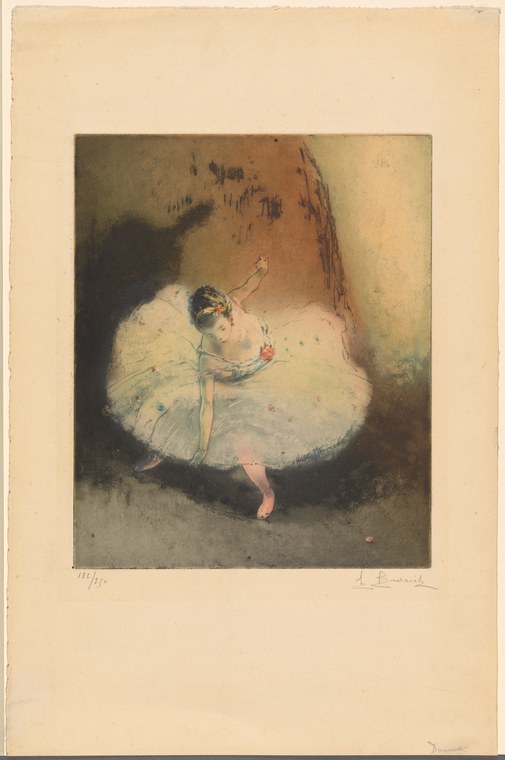
Danseuse
Unknown artist
- Collection:
- Prints depicting dance
- Source:
- New York Public Library
- Rights:
- Public domain — free to use, share and adapt.
- Recorded as:
- Public Domain
This image is a primary document of how Romantic-era ballet was imagined and circulated in popular culture. It shows us what a nineteenth-century audience valued in dance imagery: not the virtuosic spectacle, but the dancer's emotional presence and physical grace. For dance historians, it is evidence of the ballerina as a cultural obsession and a reflection of period aesthetics.
What you are looking at
A solitary ballerina in a white tutu is captured mid-movement against a warm, atmospheric background rendered in ochre and grey tones. She stands with her body angled away from the viewer, her left arm extended upward in an expressive gesture while her right arm curves across her torso. The tutu, rendered with delicate translucence, spreads around her in soft folds. The background is loosely painted with atmospheric washes and what appear to be small sketched figures or marks in the upper portion—possibly an indication of an audience or studio setting. The overall composition is intimate and introspective, emphasizing the dancer's isolation and grace. The technique is painterly and impressionistic, with warm light suffusing the figure.
The dancing
The dancer's posture suggests a moment between movements rather than a held position—her body is slightly tilted, weight appearing to rest on one leg while the other extends subtly. Her upper body is twisted in a manner characteristic of classical ballet, with the raised arm suggesting either an arabesque preparation or a port de bras moment. The arm position is fluid and expressive rather than rigidly geometric, indicating a romantic or late-classical sensibility. Her head is inclined, gaze directed downward in a pose that conveys both strength and vulnerability.
The dance depicted
This appears to depict Romantic-era ballet, the dominant theatrical dance form of the mid-to-late nineteenth century, when the ballerina in white tutu and pointe work became the central image of dance itself. The fluid port de bras (arm carriage), the elevation suggested by the tutu's spread, and the introspective mood all align with the Romantic ballet aesthetic exemplified by works like Giselle or La Sylphide. The isolation of the figure—a single dancer against an undefined space—was a common motif in nineteenth-century dance imagery, particularly in prints and paintings made for amateur collectors and dance enthusiasts.
How it was made
This is a color print, most likely a lithograph or hand-colored lithograph based on the painterly washes, the soft gradation of tone, and the characteristic way the pigment has been applied to the paper. The signature at lower right appears to be in pencil on the print itself. The technique allows for tonal subtlety and atmospheric effect that a pure engraving could not achieve, suggesting this was intended for a more affluent audience than a mass-market woodcut. The hand-coloring (evident in the pastel tones and slight irregularities) indicates this was produced in a period when such work was still hand-finished, dating it likely to the mid-nineteenth century.
About this work
This is a portrait of an idealized Romantic-era ballerina, captured in a moment of lyrical, introspective movement. The work belongs to a rich tradition of nineteenth-century dance imagery that celebrated the ballerina as an ethereal, almost supernatural figure—a visual expression of the Romantic movement's fascination with grace, emotion, and the otherworldly. The solitary, vulnerable pose suggests not a grand theatrical moment but an intimate study of the dancer's interiority. This is the kind of print that would have hung in the homes of dance enthusiasts, amateurs, and perhaps dancers themselves—visual currency in a period when the ballerina was becoming an icon of refinement and sensibility.
How to look at it
Observe the artist's choice of moment: not a leap or dramatic turn, but a quiet, contemplative pause in movement. The raised arm and twisted torso suggest the classical ballet vocabulary, but the emotional weight of the image comes from the dancer's downturned gaze and solitary placement. Note how the warm background and soft transitions in tone create a dreamlike, almost ethereal atmosphere—this is not a stage lit by footlights, but an imagined or internalized space. The tutu, rendered with transparency and delicate folds, was the signature garment of Romantic ballet and became shorthand for the ballerina herself in nineteenth-century popular imagery.
The period
This print was created during the height of Romantic ballet in Europe, roughly 1830s–1860s, when the ballerina in white tutu became the dominant image in Western dance. This was the era of Taglioni, Elssler, and the great roles in Giselle, La Sylphide, and La Bayadère. Dance imagery proliferated in prints, lithographs, and paintings for a middle-class audience hungry for representations of these celebrated performers. Such works were often based on actual performances or were idealized composites rather than portraits of specific dancers. The atmospheric, Romantic aesthetic visible here—the soft lighting, the emotional repose, the isolation of the figure—reflects broader artistic movements in European painting toward mood and sensation over narrative clarity.
Where it lives
The work is held in the New York Public Library's collection of prints depicting dance. It is numbered '118/30' in pencil at lower left, suggesting it is part of a larger series or collection. The signature at lower right appears to be the artist's hand, but attribution remains unknown.
Dance in this work
Questions about this work
How do we know this depicts Romantic ballet and not another dance form?
The white tutu, the pointe work implied by the dancer's stance, the classical ballet port de bras, and the introspective mood are all defining characteristics of Romantic-era ballet (circa 1830–1860). This aesthetic—emphasizing the ballerina as an ethereal, emotionally expressive figure—is distinct from later classical ballet and from folk or social dance forms.
Is this a portrait of a real dancer or an idealized figure?
Most nineteenth-century dance prints were idealized composites rather than accurate likenesses of named performers. While some were based on celebrated dancers like Taglioni or Elssler, they were usually marketed and understood as generic images of 'the ballerina' rather than as portraiture. The emotional mood and atmospheric setting suggest the artist was more interested in capturing an aesthetic ideal than in documenting a specific person.
What was the audience for this print?
This hand-colored lithograph was made for middle-class art lovers and dance enthusiasts who could afford to collect such prints. They would have been sold by print dealers, displayed in homes, and enjoyed by people who attended the ballet or who followed it through popular imagery and theater reviews. Such prints were both art and merchandise—cultural products that helped shape how ballet was understood and remembered.
More dance artwork





