49 works in this view — arrow keys or swipe to move between them.
Dance in Art
La N'Bitta
Unknown artist
- Collection:
- Prints depicting dance
- Source:
- New York Public Library
- Rights:
- Public domain — free to use, share and adapt.
- Recorded as:
- Public Domain
This print is evidence of how the (mostly female) body was put on theatrical display in the nineteenth century, and of the acrobatic and sensational dimensions of stage dance that art-historical accounts often overlook in favor of canonical ballet. The lift itself—an image of male strength and female weightlessness—became a visual cliché of theatrical romance, and this example shows how such moments were packaged and sold to audiences as objects of desire and spectacle.
What you are looking at
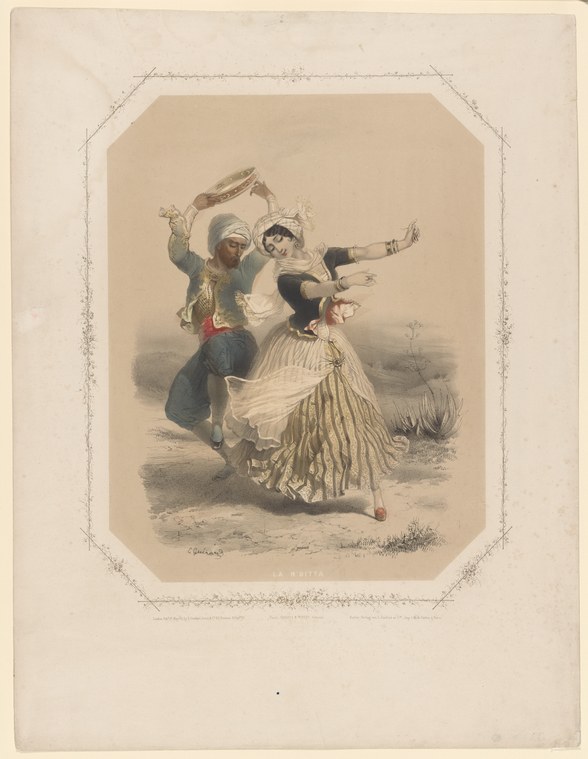
A male and female dancer execute a spirited, lifted pose against a plain background. The man, dressed in a dark military or formal jacket with ornamental details and a decorative hat or headpiece, supports the woman from behind and beneath, his arms raised to frame and steady her. The woman wears a white pleated skirt of generous volume and a dark fitted bodice; her body is inclined sharply forward and upward, one leg extended high behind her, her arms flung outward for balance. The composition captures a moment of considerable athleticism and playfulness—the woman appears nearly horizontal, suspended by her partner's strength. The artist has used warm, muted tones and soft shading to model the figures against the buff ground, with delicate cross-hatching to suggest fabric texture and shadow. A decorative border frames the scene, and a title cartouche appears at the base, though the inscription is not clearly legible in reproduction.
The dancing
The male dancer bears the female's full weight in an overhead or near-overhead lift, his posture wide-legged and braced for stability. The female dancer's body is nearly parallel to the ground, her spine extended and twisted slightly, her limbs loose and expressive—one leg kicked high, arms spread. The dynamic is one of display and trust: the man is the stable base; the woman is airborne. This is not a closed ballroom hold but an acrobatic or theatrical partnership in which the male body is purely functional support and the female body is the site of visual spectacle.
The dance depicted
This appears to be a theatrical or entertainment dance from the nineteenth century, most likely a Romantic-era theatrical ballet or a stage dance from the acrobatic and sensational repertoire of the period. The title, if correctly read as 'La N'Bitta,' does not correspond to a canonically known ballet or established choreography in the major European traditions, and may refer to an exotic or orientalist subject typical of mid-to-late 19th-century commercial theatre. The lift and the woman's costume—white pleated skirt with dark bodice—align with Romantic ballet conventions, but the extreme athleticism and the non-classical frame of the lift suggest this may be from a more sensational popular theatre, circus, or music-hall context rather than an institution like the Opéra. Without further documentation, attribution, or inscriptional clarity, the exact identity and original context of this dance remain uncertain.
How it was made
This is a hand-colored or tinted lithograph, recognizable by the soft tonal modeling, the characteristic crayon texture in the stone work, and the delicate cross-hatching used to define shadow and fabric. The work shows the hallmarks of 19th-century theatrical publicity and souvenir production: the decorative border, the title cartouche, and the warm-toned paper stock are all consistent with Parisian or European popular print culture from the 1840s–1870s. The technique allowed rapid, relatively inexpensive reproduction, making such prints ideal for advertising stage performances or selling commemorative images of celebrated dancers to audiences. The softness and warmth of the medium suited the romanticized representation of the human figure in motion.
About this work
This is a hand-colored lithographic print documenting a moment of theatrical dance from the nineteenth century—likely a Romantic-era stage performance or popular theatre piece. The image captures a distinctive lift in which a male dancer suspends a female partner nearly horizontally, her body extended and her costume—white skirt and dark bodice—visible in full motion. The work belongs to a large tradition of theatrical prints made to publicize dancers and performances, and to be sold as souvenirs to audiences. It is a primary document of how dance was represented, consumed, and circulated in urban popular culture before photography made such prints partly obsolete. The identity of the dancer and the original choreography remain unknown, but the technical quality and theatrical subject matter indicate a significant performer or well-known piece.
How to look at it
Attend to the geometry of the lift: the artist has chosen a moment of maximum extension and apparent weightlessness, with the female dancer's body nearly horizontal and her limbs loose and expressive. This is not a classical or controlled moment but a spectacular one—the point at which the female body appears most remarkable and the male body most invisible (consumed entirely by the labor of support). Note the contrast between the woman's costume and the man's formal dress: he is clothed as a gentleman or officer; she is displayed as a performer. The soft modeling and warm tone give the scene a romantic, flattering quality, but the composition itself is about power and visibility.
The period
The print dates stylistically and technically to the mid-nineteenth century, when lithography had become the dominant medium for theatrical publicity in Europe. This was the era of Romantic ballet's greatest fame—the 1830s–1850s—when dancers like Marie Taglioni and Fanny Elssler captivated audiences across Europe and North America, and when the image of the weightless, ethereal female dancer became a central symbol of the period. Simultaneously, popular theatre, circus, and music-hall performances competed vigorously for audiences, often adopting and exaggerating the visual vocabulary of ballet—the tutu, the lift, the exotic subject matter—to attract spectators. The result was a prolific market for theatrical prints showing both canonical ballet and more sensational stage dances, many performed by now-forgotten artists.
Where it lives
The print is held in the New York Public Library's collection of prints depicting dance, indicating it was valued as a document of theatrical history or as a souvenir of a stage performance. Such prints were typically sold to audiences at the stage door or through print shops in theatre districts, making them accessible to a broad urban public.
Dance in this work
Questions about this work
What dance is this?
The title suggests a specific choreography called 'La N'Bitta,' but no trace of this work survives in documented ballet or theatrical histories. The image shows a lift and costume consistent with mid-19th-century Romantic ballet or popular theatre, but the exact work, choreographer, and original performer are unknown. It may have been a minor or regional production, or a work that was never formally recorded or canonized.
Who danced this?
The artist and dancer are not recorded. The print was made to be sold to theatre audiences, and such items rarely identify the performers by name on the image itself; the name would have been known to contemporary viewers but is lost to posterity.
What technique is the lift?
This appears to be an overhead or near-overhead lift in which the male dancer supports the female dancer nearly horizontally, with her legs and arms free to move expressively. It is not a classical ballet lift (such as a supported arabesque or attitude) but rather an acrobatic or sensational lift designed for visual spectacle. The technique requires significant male strength and partner trust, and it became a signature moment in Romantic-era theatre.
How was this print made?
This is a hand-colored or tinted lithograph, a print made from a design drawn in greasy crayon on a limestone block. Lithography allowed multiple copies to be made quickly and inexpensively, making it ideal for theatrical publicity and souvenir production. The hand-coloring was often done by teams of workers, each applying one color across a batch of prints.
More dance artwork





