49 works in this view — arrow keys or swipe to move between them.
Dance in Art
Armide
Unknown artist
- Collection:
- Prints depicting dance
- Source:
- New York Public Library
- Rights:
- Public domain — free to use, share and adapt.
- Recorded as:
- Public Domain
Armide was foundational to the development of French ballet and opera in the 17th century, and this print is evidence of how court spectacles were documented and circulated among the European nobility. For dance historians, the work illustrates the theatrical context in which aristocratic dancing took place—as part of elaborate allegorical and architectural productions where dance was one element of an ensemble art.
What you are looking at
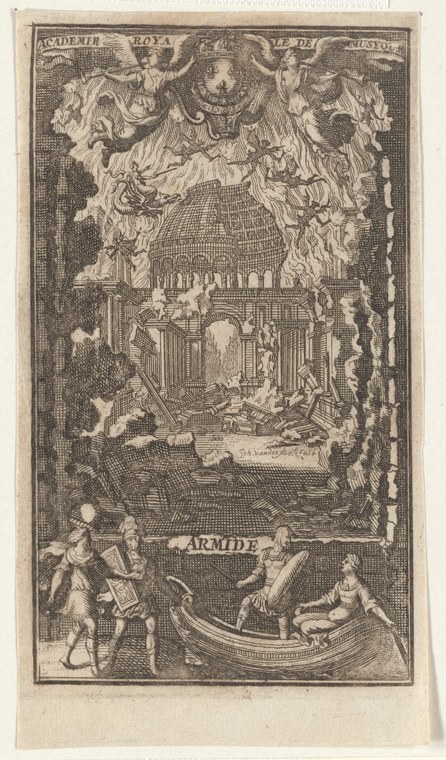
This is an engraved allegorical frontispiece depicting a theatrical scene framed by elaborate Baroque ornament. The composition is vertically organized with a celestial zone at the top inhabited by classical putti and allegorical figures amid swirling clouds, and a terrestrial zone below showing an architectural interior with colonnades. At ground level, elegantly dressed figures in 17th-century court costume occupy a palatial space. The entire scene is contained within a decorative architectural border with the title "ARMIDE" inscribed at the foot. The engraving style is dense with fine parallel hatching to create tonality and depth, typical of Northern European court art production.
The dancing
The figures in the lower zone stand in formal, frontal poses characteristic of court presentation rather than action. Several figures in the foreground wear draped robes and ornate dress; their stance is static and ceremonial, hands held at sides or gesturing minimally. There is no evidence of specific partnered dancing—no closed holds, no turning, no weight transfer through the feet. The arrangement is processional and heraldic rather than choreographic, suggesting tableau or court spectacle rather than social or theatrical dance.
The dance depicted
This engraving illustrates the subject matter of Armide, the sorceress from Torquato Tasso's *Jerusalem Delivered*—a subject that became a major vehicle for French baroque court ballet and opera throughout the 17th and 18th centuries. The work likely documents a court ballet or operatic performance rather than depicting a specific moment of dance. The static quality of the figures and the emphasis on allegorical ornament suggest this is a title page or commemorative print rather than a record of actual choreography. No specific dance form or technique is visible in the composition.
How it was made
This is an engraving, identified by the uniform parallel hatching and fine linear detail characteristic of burin work on copper plate. The technique allowed for precise articulation of costume detail and architectural perspective, and the small scale and high finish suggest this was made for circulation as a book illustration or broadsheet. Engraving was the dominant medium for documenting court spectacles and operatic productions in the 17th century, reaching educated audiences across Europe. The quality and complexity of the work indicates a professional printmaker of some standing, though the hand is not identified in the record.
About this work
This is an allegorical engraved frontispiece documenting or commemorating a court spectacle based on *Armide*, one of the most celebrated subjects in Baroque performing arts. The work sits at the intersection of theatrical production, courtly display, and allegorical print culture—it claims to represent a performance but operates as an emblem of artistic magnificence rather than a factual record. The title and subject matter are legible, but the original context (which court, what year, what performance) is lost; the work survives as an artifact of the international circulation of Baroque spectacle imagery.
How to look at it
Read this as an emblem rather than a documentary photograph: the artist has created a visual argument about what the performance *means* (hence the celestial apparatus) rather than capturing how the dancers actually moved. The architectural framing and processional arrangement of figures reflect the physical reality of court spectacles, which took place in palace galleries and halls with fixed perspective points. Notice how the allegorical ornament dominates the composition; this tells you that the intellectual and visual content of the work is its primary claim, not the specific choreography.
The period
Armide, drawn from Tasso's 16th-century epic poem, was first adapted for the court of Louis XIV in the 1670s and became a standard subject for French opera and court ballet throughout the late Baroque period. The allegorical enrichment of the image—celestial putti, architectural grandeur—reflects the aesthetic principles of the Ballet de Cour, where dance was presented as an emanation of divine order and courtly virtue. Engravings of this type served a diplomatic and cultural function, broadcasting the splendor and sophistication of the court to other European powers.
Where it lives
The work is held in the New York Public Library's collection of prints depicting dance, catalogued but undated and unattributed. It is one of a large body of European print documentation of court spectacle and operatic production from the 17th–18th centuries.
Dance in this work
Questions about this work
What is Armide?
Armide is a character from Torquato Tasso's 16th-century poem *Jerusalem Delivered*—a powerful sorceress who falls in love with a Crusader knight. The story became a favorite subject for French Baroque opera and court ballet, set to music by Lully, Desmarets, and others. The sorceress's magic, enchanted gardens, and ultimate defeat provided opportunities for spectacular staging and symbolic dancing.
Is this actually a dance scene?
Not in the modern sense: no specific choreography is shown, and the figures are static and presentational. The work is more accurately understood as a frontispiece or title page to a printed account or libretto of a court spectacle that included dance as one element. It documents the cultural event and its allegorical meaning rather than the actual movement of the dancers.
How were these engravings made and used?
Court spectacles and operas were commemorated through engraved prints that circulated as souvenirs, gifts, and records of royal magnificence. A printmaker would work from sketches or memory to create a compositionally unified image that captured the allegorical and visual essence of the performance. These prints reached educated audiences across Europe and served to enhance the international prestige of the sponsoring court.
More dance artwork





