49 works in this view — arrow keys or swipe to move between them.
Dance in Art
R. Gusman
Unknown artist
- Collection:
- Prints depicting dance
- Source:
- New York Public Library
- Rights:
- Public domain — free to use, share and adapt.
- Recorded as:
- Public Domain
Romantic-era lithographs of dancers are primary sources for understanding how nineteenth-century audiences saw and celebrated pointe work—a technique that had only recently become standard. The image documents the precise aesthetic values of the period: elongation, verticality, lightness, and a particular kind of feminine grace. For dance historians, such portraits are crucial evidence of how the body was trained, dressed, and presented at the moment when ballet was establishing itself as Europe's dominant theatrical dance form.
What you are looking at
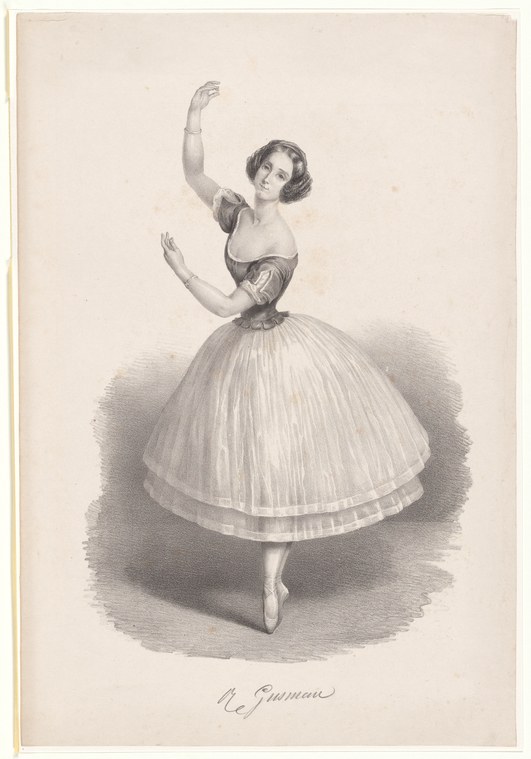
A single female dancer is shown in a moment of graceful elevation, captured in a three-quarter view against a plain background. She wears a romantic-era ball gown with a fitted bodice and voluminous skirt that extends to mid-calf, with a horizontal band of trim at the hem. Her dark hair is parted and drawn back. Her arms are raised in a soft, expressive frame—the lower arm extended forward and the upper arm opened to the side—and she stands on the point of one foot while the other leg extends behind her in a gentle penché or arabesque position. The pose suggests a moment of sustained balance mid-movement, the kind that would have been achievable only with considerable technical training. The image is rendered as a lithograph or engraving in fine pencil work, with subtle shading that models the figure against the pale background.
The dancing
The dancer stands alone, supported on the pointe of one foot with precise vertical alignment from hip through the supporting leg. Her non-supporting leg extends behind her in a gently curved line, barely parallel to the floor—a low arabesque rather than an extended penché. Her arms are arranged in an open, lyrical frame: one arm rises with the elbow softly bent, the other extends forward at approximately shoulder height. Her upper body is held upright with an elegant tilt that suggests lightness rather than strain. The overall posture conveys control and ease, the markers of a trained dancer working well within her technical range.
The dance depicted
This is almost certainly a work documenting romantic-era ballet (circa 1830–1850), the period when dancers first began regularly performing on the pointe of their feet and when the sylphid aesthetic—ethereal, weightless, otherworldly femininity—dominated European dance. The costume, the pointe work, the arm carriage, and the pose are all consistent with the vocabulary of Romantic ballet as danced in Paris and London. The inscription 'R. Gusman' at the base may refer to the dancer depicted, though this cannot be confirmed from the image alone. The arabesque, a signature position of classical ballet, appears here in its softer, more lyrical Romantic form.
How it was made
This work is a lithograph or possibly a finely detailed engraving, rendered in tones of gray and black on cream paper. The technique allows for the delicate modeling of fabric and flesh through parallel lines and subtle shading rather than bold outlines. The even, controlled tonality suggests lithography, a medium that dominated dance documentation in the 1830s–1840s and allowed prints to be reproduced and circulated relatively affordably. Such prints were common in Europe during the Romantic ballet era—they served as souvenirs of celebrated dancers and as widely distributed advertising for performances.
About this work
This is a formal portrait print of a dancer posed in a characteristic Romantic ballet attitude, almost certainly from the 1830s or 1840s. The work belongs to the well-established tradition of lithographic dancer portraiture that flourished in Europe during the height of the Romantic ballet era. It documents not just a performer but a specific technical vocabulary—pointe work, the arabesque, the open arm frame—that had become central to European concert dance by this period. The print's place in the 'Prints depicting dance' collection at the New York Public Library identifies it as part of the institutional archive of dance visual culture, one of thousands of such portraits that circulated among theatregoers and preserved the memory of celebrated performers.
How to look at it
Attend to the placement of the dancer's weight and the precise alignment of the supporting leg—this is not a static pose but a moment of sustained technical achievement. The artist has chosen to show the dancer at the apex of her rise, at the moment when she appears most weightless and controlled. Notice how the arms are arranged in an open frame rather than in the tighter positions of earlier court dance: this openness was central to the Romantic aesthetic. The slight forward tilt of the torso, the soft curvature of the extended leg, and the delicate rendering of the fabric all work together to create an impression of ethereal grace that was the dominant ideal of the period.
The artist
The artist is not recorded in the catalogue, but the inscription 'R. Gusman' likely refers to the dancer or possibly a studio that produced the print. Dance portraiture of this era was rarely signed by the printmaker; instead, the dancer's name typically appeared on the print. If 'Gusman' is the performer, no independent record of this dancer has been located. The style and technique are consistent with the commercial dance lithography industry that operated in Paris and London during the 1830s–1840s, when dozens of small publishers produced such prints for sale to the theatregoing public.
The period
This print dates to the height of the Romantic ballet era in Europe, roughly 1825–1850, when dancers like Marie Taglioni and Fanny Elssler achieved celebrity status and when pointe work evolved from a rare technical novelty into an expected accomplishment for any professional ballerina. The Romantic period coincided with the rise of lithography as a mass medium for portraiture and theatrical documentation. Dance prints of this era typically showed the dancer in a characteristic pose—often a moment of apparent weightlessness—that embodied the period's fascination with ethereal, almost supernatural femininity. The costume style, with its off-shoulder bodice and bell-shaped skirt, became iconic of the Romantic ballet silhouette.
Where it lives
The work is held in the New York Public Library's collection of prints depicting dance. No accession number, date, or other provenance information is recorded in the catalogue.
Dance in this work
Questions about this work
Is this dancer performing on pointe?
Yes. She stands on the point of one foot, a technique that was revolutionary when it first appeared in the 1820s and had become standard by the 1830s–1840s when this print was likely made. Pointe work defined the visual aesthetic of Romantic ballet.
Who was R. Gusman?
The inscription likely refers to the dancer depicted, but no independent record of this performer has been located. Dance prints of this era typically identified the dancer rather than the artist or printmaker. The figure may be a regional or touring performer whose fame did not extend beyond her own time.
Why does her skirt look different from modern ballet costumes?
This is the characteristic silhouette of Romantic-era ballet (circa 1830–1850): an off-shoulder bodice and a full, bell-shaped skirt that fell to mid-calf. The style was designed to emphasize the verticality and weightlessness of the dancer's body, particularly the raised position on pointe.
What dance is being depicted?
No specific choreography is identifiable from the image, but the vocabulary—the pointe work, the arabesque, the arm carriage—is that of Romantic ballet as performed in Paris, London, and other European capitals during the 1830s and 1840s.
More dance artwork





