49 works in this view — arrow keys or swipe to move between them.
Dance in Art
Middle Ages
Unknown artist
- Collection:
- Prints depicting dance
- Source:
- New York Public Library
- Rights:
- Public domain — free to use, share and adapt.
- Recorded as:
- Public Domain
This work documents how acrobatic and tumbling performance—distinct from ballroom or theatrical dance but equally demanding of the body—was valued and staged in court contexts. The image reveals the gendered division of labor in entertainment: female musical/directorial authority and male physical display. For historians of circus arts and acrobatics, the work provides evidence of the lineage of tumbling as an organized performance tradition predating modern circus.
What you are looking at
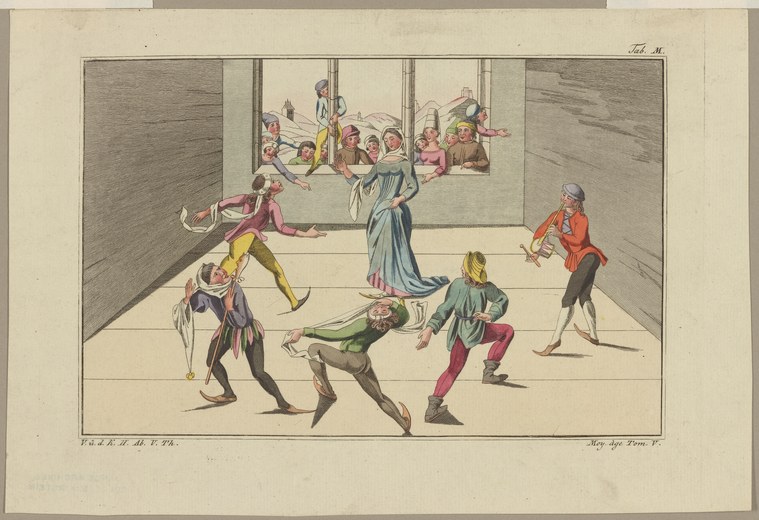
This colored engraving depicts a grand hall or ballroom scene from the medieval or Renaissance period, viewed in perspectival depth. A woman in a long blue-grey gown stands centrally, her arms raised to conduct or lead a group of figures suspended above her—a fantastical chorus of smaller dancers or acrobats hanging from or floating among architectural elements (columns and a ceiling structure rendered in brown wash). Below, on the floor of the hall, five male figures in tight-fitting doublets and hose in jewel tones—pink, yellow, green, and burgundy—perform athletic, tumbling movements. Their poses are highly acrobatic: one man arches backwards almost horizontally, another is mid-leap with legs splayed, a third crouches in a deep plié. The light is even and cool; the composition emphasizes the vertical stacking of the scene—ethereal suspended figures above, earthbound acrobats below, and the central female figure bridging both registers. The title 'Middle Ages' and the archaic costumes and spatial treatment suggest this is an allegorical or imaginative reconstruction of medieval entertainment.
The dancing
The five male performers on the ground display extreme flexibility and gymnastic strength. Their weight is not in a ballroom frame; instead, each body is captured mid-rotation, mid-arch, or mid-flight—one is nearly horizontal in a deep backbend, another shows explosive extension of the legs. Their clothing—tight hose and short doublets—exposes the full musculature and line of the legs and torso, essential for displaying the virtuosity of the movements. The central woman's raised arms and upright bearing suggest authority or musical direction rather than participation in the acrobatics. The suspended figures above appear to be in various poses of lightness and flight, adding a dreamlike quality. The arrangement is asymmetrical and spatially complex, suggesting multiple simultaneous actions rather than unified group choreography.
The dance depicted
This is not ballroom or social dance in any conventional sense. The image documents or imagines acrobatic performance and tumbling—a circus or court entertainment tradition that predates or runs parallel to formalized dance styles. The male performers are engaged in partner acrobatics, contortion, and tumbling, forms of physical display that appear in medieval courts and fairs. The woman's role as a central authority figure—possibly a musician, conductor, or patroness—is typical of court entertainment hierarchies. The title 'Middle Ages' and the style of dress suggest this is either a historical record of period performance practices or, more likely, a later (possibly 18th- or 19th-century) romantic or imaginative reconstruction of medieval spectacle. The extreme athleticism and the emphasis on flexibility places this squarely in acro-dance traditions, though the historical moment of actual performance remains unknown.
How it was made
This is a hand-colored engraving, identifiable by the fine parallel lines (hatching and cross-hatching) used to model form and create shadow, particularly visible in the architectural elements and the drapery. The brown and grey wash applied to the background architecture and the careful application of watercolor pigments to the figures suggest this was a plate-printed engraving that was subsequently colored by hand—a common practice for 16th- through 18th-century print distribution. The technique allows fine detail in the figures' musculature and costume and permits the artist to render spatial depth convincingly through perspective. Hand coloring indicates this was a more expensive, precious object than an uncolored print, suggesting it was made for a patron or collector with means. The engraving process itself would have allowed wide circulation and reproduction of the design.
About this work
This hand-colored engraving depicts an imagined scene of medieval court entertainment, centered on acrobatic and tumbling performance. A woman in formal dress directs or presides over five male acrobats who are captured mid-movement in extreme poses—backbends, leaps, and contortions—while suspended figures float above in an architectural fantasy space. The work appears to be a later historical reconstruction or allegorical fancy rather than a documentary record, given the unified composition and the romantic treatment of 'the Middle Ages' as a theme. It sits within a tradition of prints documenting and celebrating physical spectacle, acrobatic skill, and court entertainment as markers of cultural refinement and wonder.
How to look at it
Observe the artist's choice to capture each acrobat at the apex or extreme point of a movement rather than in transit—the backbend is almost geometric in its extremity, the leap is frozen with maximum extension. The perspective construction draws the eye upward from the grounded acrobats toward the ethereal suspended figures, creating a visual hierarchy that mirrors the theme: earthly, straining physical effort below; celestial, effortless grace above. The central woman's stillness and formal dress contrast sharply with the contorted, near-naked male bodies, a compositional strategy that emphasizes the spectacle of male virtuosity under female patronage.
The period
The engraving style, costume detail, and perspective technique suggest a creation date somewhere between the 16th and 18th centuries, most likely the 17th or 18th century—long after the 'Middle Ages' themselves. During this period, prints depicting historical, allegorical, or fantastical scenes were popular as educational and decorative objects. The romanticization of the medieval period as a site of spectacle, wonder, and courtly refinement was a common theme in Renaissance and Baroque art and literature. Acrobatic performance was a recognized and valued court entertainment throughout European history; prints depicting such acts celebrate both the physical skill of performers and the taste and patronage of the court that employed them.
Where it lives
The work is held in the New York Public Library's collection of prints depicting dance. It is catalogued with a title and era label but with minimal additional descriptive information, suggesting it may have been acquired as part of a larger collection or portfolio without full documentation of its original provenance or publication details.
Dance in this work
Questions about this work
Is this a real historical scene from the Middle Ages?
Almost certainly not. The engraving style, printing technique, and hand coloring suggest it was created in the 17th or 18th century—centuries after the medieval period. It is more likely an imaginative or allegorical reconstruction of what an artist or patron thought medieval court entertainment might have looked like, or a fanciful fantasy inspired by the period.
What kind of dance is this?
This is not social or ballroom dance. The performers are engaged in acrobatics, tumbling, and extreme physical feats—skills that were part of court entertainment traditions but distinct from choreographed dance styles. Modern terminology would classify this as acro-dance or circus arts.
Why is the woman in the center not dancing?
She appears to be a patron, conductor, or musician who directs or presides over the performance. This reflects actual court hierarchies in which noble or royal women often controlled or sponsored entertainment while male performers displayed skill and strength. Her formal dress and central position emphasize her authority.
How do we know this is an engraving?
The fine parallel lines (hatching) visible particularly in the background and drapery are the characteristic mark of engraving technique. The hand-coloring—watercolor pigments applied over the printed lines—is visible in the uneven application and the way colors sit on top of the line work rather than being integral to it.
More dance artwork





