49 works in this view — arrow keys or swipe to move between them.
Dance in Art
Circle dance
Unknown artist
- Collection:
- Prints depicting dance
- Source:
- New York Public Library
- Rights:
- Public domain — free to use, share and adapt.
- Recorded as:
- Public Domain
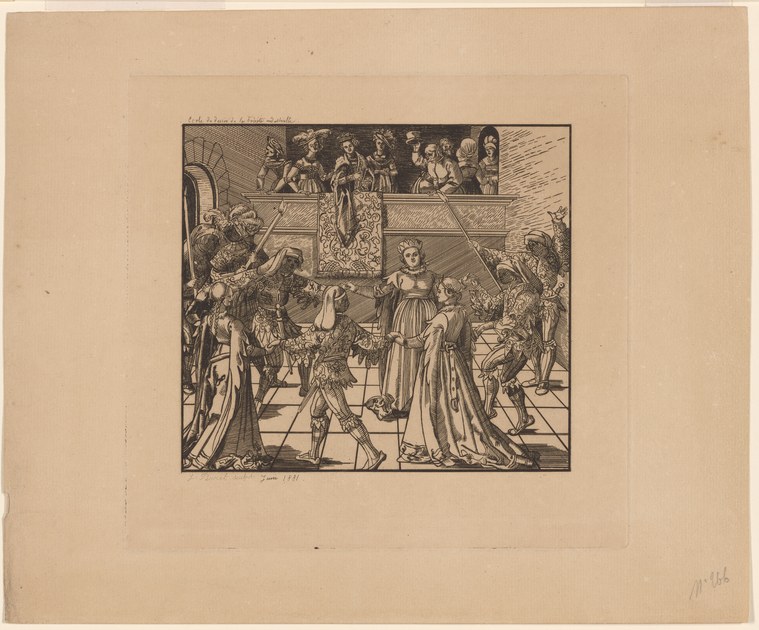
This work documents the form and social context of Renaissance court dance—a genre that structured European courtly life and influenced dance aesthetics for centuries. The engraving preserves how dance was understood and represented in print culture, showing that documentary interest focused on hierarchy, costume, and ritual rather than footwork or kinetic detail. For anyone studying the history of social dance or the cultural role of dance in early modern courts, this print is primary evidence of what was considered worth recording and how.
What you are looking at
This is a formal court dance or social gathering set in an interior hall with tiled flooring and architectural elements visible in the background. A central female figure in an elegant long gown stands amid a gathering of courtiers and nobles, some in rich cloaks and plumed headwear, others in formal dress. The composition suggests a structured social ritual rather than spontaneous movement: figures are arranged with deliberate spacing, some standing in conversation, others positioned as observers. The upper register of the composition shows additional figures in what appears to be a gallery or elevated viewing area, suggesting this is a formal occasion with an audience. The style, costume, and setting—the women's high waistlines, the men's elaborate doublets and cloaks, the architectural framing—all point to the Renaissance or early 16th century. The engraving technique captures fine detail in the fabrics and conveys social hierarchy through positioning and dress.
The dancing
The dancers and courtiers hold themselves upright and formal, with no visible embrace or close partnership hold. Gestures are restrained and courtly—hands and arms positioned to show rank and bearing rather than kinetic energy. The central woman appears poised for dance or ceremonial greeting, her body frontal and her gown configured to allow controlled movement. Several male figures maintain distance, suggesting the formal spacing characteristic of court dances of the period. The composition records a moment of stillness or preparation rather than active dance steps, which was typical of how printmakers of this era represented courtly dance—capturing the order and hierarchy rather than the movement itself.
The dance depicted
This appears to depict a Renaissance court dance or formal social gathering, most likely a branle, pavane, or similar processional court dance. The formal dress, the interior palace setting, the presence of nobility and court attendants, and the deliberate spacing and positioning all align with Renaissance court dances documented in period manuals. The title 'Circle dance' suggests a formation dance in which participants moved in lines or circles, which would be consistent with branle or similar social forms. The engraving does not freeze mid-step or show virtuosic footwork, but rather captures the social and hierarchical order within which the dance took place—a common approach to dance documentation in prints of this era, where spectacle and rank mattered as much as movement.
How it was made
This is an engraving or possibly a woodcut on paper, executed with fine lines to capture detail in costume and architectural setting. The technique allowed for the reproduction and circulation of court imagery, making it a documentary record accessible beyond the court itself. The precision of the medium—the careful cross-hatching for tone, the detail in embroidered fabrics and facial features—suggests this was made for an educated audience familiar with court culture. The formal, restrained composition is characteristic of Renaissance print-making, which typically prioritized legibility and social significance over dynamic or naturalistic depiction of movement.
About this work
This engraving documents a Renaissance court gathering organized around formal dance or ceremonial greeting. The work captures not the kinetic moment of dance but the social architecture within which dance occurred—the hierarchy of dress, the spacing of bodies, the presence of witnesses—suggesting that for this era and audience, the significance of court dance lay in its role in displaying and maintaining social order. The image preserves evidence of how Renaissance elites understood dance as ritual and spectacle rather than as pure movement.
For the dance historian, this print is valuable precisely because it does not attempt to capture individual steps or authentic movement. Instead, it records what Renaissance courtiers and their artists considered worth preserving: the formal arrangement, the quality of dress, the presence of authority, the frame of the occasion. It testifies to a moment when dance was inseparable from its social and architectural context.
How to look at it
Attend first to the dress and architectural setting, which establish this as a formal court occasion. Note the arrangement of figures—the way some are positioned as active participants while others stand as witnesses or interlocutors—which reveals the social logic of court dance as a hierarchical performance. The stillness of the composition itself is significant: the artist has chosen a moment of preparation or formal greeting rather than mid-movement, reflecting Renaissance print convention and suggesting that the form and social meaning of the dance mattered more to this audience than the footwork. The engraving technique allows you to see fine detail in fabrics and faces, but not the actual motion of the body.
The period
This engraving dates to the Renaissance era, when court dance was a central fixture of aristocratic life and a means of displaying social rank, wealth, and cultural refinement. Court dances of the 15th and 16th centuries—pavanes, branles, galliards, and almains—were documented in written manuals such as those by Thoinot Arbeau and Fabrizio Caroso, but visual records in prints are rarer. When printmakers depicted dance, they typically chose formal occasions and invested heavily in costume and setting, reflecting how court society valued dance as social theater rather than as a technical performance art. The development of engraving as a medium in the 15th and 16th centuries made it possible to circulate images of court life beyond the court itself, creating a wider audience for imagery of aristocratic ritual.
Where it lives
This work is held in the New York Public Library's collection of prints depicting dance, a collection that documents how dance has been represented across media and centuries. As a historical print in a research collection, it serves as primary visual evidence of Renaissance court culture.
Dance in this work
Questions about this work
Is this an actual depiction of a real dance, or an imaginary scene?
It is most likely a depiction of a real dance event or a typical court gathering, rendered according to Renaissance conventions for representing aristocratic life. The title 'Circle dance,' the formal dress, and the palace setting all point to a documented social practice. However, the artist was not attempting photographic accuracy; the image conveys the order and significance of the occasion rather than authentic movement or footwork.
What specific dance is this showing?
The engraving is titled 'Circle dance,' which suggests a formation dance such as a branle or pavane, both common in Renaissance courts. The dress and setting are consistent with these forms, but the print does not provide enough detail to identify the specific dance with certainty. The formal, procession-like arrangement and the central female figure are consistent with several court dances of the era.
Why don't the dancers look like they're actually moving?
Renaissance printmakers typically chose moments of stillness or formal arrangement rather than active movement, reflecting both technical limitations and cultural priorities. For court society, the significance of dance lay in its role as ritual and status display, not in the virtuosity of footwork. Prints documented the social structure and visual spectacle of the occasion rather than attempting to capture dynamic movement.
How do we know this is the Renaissance and not another period?
The women's dress (high waistline, full skirts, long sleeves), the men's clothing (doublets, cloaks, feathered headwear), the interior architecture, and the style of the engraving all point consistently to the 15th or 16th century. The date notation visible in the print may provide a more precise date, though the catalogue record does not specify one.
More dance artwork





