49 works in this view — arrow keys or swipe to move between them.
Dance in Art
Lady Henriette
Unknown artist
- Collection:
- Prints depicting dance
- Source:
- New York Public Library
- Rights:
- Public domain — free to use, share and adapt.
- Recorded as:
- Public Domain
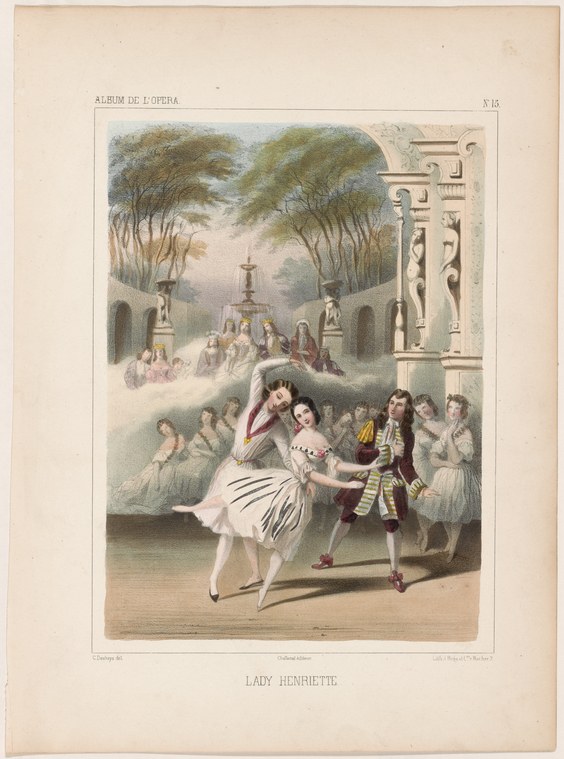
This print preserves both the visual and conceptual world of Romantic ballet—not only what the ballerina wore and how she was positioned, but the social ritual of the ballet performance and the conventions of male and female roles within it. For dancers and historians, it shows how the solo ballerina was framed as a singular object of aesthetic attention within a formally arranged society, a posture central to the Romantic ballet's ideology and its popularity.
What you are looking at
A Romantic-era ballet scene set in a formal garden or colonnade with classical architecture. A young female dancer in a pale tutu stands at center-right, balanced on one leg in an attitude or similar pose, her torso leaning gracefully backward. She is surrounded by formally dressed courtiers and musicians—men in military uniforms with decorative sashes and braid, women in ball gowns—who watch and gesture toward her with evident delight. The setting is architectural and sylvan: tall trees frame the scene, a classical fountain or monument rises in the background, and ornate pilasters define the space. The lighting is soft and diffuse, suggesting an evening garden party. The composition draws the eye to the solitary dancer as the focus of collective attention and admiration.
The dancing
The ballerina occupies the center of a circle of spectators who all orient toward her. Her supporting leg appears straight and turned out; her free leg is raised high and bent, with her torso arched backward in an elegant, elongated line. Her arms are positioned to frame this extension. The gentlemen surrounding her—some in officer's dress—lean in with gestures of appreciation; the ladies in their full skirts maintain a respectful distance. The ensemble creates the impression of a formal presentation or moment of theatrical display rather than social dancing.
The dance depicted
This depicts a scene from Romantic ballet, almost certainly a pas de deux or solo from a narrative ballet staged for an aristocratic or court audience. The solitary ballerina, the formal garden setting, the spectacle of a single dancer commanding attention, and the Romantic-era costume and physique all point to early-to-mid 19th-century ballet d'action. The moment captures the convention of the *divertissement*—a spectacular solo designed to showcase the ballerina's technique and beauty, set within a dramatic frame. The title *Lady Henriette* may refer to the character being danced or a real performer.
How it was made
This is a hand-colored engraving or lithograph, as evidenced by the fine linear detail, the use of aquatint or tinted wash for color, and the characteristic soft modeling of form. The technique allowed wide circulation as a print; such images were sold to audiences who had seen the ballet performed or who wished to own a record of a celebrated dancer or role. The hand-coloring was applied after printing, which explains the somewhat flat, decorative character of the color and the precision of the underlying line. This was a standard vehicle for dance publicity and artistic reproduction in the 19th century.
About this work
This is a Romantic ballet scene—a hand-colored engraving or lithograph depicting a celebrated ballerina performing a solo before an assembled court or society audience in a formal garden. The work sits squarely within the 19th-century tradition of dance prints: images made to commemorate performances, to preserve the memory of celebrated roles and dancers, and to be collected as fashionable art objects. The scene encapsulates the Romantic ballet's theatrical machinery—the isolation of the ballerina as the object of desire and wonder, the formal setting that frames her as both spectacle and narrative subject, and the emphasis on ethereal grace and technical mastery. As a record of how Romantic ballet was staged, circulated, and remembered, it is a primary historical document.
How to look at it
Notice the moment the artist chose: not a conventional closed-position dance, but a moment of display—a pose held for admiration rather than in motion. The ballerina's backward arch and elevated leg position would have been technically difficult and visually striking; the artist freezes this peak moment. Observe how the surrounding figures frame her: their gestures and orientation reinforce the convention that the ballerina is the sole object of attention, a convention fundamental to Romantic ballet. The soft, diffuse lighting and the dreamlike garden setting also reinforce the era's aesthetic—this is not a salon or a ballroom, but a fantasy space in which the ballerina appears almost supernatural.
The period
This work belongs to the Romantic ballet era, roughly 1830–1850, when the ballerina became the principal vehicle of narrative and spectacle. Ballets such as *La Sylphide* (1832) and *Giselle* (1841) established the convention of the supernatural or otherworldly female dancer, often observed by mortal male courtiers. The garden or court setting—rather than a ballroom—and the emphasis on the ballerina's isolated, weightless grace reflect the Romantic era's aesthetic of the ethereal and the unattainable. During this period, lithography and hand-colored engraving became the dominant means of circulating images of celebrated dancers and roles; theaters and publishers produced thousands of such prints for a bourgeois market eager to own mementos of performances.
Where it lives
The work is held in the New York Public Library's prints collection. It is catalogued as part of the library's extensive holdings of 19th-century dance prints, which document the visual culture of theater and performance during the Romantic era.
Dance in this work
Questions about this work
What is the title character, Lady Henriette?
The title likely refers either to a character in a ballet narrative or to a celebrated dancer who performed a celebrated role. Without additional documentation, we cannot definitively say which. The print may have been made to commemorate a specific performance or to preserve the memory of a famous interpretation of a role.
What dance is the ballerina performing?
The pose and setting do not correspond to any single named dance. Rather, this appears to be a solo or *pas seul* from a Romantic-era ballet d'action—the type of narrative ballet popular in the 1830s–1850s. The pose itself—an attitude or similar extension with the body arched backward—was a standard display moment designed to showcase the ballerina's technique.
Why are the men in uniform?
In Romantic ballet, aristocratic or noble male courtiers were routinely depicted in military dress or formal court costume, which underscored their social status and power. The contrast between the men's heavy, decorated uniforms and the ballerina's ethereal, nearly weightless tutu was visually and symbolically central to the era's gender ideology.
How do we know this is a Romantic ballet and not a court dance?
Several details point to theatrical ballet rather than social dancing: the asymmetrical pose (one leg raised and bent), the ballerina's apparent points (the pointe shoes used in ballet, though not entirely clear in the print), the theatrical setting designed as a backdrop rather than an actual ballroom, and the formal presentation of the solitary ballerina to an assembled and admiring audience. Court dances were reciprocal and involved couples or groups in formation.
More dance artwork





