49 works in this view — arrow keys or swipe to move between them.
Dance in Art
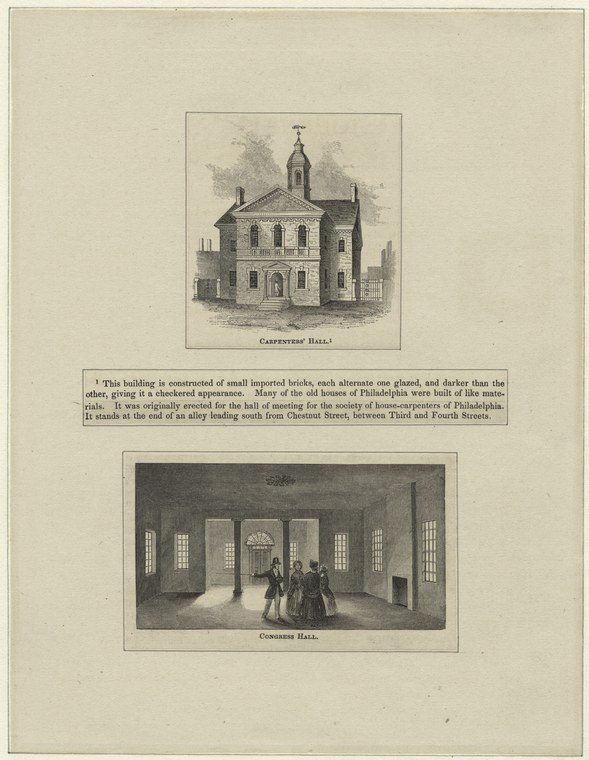
Carpenter's Hall ; Congress Hall.
Unknown artist
- Source:
- New York Public Library
- Rights:
- Public domain — free to use, share and adapt.
- Recorded as:
- public_domain
For dance historians, this engraving is valuable as visual evidence of the physical settings in which formal social dances and civic balls took place in early America. Understanding the proportions, lighting, and layout of these spaces informs our knowledge of how dances like minuets, country dances, and cotillions were performed in period venues.
What you are looking at
Two architectural interior views are presented in this engraving, stacked vertically. The top image shows Carpenters' Hall, a two-story brick building with alternating glazed and darker brick courses creating a checkered pattern. The structure features a central cupola with a cross, symmetrical windows, and a formal entrance. The lower image depicts Congress Hall's interior—a spacious rectangular room with high ceilings, large sash windows admitting bright light on both sides, and classical proportions. Three figures are visible in the Congress Hall interior, positioned in the middle distance, wearing period dress. The lighting in the interior view is naturalistic, showing the depth of the room through graduated shadow.
The dancing
The three figures in Congress Hall are shown in standing poses at what appears to be a formal distance from one another, occupying the center of the hall. They wear the dress of the late eighteenth or early nineteenth century. No dance movement or partnered hold is evident; the figures appear to be static or moving in everyday fashion, not in coordinated steps or embrace. Their positions and deportment suggest they are witnesses to or occupants of the space rather than dancers.
The dance depicted
No dance is depicted in this work. While the interior space of Congress Hall was indeed a venue for formal gatherings, balls, and social events in Philadelphia's early history, the figures shown here are not engaged in dance. They stand in everyday posture within an architectural setting. The image documents the built environment rather than any specific dance practice or occasion.
How it was made
This is an engraving, likely a wood or steel engraving based on the fine line work and tonal gradation visible in the architectural details and the interior shading. The technique allows precise rendering of architectural proportion and the play of light through windows. The work demonstrates the documentary precision typical of architectural engravings used in historical records and publications, allowing wide circulation through printing.
About this work
This is an architectural engraving showing two interior and exterior views of important early American civic buildings in Philadelphia—Carpenters' Hall and Congress Hall. The accompanying printed text notes that Carpenters' Hall was constructed of alternating glazed and darker brick and was originally built as a meeting hall for the Carpenters' Company. The image serves as a historical document of Philadelphia's built environment during the late eighteenth century, when these buildings hosted civic, political, and social functions. While such halls hosted balls and social dances, this particular image documents the architectural spaces themselves rather than any dance activity.
How to look at it
Examine the architectural details: the proportion of the hall, the placement and size of windows, and the ceiling height all conditioned how dancers moved through these spaces. The interior view of Congress Hall shows a room of considerable formality and generous dimensions—note the regular fenestration on both long sides, which would have provided consistent light for evening events and suggested the symmetrical, orderly movement appropriate to formal dances of the period. The small figures serve as a scale reference, showing how dancers would have occupied this formal interior.
The period
These Philadelphia buildings date to the late eighteenth century and represent the civic and associational architecture of the early American republic. Carpenters' Hall (completed 1770) was the meeting place of the Carpenters' Company and later served various civic functions. Congress Hall (1787–1789) was built to house the U.S. Congress during Philadelphia's years as the nation's capital (1790–1800). Both buildings hosted formal social events, balls, and gatherings where fashionable dances of the era—minuets, cotillions, and country dances—would have been performed. The engraving likely dates to the early nineteenth century, commemorating these significant structures for a historical audience.
Where it lives
The work is held in the New York Public Library collection. It appears in a historical documentation of Philadelphia's notable buildings, likely published in the early nineteenth century as part of a broader civic or architectural record.
Questions about this work
Did people dance in Congress Hall?
Yes. Congress Hall hosted official receptions, dinners, and social events during Philadelphia's tenure as the U.S. capital (1790–1800), and these included formal dances. However, this particular engraving shows the architectural space itself rather than a dance in progress.
What dances would have been performed in these spaces?
In this period, formal Philadelphia society would have performed minuets, cotillions, country dances, and quadrilles. These required considerable floor space and formal positioning, which the generous proportions of Congress Hall would have accommodated.
Why is an architectural engraving included in a dance collection?
Dance does not exist only in bodies—it exists in time, place, and material culture. Understanding the venues where dances took place, their dimensions, lighting, and acoustics, is essential to reconstructing how historical dances were actually performed.
More dance artwork