49 works in this view — arrow keys or swipe to move between them.
Dance in Art
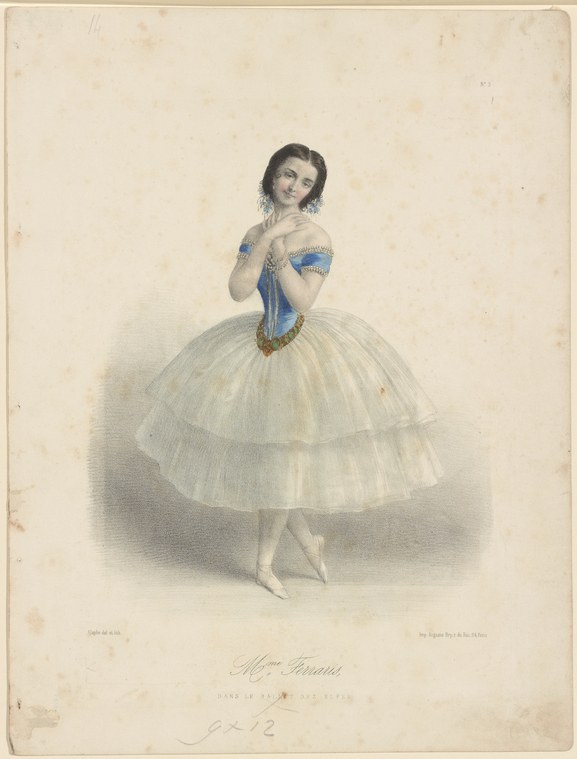
Mme. Ferraris, dans le ballet des Elfes
Unknown artist
- Collection:
- Prints depicting dance
- Source:
- New York Public Library
- Rights:
- Public domain — free to use, share and adapt.
- Recorded as:
- Public Domain
This image documents the visual culture and costume conventions of romantic ballet at its height in the mid-19th century, preserving the silhouette, bodice construction, and aesthetic ideal of the supernatural female dancer that defined the era. For historians of dance and costume, it provides material evidence of how the genre was visually constructed and promoted to audiences. For dancers, it offers a direct window into the formal, composed presentation of the performer as a cultural object—how the moving body was stilled and framed for public consumption.
What you are looking at
A young female dancer is posed in a standing position against a plain beige background, wearing a romantic ballet costume consisting of a blue satin bodice with bare shoulders and a voluminous white tulle skirt that extends to mid-calf. Her dark hair is styled close to the head. She stands in a graceful attitude, her left arm raised and bent, her right arm lowered, her weight appears to rest primarily on her right leg while the left is slightly extended. The figure is rendered in a soft, romanticist style typical of 19th-century theatrical portraiture, with subtle shading that creates volume in the skirt and delicate modeling of the face. The print shows signs of hand coloring, with the blue bodice distinctly tinted and the flesh tones warmly rendered.
The dancing
The dancer stands in a composed, frontal pose that suggests the formal presentation typical of mid-19th-century ballet promotion. Her arms are positioned in a soft, rounded frame—the raised left arm bent at the elbow with the hand near the shoulder, and the right arm slightly lower and forward. The pose is not actively dancing but rather a balletic "attitude" or repose: weight is held primarily on the supporting right leg while the left leg extends just slightly forward, suggesting the preparation for or the grace of a single position rather than the capture of dynamic movement. Her torso is upright and elongated.
The dance depicted
This is a theatrical ballet image from the romantic era, almost certainly depicting a scene from *Ballet des Elfes* (Ballet of the Elves), a mid-19th-century work. The costuming—bare-shouldered bodice, voluminous tulle skirt, delicate pointe work suggested by the positioning—is consistent with the sylphide-inspired aesthetic that dominated European ballet in the 1830s–1850s. The white tulle skirt and ethereal presentation mark this as a representation of a supernatural or sylph-like character typical of romantic ballet, in which female dancers portrayed weightless, otherworldly beings. Mme. Ferraris was a known dancer of the romantic period, and this print served as a promotional image circulating the dancer's participation in this specific production.
How it was made
This is a hand-colored lithographic print, a technology that allowed rapid reproduction and wide distribution of theatrical imagery in the 19th century. The delicate coloring of the blue bodice and the subtle gradations in the white skirt suggest careful hand application by a skilled colorist. Lithography permitted both the fine detail in the facial features and the soft atmospheric background, making it an ideal medium for distributing images of celebrated dancers to theaters, studios, and collectors across Europe. The technique and presentation indicate this was a commercial theatrical print, likely sold in folios or as individual sheets to promote the production and the performer.
About this work
This hand-colored lithograph is a theatrical portrait of Mme. Ferraris as a character dancer in *Ballet des Elfes*, a mid-19th-century romantic ballet. It exemplifies the visual culture of mid-19th-century European theatre, where celebrated dancers were promoted through widely distributed prints that captured both their costume and their performance aesthetic. The image belongs to a significant tradition of dance portraiture that served as both documentation of specific performances and advertisement of particular performers and their roles.
As a record of romantic ballet practice, the work is valuable for what it shows about costume, bodily idealization, and the visual presentation of the sylphide aesthetic that dominated ballet during this era. The print's survival and circulation—it has entered a major institutional collection—testifies to the cultural importance of both the performance tradition and the commercial machinery that celebrated it.
How to look at it
Attend to the construction of the costume—particularly the bare shoulder, the fitted bodice, and the architectural engineering of the skirt, which was achieved through layered tulle and internal structures that no longer survive. Notice the pose: it is not a moment of rapid movement but rather a composed presentation, typical of romantic ballet imagery, in which the dancer is shown as an idealized figure rather than captured mid-action. The soft, almost ethereal quality of the rendering, particularly in the tulle skirt where the lithographic crayon creates feathery gradations, reflects the printmaker's effort to convey the otherworldly, weightless quality that romantic ballet audiences expected to see. The frontality and the gentle, almost passive expression are deliberate choices that position the dancer as an object of aesthetic contemplation rather than as an agent of kinetic force.
The artist
The print is unattributed in the catalogue record. However, the production credit visible at the bottom of the print indicates it was lithographed and hand-colored by commercial theatrical print publishers working in mid-19th-century Europe, likely Paris or London, the primary centers of ballet culture and theatrical merchandise production at the time. The style and technique are consistent with the practice of major theatrical print firms that specialized in images of celebrated performers.
The period
This print was produced during the height of romantic ballet in Europe, roughly 1830–1860, when ballet was dominated by representations of sylphs, spirits, and supernatural female figures. The aesthetic emphasized weightlessness, ethereality, and the idealized female form en pointe. During this period, theatrical portraiture became a central medium of celebrity culture; prints of famous dancers were collected, displayed in homes and studios, and traded among enthusiasts much as photographs would be in later decades. The *Ballet des Elfes* was one of several works in the romantic repertoire that explored supernatural themes; similar works included *La Sylphide*, *Giselle*, and *Les Sylphides*. Ferraris's career placed her among the celebrated international ballerinas of the era, and her image would have circulated widely among ballet-going publics.
Where it lives
This print belongs to the New York Public Library's collection of prints depicting dance, a repository assembled to document the visual history of performance. It represents the class of theatrical merchandise—widely produced, commercially distributed, and originally ephemeral—that has survived in institutional collections precisely because libraries recognized their historical value as records of performance culture.
Dance in this work
Questions about this work
What is the 'Ballet des Elfes' and was it a famous work?
The *Ballet des Elfes* (Ballet of the Elves) was a mid-19th-century theatrical work that participated in the broader romantic ballet preoccupation with supernatural, otherworldly characters. While not as widely documented as *La Sylphide* or *Giselle*, it represents the kinds of spectacles that European theaters regularly commissioned and produced during the romantic era. Such works typically featured corps de ballet in matching costumes representing ethereal beings—elves, sylphs, spirits—and were vehicles for celebrated solo dancers like Ferraris.
Who was Mme. Ferraris?
Mme. Ferraris was a celebrated mid-19th-century dancer known for performances in romantic ballet roles across European stages. Beyond the specific works in which she appeared, little detail survives in the historical record; her fame was documented primarily through theatrical prints like this one and through playbills and dance histories. She represents the class of international performing artists who achieved celebrity in the mid-19th century through touring and performance rather than through publication or documentation that would ensure lasting biographical memory.
How were dancers promoted before photography and film?
Theatrical prints like this one were the primary medium for promoting dancers and circulating their image among audiences and theater-goers. These hand-colored lithographs could be produced in quantity and sold as individual sheets, collected in theatrical albums, or displayed in theater lobbies and studios. They were the equivalent of modern theatrical photographs and posters, serving both to advertise specific performers and productions and to create lasting records of celebrated roles and performers.
What do the bodice and skirt tell us about romantic ballet technique?
The bare-shouldered bodice and voluminous tulle skirt were costume conventions of romantic ballet designed to emphasize the idealized, ethereal female figure. The skirt was constructed with internal hoops and layers to maintain its bell shape and allow rapid movement while creating the illusion of weightlessness. The costume's design facilitated pointe work and the sustained lines that romantic choreography demanded, while its construction—the fitted bodice and sculptural skirt—created a visual frame that emphasized the dancer's verticality and balletic extension.
More dance artwork





