49 works in this view — arrow keys or swipe to move between them.
Dance in Art
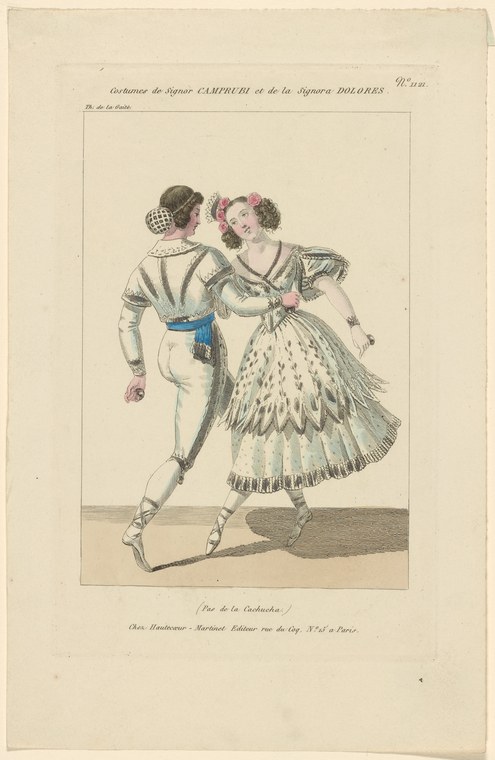
Costumes de Signor Camprubi et de la Signora Dolores, pas de la Cachucha, Th. de la Gaité
Unknown artist
- Collection:
- Prints depicting dance
- Source:
- New York Public Library
- Rights:
- Public domain — free to use, share and adapt.
- Recorded as:
- Public Domain
The Cachucha was one of the most celebrated dances of the Romantic ballet period, and this print documents how it was performed and marketed to audiences. For historians of dance, the image provides concrete evidence of costume, body position, partnering style, and the scale of interaction between dancers in a canonical duet of the 1830s–40s.
What you are looking at
Two dancers perform a theatrical duet in a stage space. On the left, a male dancer in tight breeches, short jacket with ornate trim, and a blue waist sash strikes an energetic pose with one leg extended and raised, his body twisted toward his partner. On the right, a female dancer wears a romantic-era costume: a white bodice with short puffed sleeves and a voluminous skirt decorated with a scalloped or feathered hem pattern. She leans into her partner with an intimate, flirtatious gesture, her head tilted toward his, her arms relaxed. Both wear their hair styled in the fashion of the 1830s–1840s. The stage floor is visible beneath them, rendered in neutral gray-brown wash. The composition captures a moment of intense partnered interaction—part courtship display, part virtuosic movement.
The dancing
The dancers are in close proximity but not in a formal closed ballroom hold. The male dancer's weight is centered and active, with one leg lifted in an extended arabesque or attitude position, demonstrating elevation and control. The female dancer's posture is softer and more yielding, her torso folded slightly forward toward her partner in a gesture of flirtation or response. Her weight appears grounded. The spacing and attitude between them suggests a moment of theatrical dialogue rather than synchronized unison movement. Both figures are drawn with anatomical attention to the professional dancer's frame.
The dance depicted
The title identifies this as a *pas de la Cachucha*, a theatrical duet that became one of the signature pieces of Romantic-era ballet in the 1830s. The Cachucha originated as a Spanish folk dance but was transformed into a virtuosic solo and duet vehicle for the stage, most famously danced by Fanny Elssler. The costume and pose of the female dancer—the white muslin skirt, the intimate scale, the flirtation—align with Romantic ballet convention. The male dancer's energetic lifted position and the overall theatrical presentation indicate this is a stage version rather than a folk performance. The work depicts professional dancers executing a celebrated duet of the 1830s–40s theatrical repertory.
How it was made
This is a hand-colored engraving or aquatint, recognizable from the fine linear work defining the figures' outlines and the selective hand-coloring in watercolor or gouache applied after printing. The technique is typical of theatrical print production in the 1830s–40s, when such images were distributed widely as souvenirs of famous performances and dancers. The medium allowed rapid reproduction and circulation to a middle-class audience interested in following stage fashions and celebrity performers. The delicate line work and controlled shading demonstrate the skill of a professional theatrical engraver rather than a casual illustrator.
About this work
This engraving documents a performance of the *pas de la Cachucha* by the dancers Signor Camprubi and Signora Dolores at the Théâtre de la Gaité in Paris. It belongs to a rich tradition of theatrical prints that captured the movements, costumes, and partnerships central to Romantic ballet in the 1830s. The work serves as both a record of a specific historical performance and an artifact of how theatrical dance was circulated, celebrated, and consumed by audiences of the era. Such prints were essential marketing tools for dancers and theaters, and they offer modern viewers a window into the physical practices and aesthetic values of Romantic-stage dance.
The image is valuable precisely because it freezes a moment of narrative and partnered play—the intimate exchange between two dancers—rather than a formal pose. It shows how the Cachucha was performed as a duet on the professional stage: with asymmetry, flirtation, and a balance between male virtuosity and female responsiveness that defined the Romantic aesthetic.
How to look at it
Observe the contrast between the two dancers' body attitudes: the male dancer is lifted, rotated, and energetically extended, while the female dancer is grounded, open, and responsive. This asymmetry is not accidental but fundamental to how Romantic-era duets worked—male dancers performed technical virtuosity while female dancers performed expressiveness and availability. Notice the precision of the arm positions and the control implied by the raised leg on the male dancer; the engraver has taken care to show the musculature and extension. The female dancer's costume—the white muslin, the feathered skirt hem—marks her as the central theatrical object, even as the male dancer commands the more athletic pose. The intimate proximity and the directions of their gazes and heads tell the story of the duet as one of courtship and mutual flirtation.
The period
This engraving was produced during the height of the Romantic ballet era in France, a period when Spanish and Italian dance forms were being adopted and theatricalized by the European stage. The 1830s–40s saw the rise of celebrity dancers—especially female dancers like Fanny Elssler and Marie Taglioni—whose performances were documented in prints and lithographs distributed to eager audiences. The Cachucha in particular became a star vehicle, performed in multiple European cities and subject to many interpretations. Theatrical prints of this type were essential to the machinery of dance celebrity; they advertised performances, immortalized celebrated dancers, and allowed audiences to study movement and costume in portable form. The hand-colored engraving was the dominant technology for this purpose before photography.
Where it lives
This print is held in the New York Public Library's collection of prints depicting dance. It was originally created as a souvenir and advertisement for a specific performance or run of performances at the Théâtre de la Gaité in Paris, as indicated by the printed text. Such prints were sold to audiences and theater-goers and circulated among dance enthusiasts.
Dance in this work
Questions about this work
What is the Cachucha?
The Cachucha began as a Spanish folk dance but was adopted and transformed into a virtuosic theatrical solo and duet in the 1830s–40s. It became one of the signature pieces of Romantic ballet, celebrated for its blend of technical brilliance and theatrical charm. Fanny Elssler's performance of the Cachucha was so famous that it became her signature role.
Who were Camprubi and Dolores?
The caption identifies them as the dancers who performed this duet at the Théâtre de la Gaité in Paris. Beyond that, the record does not specify their biographical details or the date of the performance. They were professional ballet dancers working in the Paris theater system, likely in the 1830s–40s based on the costume and style.
Why is this an engraving rather than a photograph?
This print predates the widespread use of photography in theatrical documentation. Engraving and hand-coloring allowed artists to capture movement, costume detail, and theatrical atmosphere in ways that early photography could not. The technique also allowed prints to be produced and distributed quickly and affordably.
What do the dancers' clothes tell us?
The female dancer's white muslin skirt and short puffed sleeves are hallmarks of Romantic ballet costume—ethereal, lightweight, and designed to emphasize the body's line and movement. The male dancer's tight breeches and fitted jacket with ornate trim show the Spanish influence on the choreography while maintaining the formal lines required for male ballet dancers of the era.
More dance artwork





