49 works in this view — arrow keys or swipe to move between them.
Dance in Art
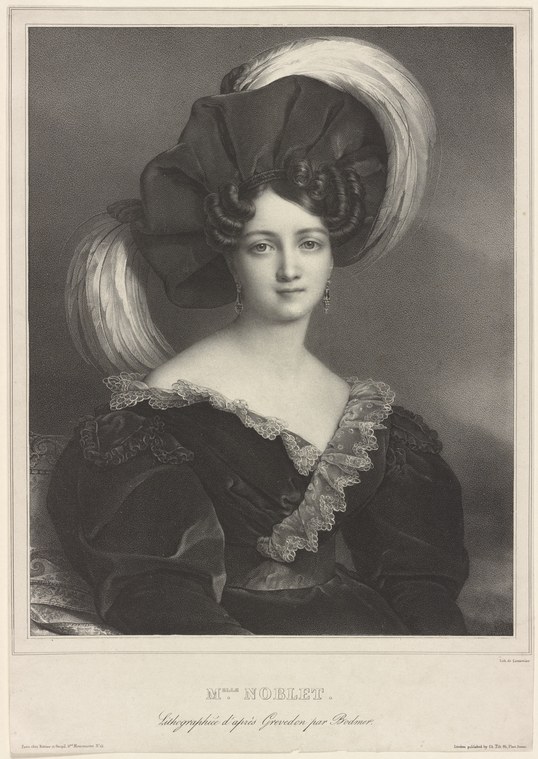
Melle. Noblet
Unknown artist
- Collection:
- Prints depicting dance
- Source:
- New York Public Library
- Rights:
- Public domain — free to use, share and adapt.
- Recorded as:
- Public Domain
Mlle. Noblet was a significant Romantic-era performer whose career spanned the most innovative period in ballet history. This engraving is primary material for understanding the relationship between theatrical costume, celebrity portraiture, and the print trade that made international ballet stars recognizable across Europe.
What you are looking at
A three-quarter-length portrait of a woman identified as Mlle. Noblet, posed in elegant profile-frontal stance against a neutral background. She wears a high-waisted dark velvet dress with voluminous short sleeves finished in white lace ruffles, the neckline cut low and edged in delicate lace. Her most striking feature is an elaborate headdress: a towering white feathered or plumed creation that rises dramatically above her dark, centrally-parted hair, which is dressed in long ringlets. The feathered arrangement sweeps backward and to the side, creating an asymmetrical silhouette. She gazes directly outward with a composed expression. The execution is a steel engraving or similar intaglio print, rendered in precise grayscale tones that model the soft fabrics and create luminous highlights on the plumage and pale lace.
The dancing
The subject is a single standing figure, poised in a relaxed but formal contrapposto stance. Her weight appears evenly distributed, her posture upright and dignified rather than in any active movement. The arm nearest the viewer hangs at her side; no arms are raised or extended. The overall bearing is static and presentational—this is a portrait of a performer, not a depiction of her dancing. The figure's proportions and the artist's rendering suggest trained posture and poise.
The dance depicted
Mlle. Noblet was a celebrated Romantic-era ballet dancer, likely from the 1830s–1840s. This is a portrait rather than a scene of dance, and it tells us about theatrical presentation and costume rather than choreography or technique. The dress—high-waisted, short-sleeved, with layered skirts suggested beneath—and the elaborate headdress are consistent with early Romantic ballet costuming. The image documents how a principal ballerina of the period was dressed and presented to the public in print form.
How it was made
This is a steel engraving, a precision intaglio technique that produced sharp lines and fine tonal gradations ideal for reproducing portraiture and theatrical imagery. Steel engraving replaced copper in the early 19th century because it allowed far longer print runs and finer detail. The technique's sophistication and the work's formal presentation indicate it was created for a paying audience—likely sold as a separate theatrical print or as part of a series documenting famous performers. The printed inscription at base confirms this was a commercial portrait, probably issued by a Paris or London publisher.
About this work
This is a portrait engraving of Mlle. Noblet, a star of the European Romantic ballet stage. The work documents both her celebrity status and the visual conventions of Romantic-era ballerina costume and presentation. The elaborate feathered headdress, the cut and drape of her dress, and the formal three-quarter pose are all markers of how premier dancers were marketed to the public in the 1830s–1840s. It belongs in a dance history collection not as documentation of choreography or technique, but as evidence of how dancers were commodified, dressed, and circulated as cultural icons.
How to look at it
Note the extreme sophistication of the headdress: it is not a bonnet or decorative cap but an architectural construction of feathers and (likely) wire, designed to be worn during vigorous movement. Observe the tiny scale of her feet and the high arch they suggest—this was a marker of trained, elite ballet technique. The formality of her dress contrasts with the theatrical exaggeration of the headdress: she is simultaneously a society portrait subject and a fantastical creature. The lace at her neck and sleeves signals both gentility and the performer's need for an illusion of refinement and otherworldliness.
The artist
The artist is not recorded in the catalogue, but the engraver's signature or initials may appear on the print itself (not clearly legible in this reproduction). Steel engravings of theatrical subjects in this period were typically executed by specialist reproductive engravers working from drawings or paintings by portraitists. The quality and scale suggest a significant print shop, possibly in Paris, where the Romantic ballet market was most robust.
The period
The 1830s–1840s saw the establishment of ballet as Europe's dominant theatrical dance form, with Romantic ideology reshaping both choreography and costume. The exotic, ethereal aesthetic demanded by Romantic themes found expression in costume design: the elevated waistline (echoing neoclassical conventions but now applied to dance), the shortened skirt (to display footwork), and the fantastical headdress (often suggesting nationality, otherness, or fantasy). At the same time, the commercial print trade—fed by new technologies like steel engraving—made theatrical stars into portable images, circulated as separate prints, in annuals, and as souvenirs. Mlle. Noblet's image belongs to this economy of celebrity.
Where it lives
This work is held in the Prints depicting dance collection at the New York Public Library, indicating it was acquired as documentary material on dance history rather than as a fine art object. The inscribed title and publication information suggest it is a commercially issued theatrical print of the sort that would have been sold separately or as part of performance programs and theatrical annuals.
Dance in this work
Questions about this work
Who was Mlle. Noblet?
Mlle. Noblet (first name often recorded as Clara or Lise) was a prominent Paris Opéra ballerina of the 1830s–1840s, performing during the height of the Romantic ballet movement. She danced in major productions and was famous enough to be immortalized in prints like this one. Biographical details remain sparse, as was typical for dancers of the era in published records.
Why is the headdress so elaborate?
Romantic-era ballet used fantastical and exotic costuming to create illusion and otherworldliness. Elaborate headdresses were part of this aesthetic—they signaled that the dancer represented a supernatural being, a foreign land, or a creature beyond ordinary life. The height and drama of the feathered construction would have been visible from the back rows of a theater and would have moved and caught light during performance.
Is this engraving a faithful record of what she actually wore?
It is likely a stylized and idealized version. Theatrical prints of the period often softened and perfected the dancer's appearance and sometimes exaggerated costume details for visual impact. However, the basic components—the high waist, short sleeves, lace trim, and feathered headdress—are consistent with documented Romantic ballet costumes and suggest the engraver worked from reliable source material.
Why was this image printed and sold?
Theatrical prints were a major entertainment commodity in the 19th century. Fans purchased portraits of favorite performers as souvenirs, much as modern audiences buy celebrity photographs. These prints were often sold at the theater, by print shops, or included in theatrical annuals and journals. They served the dual purpose of promoting the performer and generating revenue.
More dance artwork





