49 works in this view — arrow keys or swipe to move between them.
Dance in Art
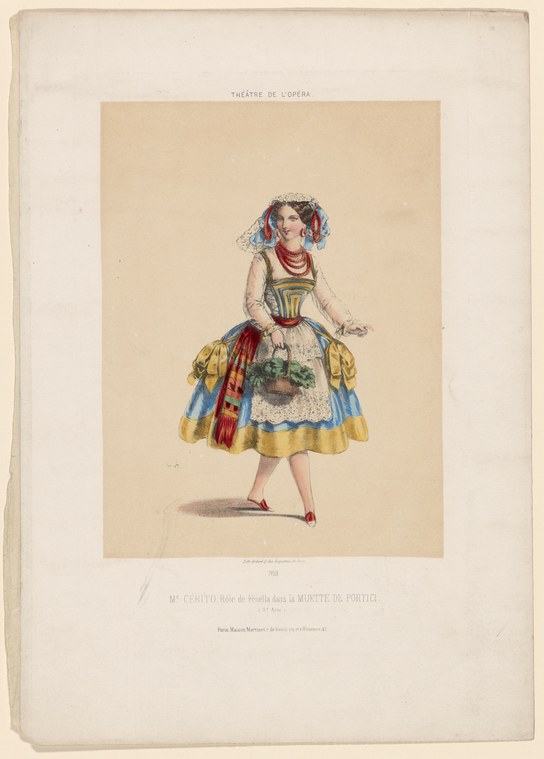
Me. Cérito, rôle de Fénella dans La muette de Portici (3e. acte)
Unknown artist
- Collection:
- Prints depicting dance
- Source:
- New York Public Library
- Rights:
- Public domain — free to use, share and adapt.
- Recorded as:
- Public Domain
Cérito was one of the most technically accomplished female dancers of the Romantic era and a pioneering figure in establishing the Italian school of ballet. This image preserves not only her likeness but the specific costume and character she made famous, offering insight into how Romantic ballet characters were visualized and marketed to audiences. The print itself exemplifies how lithography democratized access to theatrical imagery in the 19th century, allowing fans far from the opera house to own a souvenir of the performance.
What you are looking at
A young woman in theatrical costume stands alone against a pale background, posed as if mid-performance. She wears a fitted corseted bodice with horizontal striping in earth tones, over a voluminous skirt of brilliant yellow silk gathered at the waist and falling to mid-calf. The skirt is lined with deep blue and trimmed with red ribbon at the hem. She has dark curled hair adorned with flowers and ribbons, and wears a red coral necklace. A white apron with a decorative landscape vignette is tied at her waist. Her pose is upright and graceful, with weight on one leg, one arm extended gently, the other at her side. The figure is rendered in hand-colored lithograph or engraving with fine detail in the fabrics and delicate shading on the face.
The dancing
The dancer stands in a single, composed pose rather than mid-leap or mid-turn. Her frame is upright, shoulders relaxed, with a gentle S-curve to the torso. One leg bears weight while the other is lightly positioned, suggesting readiness for movement rather than active dancing. The arm positions are modest and natural—not the high extensions or dramatic gestures of later Romantic ballet. Her body displays the refined carriage and stillness valued in early 19th-century theatrical dance, with emphasis on poise and elegant line rather than dynamic action.
The dance depicted
This is a portrait of Mademoiselle Cérito in the role of Fénella from Act III of *La muette de Portici* (The Dumb Girl of Portici), Auber's 1828 opéra comique. Cérito (1817–1909) was one of the most celebrated Italian ballet dancers of the Romantic era, known for her technical brilliance and dramatic presence. The costume shown—the embroidered bodice, full peasant skirt, folk-style necklace, and apron—represents Fénella as a Neapolitan street dancer and pantomime heroine rather than a classical ballet character. The image documents not the dance itself but the role, showing the character as an audience would recognize her on stage.
How it was made
This is a hand-colored lithographic print, a process that allowed for rapid reproduction and wide circulation of theatrical portraits. The costume details are rendered with considerable finesse—the striping and texture of the bodice, the billowing silk of the skirt, the jewelry and flowers—suggesting the print was created as a souvenir for audiences or a record for theatrical archives. The technique was ideal for capturing the bright colors and specificity of stage costume, making this both a performance document and a fashion image. The heading 'THÉÂTRE DE L'OPÉRA' at the top confirms this as an official or semi-official theatrical portrait.
About this work
This is a theatrical portrait print of Mademoiselle Cérito, one of the 19th century's most accomplished ballet dancers, in her celebrated role as Fénella in Auber's *La muette de Portici*. The image captures the character as the Neapolitan heroine would have appeared to audiences—costumed in peasant dress that bridges folk tradition and theatrical artifice. It belongs in a gallery of dance art both as a record of how a major dancer embodied a major role and as evidence of how the ballet world circulated images of its stars. The portrait shows not choreography or technique in action, but rather the dramatic identity and visual presence the dancer brought to the stage.
How to look at it
Look at the costume as the primary content: every element—the embroidered bodice, the striped apron, the voluminous skirt, the flowers in the hair, the coral necklace—identifies this as a character role rather than a classical ballet part. The pose is one of stillness and presentation rather than motion, which is typical of theatrical portrait prints; the artist's task was to show the character as an audience member would recognize her, not to suggest the choreography. Notice how the skirt is arranged to display its color and volume without suggesting movement; this is a fashion plate as much as a dance image. The upright, composed posture and modest arm positions would have read to contemporary viewers as elegant and refined, the hallmark of the accomplished theatrical dancer.
The artist
The artist is not recorded in the catalogue. The style and production quality suggest this was created by a professional theatrical portrait lithographer working in Paris in the 1830s–1840s, when *La muette de Portici* was in active repertory and Cérito was at the height of her fame. Many such prints were issued anonymously or under a publisher's name rather than the artist's, making attribution difficult without archival research.
The period
This print dates to the height of the Romantic ballet era, when dancers like Cérito, Taglioni, and Essler captivated European audiences and became celebrities whose images were mass-produced and collected. *La muette de Portici*, which premiered in 1828, was one of the major works of the period—an opéra comique with substantial dance content that blended pantomime, character dancing, and classical ballet technique. Lithography, perfected and commercialized in the early 19th century, was the primary medium for circulating these images; they were sold in print shops, collected in albums, and displayed at home. The fashion for theatrical costume prints was at its peak during the 1830s–1840s, reflecting both genuine theatrical enthusiasm and the emergence of celebrity culture.
Where it lives
The New York Public Library holds this print as part of its Dance collection. It is catalogued as a theatrical portrait from the Prints depicting dance series, without recorded artist, date of creation, or publication information beyond the French title and role attribution. The print's format and inscription suggest it was created as a commercial souvenir or archival record during *La muette de Portici*'s active years in the Paris Opéra repertory.
Dance in this work
Questions about this work
Who was Mademoiselle Cérito?
Fanny Cerrito (1817–1909) was an Italian ballet dancer and choreographer who became one of the most celebrated dancers of the Romantic era. She was known for her technical virtuosity, dramatic presence, and distinctive Italian style. She danced across Europe and the Americas, created her own choreography, and was a major star of the 1830s and 1840s.
What is La muette de Portici?
*La muette de Portici* (The Dumb Girl of Portici) is an opéra comique by Daniel Auber, which premiered in 1828. It tells the story of Fénella, a deaf-mute girl caught in the tumult of the 1647 Neapolitan uprising. The role was famous for its pantomime and dancing, and became a major vehicle for Romantic-era dancers including Cérito.
What does the costume tell us about the dance?
The peasant costume—the embroidered bodice, full skirt, apron, and folk jewelry—indicates that Fénella was a character role requiring dramatic presence and pantomime skill rather than pure classical technique. The style of costume reflects early 19th-century theatrical conventions: exaggerated and romanticized interpretations of folk dress that blended authenticity with theatrical fantasy.
Why does this print matter to dance history?
This image documents both a major role in a canonical work and the way theatrical dance was circulated and consumed in the 19th century. It shows us what a celebrated dancer looked like in a famous role, how the character was costumed, and preserves a moment in the history of dance celebrity and theatrical culture.
More dance artwork





