49 works in this view — arrow keys or swipe to move between them.
Dance in Art
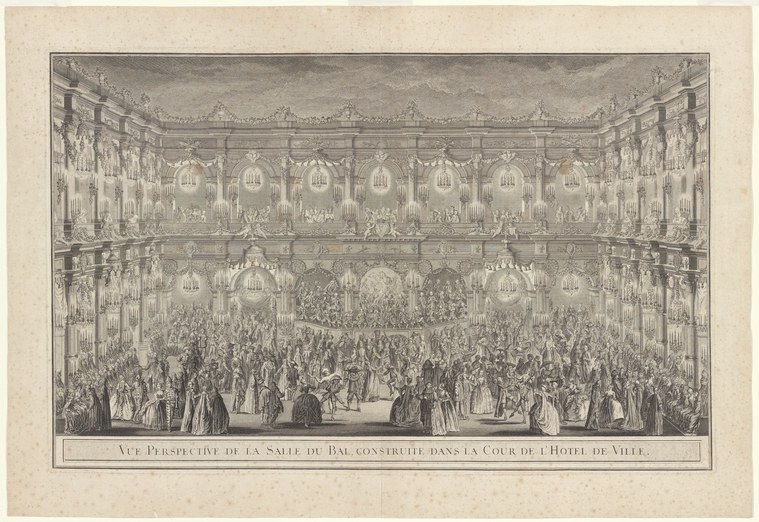
Vue perspective de la salle du bal, construite dans la cour de l'Hotel de Ville
Unknown artist
- Collection:
- Prints depicting dance
- Source:
- New York Public Library
- Rights:
- Public domain — free to use, share and adapt.
- Recorded as:
- Public Domain
This image is invaluable for understanding the scale, setting, and collective nature of 18th-century court dance. Unlike paintings or descriptions, the engraving shows us how geometric dance formations actually filled architectural space and how dancing was embedded in a rigid hierarchy of spectators and participants. It demonstrates that 'dance' in this context was inseparable from ceremony, display, and the performance of state power.
What you are looking at
A grand ballroom in the Hôtel de Ville during the ancien régime, depicted in a bird's-eye perspective that reveals the full magnificence of the space. Two tiers of arcaded galleries ring the rectangular hall, each archway framing seated spectators. The walls are articulated with engaged columns and decorated panels; the ceiling shows elaborate coffering and ornamental detail. The floor of the main hall is crowded with dancers and musicians in formal dress—men in coats and breeches, women in wide skirts—arranged in the geometric formations characteristic of ceremonial court dancing. Hundreds of standing guests line the perimeter and fill the galleries, all turned toward the dancers. The lighting is even and architectural; the engraver has rendered depth through aerial perspective and the recession of the colonnade. This is a state occasion, a formal ball held in a civic palace for a large invited audience.
The dancing
The dancers occupy the center floor in loose linear and square formations typical of quadrilles and contredanses. Figures stand upright in formal posture; women's skirts are full and extend to the ankle, constraining stride length. Couples and small groups orient toward one another and toward the musicians who occupy a raised platform at the far end. No individual dancers are isolated or shown mid-leap; all movement is architectural and collective. The density and repetition of small figures across the floor emphasize mass participation rather than virtuosity or passion.
The dance depicted
This is a formal ball in the style of the French court during the 17th or early 18th century, almost certainly depicting contredanse or quadrille—the structured, geometric social dances favored in aristocratic settings. The title specifies that the ballroom was constructed within the courtyard of the Hôtel de Ville, suggesting a civic or ceremonial celebration of state importance. The orderly arrangements and the presence of an orchestra indicate planned, choreographed sequences rather than freestyle social dancing. The scale and formality suggest this may commemorate a specific historical event, though the subject and date are not established by the catalogue.
How it was made
This is an engraving on paper, identifiable from the fine parallel hatching and cross-hatching used to create shadow, depth, and tonal gradation—techniques characteristic of early-to-mid-18th-century French printmaking. The perspective construction and the architectural precision suggest the work of a professional engraver, likely made for circulation as a commemorative print or record of ceremony. Engravings of this type were expensive and labor-intensive, indicating this event warranted substantial investment in its visual documentation. The print would have been distributed among the nobility and the educated classes as a record of royal or civic grandeur.
About this work
This engraving documents a grand ball held in a civic palace, showing the formal geometric dances—quadrilles and contredanses—that were central to aristocratic social ceremony in the ancien régime. The artist's use of aerial perspective allows the viewer to read the entire architectural space and the choreography of hundreds of dancers and spectators simultaneously, a feat impossible in a ground-level view. The work belongs to a tradition of ceremonial documentation through printmaking, recording not just a dance but the political and social order inscribed in its formal arrangements.
How to look at it
Study the floor plan visible in the engraved perspective: observe how couples and groups are positioned in parallel lines or interlocking squares. Note that no figure is caught in an extreme of movement—all stand upright and relatively still, suggesting the photographer has captured a moment of formation or transition rather than a dynamic leap or turn. The symmetry and repetition across the floor—evident even from this distance—reveal the choreography's mathematical structure. The galleries are as important as the floor: this is a ball where being seen watching matters as much as the dancing itself.
The period
In the 17th and 18th centuries, the contredanse and quadrille dominated European aristocratic social dance. These were choreographed group dances performed in lines or squares, derived partly from French court tradition and partly from popular country dances. Unlike the couple-centered waltz that would emerge later, these dances involved multiple couples in synchronized formations. The genre was documented extensively in prints and treatises, particularly in France, where the court of Louis XIV had established dance as a central instrument of courtly ritual. Formal balls were political events; their documentation in prints served propagandistic purposes.
Where it lives
The New York Public Library holds this print as part of its collection of dance-related prints. The catalogue record provides no artist, date, or accession details, suggesting it may have been catalogued before such information was available or because the print was acquired as a lot. It is a primary historical source for the study of 18th-century court ceremony.
Dance in this work
Questions about this work
Is this a real event or an imaginary scene?
The title indicates it depicts a ballroom constructed within the courtyard of the Hôtel de Ville, and the specificity of the architecture and the scale of the gathering suggest it documents a real ceremony. However, the catalogue record does not confirm the date, occasion, or whether the print is contemporary to the event or a later commemoration. The title is in French and uses the formal language of architectural documentation, implying authenticity.
What dances are these people doing?
The geometric formations—parallel lines and interlocking squares—and the formal dress and setting are consistent with quadrilles and contredanses, the dominant structured dances of 18th-century European courts. These were choreographed group dances, not solo performances or partner couple dances. Each formation would have involved specific steps and figures, but the engraver has not captured fine movement detail.
Why are there so many people who are not dancing?
In court ceremony, dancing was a privilege and a performance. The galleries full of spectators were an essential part of the event's purpose: to display wealth, power, and refinement before witnesses. Being invited to watch—and to be seen watching—was itself a mark of status. The formal ball was political theater as much as social activity.
How can you tell when this was made?
The engraving technique, the style of the architecture and dress, and the types of dance visible all suggest the mid-18th century, but the catalogue record provides no definite date. If the ballroom was a temporary structure built for a specific event, archival research into Paris civic records might identify the occasion and the date of the engraving.
More dance artwork





