49 works in this view — arrow keys or swipe to move between them.
Dance in Art
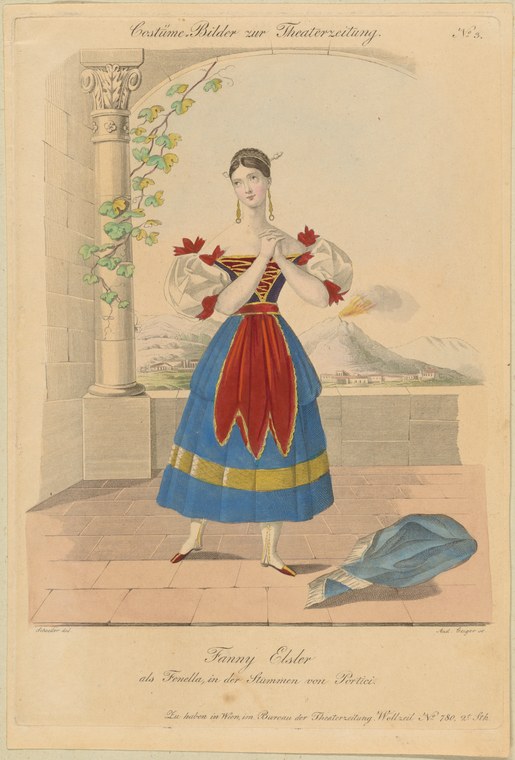
Fanny Elsler [sic] als Fenella, in der Stummen von Portici
Unknown artist
- Collection:
- Prints depicting dance
- Source:
- New York Public Library
- Rights:
- Public domain — free to use, share and adapt.
- Recorded as:
- Public Domain
This work documents a crucial moment in dance history when ballet was merging with opera and melodrama to create a new theatrical form. It preserves the appearance and style of one of the most celebrated roles of the Romantic era, a part that would be danced by leading ballerinas across Europe for decades. For historians of costume, mime, and theatricality, it is a primary record of how Romantic spectacle was actually staged and costumed.
What you are looking at
A woman in theatrical costume stands on a classical stone terrace overlooking a mountainous landscape. She wears a vibrant red sleeveless tunic with a deep blue skirt trimmed in gold, secured by a dark corset at the waist. Her dark hair is styled up and adorned with what appears to be a jeweled ornament. She holds her arms raised and slightly forward, displaying large red feathered props or wings attached to each wrist. A blue fabric—possibly a cape or trailing drapery—lies discarded on the stone floor at her feet. A fluted classical column with acanthus capital rises to her left, framing the composition. The setting and her pose suggest a moment of dramatic expressiveness or revelation, characteristic of Romantic ballet spectacle.
The dancing
The dancer stands in an upright, frontal pose with weight evenly distributed. Both arms are raised to approximately shoulder height, slightly forward of the body, with the large feathered objects held in the hands creating a wide, open silhouette. Her torso is erect and her gaze directed outward, engaging the viewer. The extended arms and theatrical prop wings suggest a moment of soaring or transformation rather than a conventional dance position. There is no partner; she occupies the stage alone.
The dance depicted
This is almost certainly a scene from *La Muette de Portici* (*The Dumb Girl of Portici*), a grand opéra-ballet that premiered in Paris in 1828 and became one of the most successful theatrical works of the Romantic era. The title inscription confirms the subject as Fenella, the mute protagonist. The costume—the red tunic, blue skirt, and feathered props—are consistent with period illustrations of this role. The dance depicted here is not a strict ballet technique but theatrical mime-dance, a blend of expressive gesture and stylised movement that was central to Romantic opera-ballet. The red feathered objects may represent doves or wings integral to a specific scene or transformation moment. The scale and style of the print suggest this was a popular role danced across European stages in the 1830s–1840s.
How it was made
This is a hand-coloured engraving or lithograph (the record does not specify), typical of theatrical publicity and costume documentation from the 1830s. The delicate line-work, the careful register of the classical setting, and the precise delineation of fabric and ornament are characteristic of engraving; the soft tonal washes appear to be watercolour or gouache applied by hand after printing. This technique allowed rapid, affordable distribution of images of celebrated dancers and roles to theatregoers and the collecting public across Europe. The inscription in German script (*Costüme-Bilder zur Theater-zeitung*, 'Costume Pictures for the Theatre Newspaper') confirms this was part of a series documenting theatrical fashion for a German-language publication, suggesting the work circulated among German-speaking audiences and theatregoers.
About this work
This is a hand-coloured theatrical portrait-print of Fanny Elssler—or a dancer in her role—as Fenella from *La Muette de Portici*, one of the defining Romantic ballet-operas of the 1820s–1830s. The image documents not ballet in the strict sense but the spectacular, mime-heavy theatrical dance of the Romantic grand opéra, a form that blended pantomime, expressive gesture, elaborate costume, and scenery to tell dramatic stories. The work belongs to the rich print culture of theatrical documentation that flourished in the Romantic period, recording celebrated roles and dancers for an audience hungry for images of the stage. It captures a specific theatrical moment—Fenella's transformation or revelation—rendered in the classical idiom of theatrical portraiture: the solitary figure, the eloquent gesture, the symbolic props, the architectural frame.
How to look at it
Observe the moment the artist has chosen: not a movement caught mid-leap or turn, but a held, theatrical pose—the arms extended with the feathered props creating a strong silhouette, the body frontal and declarative. This is characteristic of Romantic theatrical portraiture, which valued legibility and emotional expression over captured motion. Note the blend of classical reference (the column, the architectural frame, the erect posture) with exotic or fantastical costume (the feathered props, the vibrant colours). The discarded blue fabric at her feet suggests a narrative moment—a transformation, a revelation—rather than a pure dance step. This is mime-dance, the theatrical language of the Romantic era.
The artist
The work is attributed to no artist in the catalogue record. The engraver's or lithographer's name may appear on the print itself but is not recorded here. The series *Costüme-Bilder zur Theater-zeitung* was a German theatrical periodical feature, and the technical quality and consistent style suggest a professional theatrical print shop or publishing house, likely in Vienna, Berlin, or another major German cultural centre. These prints were often produced quickly to capitalise on the popularity of successful roles.
The period
This work dates from the height of the Romantic ballet era, roughly 1830–1845. *La Muette de Portici* premiered in Paris in 1828 and became a sensation across Europe; it was performed in Vienna, Berlin, Milan, and London by leading dancers of the day. The Romantic period privileged pantomime and expressive gesture over pure technique, and ballets increasingly served as vehicles for celebrated performers and spectacular scenery. Fanny Elssler (1810–1884) was one of the greatest dancers of the age and a rival to Marie Taglioni; she was known for her technical brilliance and her dramatic intensity. The theatrical print became a major medium for circulating images of celebrated dancers and roles, functioning as a precursor to theatrical photography.
Where it lives
The work is held in the New York Public Library's collection of theatrical prints and costume documentation. It is part of a German theatrical periodical series and was likely printed in the 1830s or early 1840s, circulating among German-speaking theatregoers and collectors. Such prints were often bound into albums or collected singly and are now dispersed across institutional and private holdings.
Dance in this work
Questions about this work
Who was Fanny Elssler?
Fanny Elssler (1810–1884) was an Austrian dancer and one of the greatest stars of the Romantic ballet era. She was celebrated for her technical skill, dramatic intensity, and charisma, and she rivalled Marie Taglioni as the leading ballerina of her time. She danced across Europe and the Americas and was particularly known for roles in dramatic opéra-ballets like *La Muette de Portici* and for her performances of character dances like the Cachucha.
What is *La Muette de Portici*?
*La Muette de Portici* (*The Dumb Girl of Portici*) is a grand opéra-ballet that premiered at the Opéra in Paris in 1828, with music by Daniel Auber and choreography by Louis Milon. It tells the story of Fenella, a deaf and mute girl in 17th-century Naples, whose silent pantomime is the emotional centre of the work. The opera was a tremendous success and was performed repeatedly across Europe throughout the 19th century.
What is the difference between Romantic ballet and classical ballet?
Romantic ballet (c. 1830–1890) emphasised poetic storytelling, pantomime, supernatural and exotic themes, and the ballerina as the focal point. It valued expressive gesture and emotional intensity. Classical ballet (c. 1890 onwards) emphasised pure technique, symmetry, geometric patterns, and the integration of male and female dancers in abstract or mythological narratives. Romantic works like *La Muette de Portici* were theatrical spectacles; classical works like *Swan Lake* were technical showcases.
What are those feathered objects in her hands?
The feathered props likely represent doves or wings and are integral to a specific scene or symbolic moment in the ballet. They may be part of Fenella's gesture of yearning, freedom, or transformation—a common motif in Romantic ballet. Without access to the libretto or choreographic notation, the exact meaning is uncertain, but such props were typical of the elaborate, symbolic stagecraft of the period.
More dance artwork





