49 works in this view — arrow keys or swipe to move between them.
Dance in Art · 2020
Dancing on the green
Unknown artist
- Medium:
- Source:
- New York Public Library
- Rights:
- Public domain — free to use, share and adapt.
- Recorded as:
- public_domain
For dance historians, this image is a valuable visual record of English country social dance as it was remembered and represented in the late 19th century—not the formal technique of the ballroom, but the lived practice of village celebration. For illustrators and book historians, it exemplifies the Caldecott tradition and the use of narrative illustration to shape middle-class nostalgia for rural England. The image also captures a moment in which social dance was still understood as a core expression of community identity and festivity.
What you are looking at
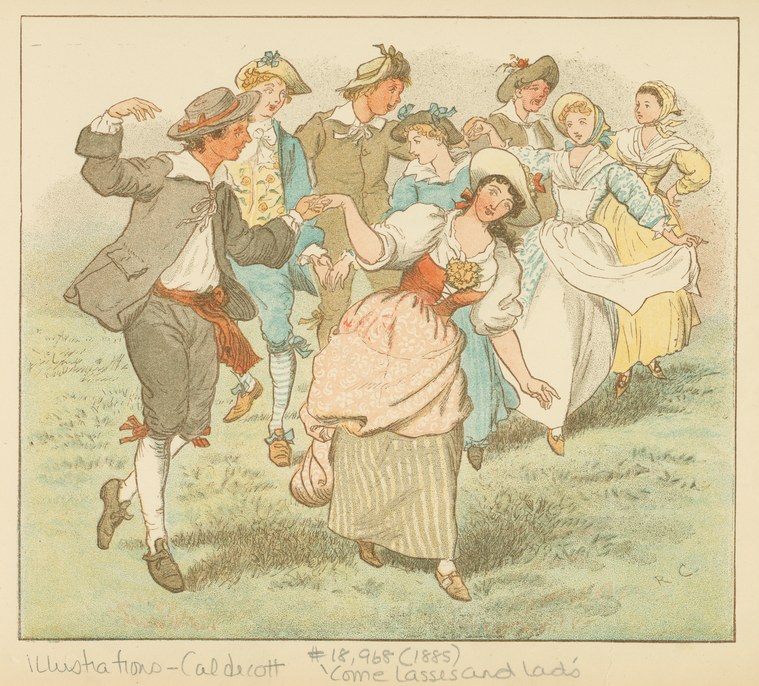
A merry outdoor scene shows a group of country dancers and revelers on a green, rendered in the soft watercolor and line style typical of late 19th-century children's book illustration. The composition is crowded and animated, with figures in rustic dress arranged loosely across a grassy foreground. At the center is a woman in a pink dress and white apron, caught mid-leap or spin, her skirts billowing outward. Around her cluster other dancers and onlookers—men in brown jackets and hats, women in simple cotton dresses and bonnets, and several children watching from the margins. The artist has captured a moment of unrestrained joy: some figures gesture wildly, one man at left has his arm raised to his head in exuberant gesture, another appears to be clapping. The scene reads as a village festivity, probably a country fair or holiday gathering. The soft greens of the grass and the warm ochres and pinks of the clothing are rendered with the delicate hand-coloring typical of chromolithography or hand-colored wood engraving.
The dancing
The dancers display the loose, exuberant posture of vernacular country dance rather than formal technique. The central woman is airborne or at the peak of a jump, her body released and uncontrolled, her arms open. The male figures around her stand upright but animated, with raised arms and open stances suggesting social merriment rather than partnered hold. The children and observers are positioned at the edges, watching rather than dancing. There is no evidence of closed position, frame, or the bodily control of trained dance—the entire group reads as spontaneous, joyous community movement.
The dance depicted
This depicts country or village social dance of the sort associated with English rural festivals, fairs, and holiday celebrations in the 19th century. The dress, setting, and uninhibited movement suggest vernacular social dance of a type documented in historic-gilded-age traditions such as country dances or céilís, but the image does not contain enough technical specificity to identify a named dance form. The presence of a fiddle or bagpipe player in the background (barely suggested) would confirm music-driven social dancing, though the musician is not clearly rendered. The scene is documentary in intent: to capture the spirit of rural festivity and unschooled pleasure in movement, not to teach technique.
How it was made
This is a chromolithograph or hand-colored engraving, a reproductive print technique common in the 1880s–1900s for children's books and popular illustration. The soft-focus watercolor effect, the delicate line work, and the restrained palette (ochres, soft greens, pale flesh tones) are characteristic of Caldecott's style and the English children's book tradition. The technique allowed wide distribution at low cost and was suited to a young or family audience. The print's preservation and provenance in the New York Public Library collection indicates it was valued as both a cultural document and children's literature.
About this work
This is a page from or illustration related to 'Come Lasses and Lads,' a nursery rhyme or folk poem celebrating country dancing and courtship. The image is characteristic of Randolph Caldecott's work: a celebration of rural English life, observed with affection and humor, rendered in a style accessible to children but engaging to adults. It sits within a tradition of 19th-century illustrators documenting folk custom and rural festivity as a form of cultural nostalgia and preservation—capturing a way of life thought to be disappearing. The work is also a document of the gender and class dynamics of village social life: the men and women dancing together, the children permitted to watch, the visible joy and informality of a community gathering.
How to look at it
Notice the moment of maximum abandon: the central woman at the peak of her jump, her body weightless and her skirts caught in mid-air. This is not a pose but an action—the artist has chosen the instant of greatest energy and joy. Look at the faces: the expressions of delight, the open mouths suggesting music and laughter. Look also at the margins: the children watching, the musicians, the adults standing aside. The composition is not symmetrical or formally balanced but crowded and joyful, as if the artist were trying to fit all of a village's happiness into one frame. The line work is energetic and loose, not tight or controlled—the technique itself enacts the spontaneity of the scene.
The artist
The illustration is identified as being by Caldecott in the catalogue notation. Randolph Caldecott (1846–1886) was a pioneering English children's book illustrator and artist whose style—lively line work, social observation, and gentle humor—defined the aesthetic of English children's literature in the 1870s and 1880s. He was celebrated for his ability to capture movement and character, and his books were widely reproduced and distributed in both England and America. His illustrations often documented rural and social life with the eye of an anthropologist but the hand of a cheerful observer.
The period
This image dates to the 1880s, a period of intense interest in folk tradition and rural custom across Europe and America. The Arts and Crafts movement, the collection of folk songs and dances (Cecil Sharp's work on English folk dance began in 1899, just after this image was made), and the rise of children's literature as a serious art form all converged to make rural festivity a subject of artistic attention. Country dance was being romanticized and formalized even as it was being practiced; the Caldecott illustration captures a moment before the codification of English country dance into a named, teachable form. At the same time, the social composition of the image—mixed-gender, mixed-age, informal—reflects 19th-century village life as it was understood in retrospect.
Where it lives
The work is held by the New York Public Library and is catalogued as a print. The notation 'Illustration–Caldecott' and 'Come lasses and lads' (a reference to a nursery rhyme or folk verse) appear on the verso or as part of the original publication data. It is likely a page from a Caldecott-illustrated children's book or a separately issued print, distributed in America as well as Britain.
Dance in this work
Questions about this work
Is this depicting a real dance or a made-up scene?
It is depicting real village social dancing—the kind that actually happened at English fairs and holiday gatherings in the 19th century. However, the artist has not attempted to show a specific named dance form. Instead, the image captures the spirit and energy of folk celebration: mixed-gender groups moving together to music in a way that prioritized joy over technique. Such dancing was common and valued as a form of courtship and social bonding.
Why is the woman in the pink dress jumping so high?
The leap captures a moment of exuberant abandon—the height of the jump expresses joy and freedom. In country dancing of the period, such jumps or springs were common, especially in livelier figures. The artist has chosen this moment to convey the uninhibited pleasure of the dance: a body released from constraint, moving for the joy of it.
What does the title 'Come Lasses and Lads' mean?
'Come Lasses and Lads' is a traditional English folk verse or nursery rhyme inviting young people—both women and men—to dance together. The title encodes the social purpose of country dancing: it was how young people of different sexes met, courted, and experienced community. The image illustrates that social function: the mingling of male and female dancers, the presence of children and observers, the visible pleasure in mixed-gender movement.
Is this a photograph or a drawing?
This is a print—most likely a chromolithograph or hand-colored wood engraving, a technique used widely in the 1880s for book and magazine illustration. The soft watercolor effect and delicate line work are characteristic of that technique. The process allowed the artist's drawing to be reproduced many times and distributed widely at low cost, making it an ideal medium for children's books and popular illustration.
More dance artwork