49 works in this view — arrow keys or swipe to move between them.
Dance in Art
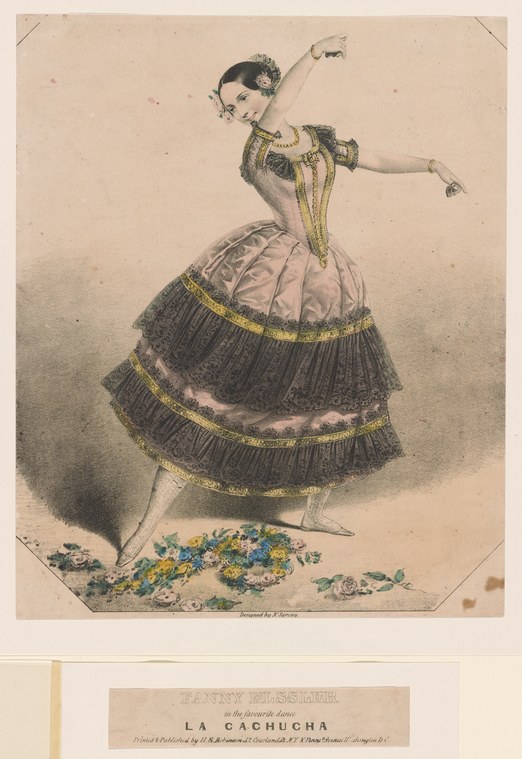
Fanny Elssler in the favourite dance La cachucha
Unknown artist
- Collection:
- Prints depicting dance
- Source:
- New York Public Library
- Rights:
- Public domain — free to use, share and adapt.
- Recorded as:
- Public Domain
Fanny Elssler was one of the dominant ballerinas of the Romantic era, second only to Marie Taglioni in fame and influence. The Cachucha exemplified her distinctive specialty—the character dance performed with technical brilliance—and established a new kind of solo role within ballet that influenced the art form for decades. This print is evidence of how 19th-century dance was circulated, remembered, and commodified as visual culture; it shows us what mattered about this performance and how it was marketed to the public.
What you are looking at
A solo female dancer is poised in a moment of theatrical performance, captured in a hand-colored lithograph or engraving. She stands in a classical ballet pose with her body turned in three-quarter view, one arm raised gracefully overhead while the other extends to the side, both hands rendered delicately. Her pose conveys the balletic vocabulary of the Romantic era—upright carriage, elongated line, a sense of weightless elegance. She wears a white muslin dress with a fitted bodice trimmed in gold thread or cord, and a full skirt composed of multiple tiers of gauzy fabric with gold-embroidered borders; the skirt, caught mid-movement, flares around her legs in pale pink and deeper shadow tones. Her dark hair is styled in the fashion of the 1830s–40s, pulled back with what appears to be a decorative arrangement. The background is minimal and atmospheric—soft gray wash that focuses all attention on the figure. At the bottom of the composition, a small still-life detail shows scattered flowers in muted colors: coral, yellow, and green blooms loosely arranged as if the dancer has danced among them or they mark the theme of the work.
The dancing
The dancer's body displays the high carriage and demeanor of classical ballet training: her spine is extended, her head held with aristocratic poise, her gaze directed away in the classical manner. Both arms are held with softness and control—not rigid, but showing the port de bras expected of the period. The weight appears to be sustained and lifted; there is no heaviness to the pose, despite its stasis. The crossed relationship of torso to hips and the angle of the legs suggest a pose drawn from the ballet vocabulary, though the precise position cannot be determined from this fixed image. She dances alone, the sole figure in the composition.
The dance depicted
This print depicts La Cachucha, a Spanish-style dance that was theatricalized and popularized by the Romantic ballet in the 1830s. The cachucha is a folk-regional Spanish dance of flamenco origin, but here it has been absorbed into the vocabulary of theatrical ballet—reimagined as a character dance or national divertissement within the ballet spectacular. The attribution to Fanny Elssler in the caption (printed below) identifies her as the dancer most famous for performing this work. Elssler, an Austrian ballerina of the Romantic era, danced the Cachucha as a solo number and it became one of her signature roles, celebrated throughout Europe and America. The theatrical presentation—the gauzy skirt, the balletic carriage, the stage pose—indicates this is ballet's genteel interpretation of Spanish folk dance, performed in the concert theater rather than in its original social or ritual context.
How it was made
This is a hand-colored lithograph or engraving, indicated by the fine line work, the subtle modeling of the figure in black line and wash, and the delicate hand-coloring applied to define the dress in pale pink, the gold embroidery, and the flowers. The technique of hand-coloring meant each print was finished individually, making this a labor-intensive production suitable for a celebrated performer and a well-heeled audience. The softness of the background wash and the precision of the figure's outline are characteristic of theatrical portraiture lithography of the 1830s–40s, a medium that allowed wide distribution of images of celebrated dancers to an international audience hungry for visual records of famous performances. The inscription below appears to name both the dance and the dancer.
About this work
This is a theatrical portrait of Fanny Elssler performing the Cachucha, a dance that occupied a unique place in Romantic ballet—a Spanish character piece that brought folk idiom into the refined world of the ballet stage. The image captures neither raw folk movement nor pure classical ballet, but rather the synthesis: the balletic body, the upright carriage, the theatrical costume, all performing a choreographed version of Spanish dance. The print itself is a document of star performance and international celebrity; it was made to circulate among patrons and admirers, allowing those who could not attend the theater to possess an image of one of the era's most celebrated dancers in one of her most celebrated roles. The work sits at the intersection of ballet history, the history of female performance stardom, and the 19th-century fascination with national and ethnic character dances.
How to look at it
Look first at the pose: the dancer is frozen mid-performance, in a controlled, lifted moment rather than a moment of dynamic action. This is typical of how 19th-century dance prints worked—they presented the dancer as a figure to be admired and contemplated, not caught in an action snapshot. Note the detail of the costume: the tiered skirt is rendered to show the voluminous silhouette and the gold trim, and the tight bodice emphasizes the upright carriage valued in Romantic ballet. The flowers at her feet suggest both the Spanish setting (floral imagery) and the tradition of presenting bouquets to celebrated performers. Observe how the artist has used the minimal background to focus all attention on the figure, a convention of theatrical portraiture that asks the viewer to see the dancer as the sole subject worthy of attention.
The artist
The artist is not recorded in the catalogue. The lithograph is signed (or attributable to) J. Bouvier, a lithographic printmaker active in the 1830s–40s, likely working in Paris or a major European theatrical center. The work is typical of the theatrical celebrity prints produced by European printmakers during this period—portraits of famous performers in their signature roles, hand-colored and sold to theater audiences and collectors.
The period
This print belongs to the height of the Romantic ballet, roughly 1830–1845, when the ballerina became the central figure of the ballet stage and the prima donna system was at its height. This was the era of Marie Taglioni's La Sylphide (1832) and the cult of the ethereal, weightless female dancer. Yet within this aesthetic, there was also a thriving tradition of character dances—Spanish, Scottish, Neapolitan—which allowed ballerinas to display virtuosity and personality beyond the ethereal sylph. The Cachucha filled this role perfectly: it was a solo vehicle, it showcased technical skill and charm, and it carried an aura of exotic foreignness that appealed to metropolitan European audiences. The hand-colored lithograph was the primary medium through which dance imagery reached the public; before photography, prints like this were how theater-goers who had seen a performance could remember it and how those who had not could imagine it.
Where it lives
The print is held in the New York Public Library's Prints collection, which holds extensive holdings of 19th-century theatrical portraiture and dance imagery. The catalogue describes this as part of the general dance prints collection, indicating it is one of many such documents of performance preserved in the institution.
Dance in this work
Questions about this work
What is the Cachucha and why did Fanny Elssler make it famous?
The Cachucha is a Spanish folk dance of flamenco origin. In the 1830s, it was adapted for the concert stage as a character dance within ballet, performed by leading ballerinas as a showcase for both technical skill and personality. Fanny Elssler danced it as a solo number and made it her signature role; it became so closely associated with her that it is often called 'Elssler's Cachucha.' The dance represented a new kind of role for Romantic ballet—one that combined balletic training with the energy and color of folk idiom.
How do we know this shows Fanny Elssler?
The text printed below the image, which reads 'Fanny Elssler in the favourite dance La cachucha,' identifies both dancer and dance. This is a labeled theatrical portrait, made to celebrate a specific performance and to capitalize on the dancer's fame by putting her name prominently on the print.
What does this print tell us about how dance was seen in the 19th century?
This print shows that dance in the theater was understood as a visual spectacle centered on the celebrated female performer. The image freezes a moment for contemplation rather than showing movement; it emphasizes costume and pose as much as dance. The fact that such prints were mass-produced and circulated shows that dance was commodified and that images of famous dancers were objects of desire—souvenirs of performance that allowed fans to take the theater home with them.
Is this a painting or a print?
This is a print—specifically, a hand-colored lithograph or engraving. The line work and the method of hand-coloring each copy individually are visible in the image. This technique allowed the image to be reproduced and distributed to a wide audience, making it far more accessible than a unique painting would have been.
More dance artwork





