49 works in this view — arrow keys or swipe to move between them.
Dance in Art
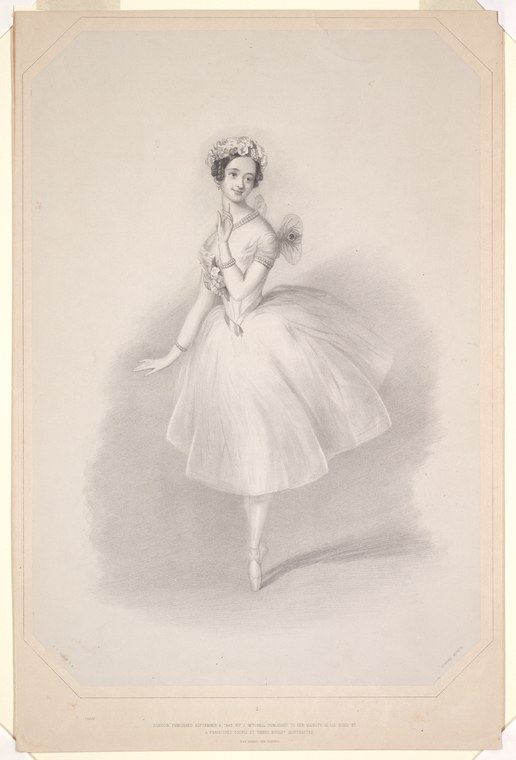
[Souvenir d'adieu de Marie Taglioni].
Unknown artist
- Collection:
- Prints depicting dance
- Source:
- New York Public Library
- Rights:
- Public domain — free to use, share and adapt.
- Recorded as:
- Public Domain
Taglioni was the supreme virtuoso of Romantic ballet and the first dancer to achieve genuine international stardom; this print captures her image at the height of her fame and influence. The work documents the visual aesthetics of Romantic dance — the silhouette, the costume, the ideal of weightlessness — as they were understood and circulated to a broad public. Prints like this shaped how 19th-century audiences understood and remembered great dancers, making the image as historically important as the live performance.
What you are looking at
A young woman stands in a balletic pose against a plain background, wearing a romantic-era tutu of pale, layered tulle that falls to mid-calf. The dress has short, puffed sleeves of gauze and a fitted bodice decorated with what appears to be jewelled ornament at the waist. Her hair is styled up and adorned with a wreath or tiara. She stands on the ball of one foot in a pose of elegant repose, with the other leg lightly bent and the corresponding arm extended in a graceful line. The lighting is soft and atmospheric, rendered in the tonal range of a lithograph or engraved print, with careful shading that gives volume to the skirts and definition to the figure. The image is a portrait of the dancer alone, framed as a commemorative souvenir — the inscription below (partially visible) refers to a farewell or valediction.
The dancing
The dancer is shown in a single, sustained position rather than caught mid-movement: standing on one leg with a posture of poised elegance, the supporting leg straight though not locked, the free leg gently bent. The arms are arranged with classical clarity — one extended, the other positioned to balance the composition. The pose suggests a moment between steps rather than the dynamic explosion of a jump or turn. The figure is solitary and frontal, presented as a portrait of the body itself rather than as part of an ensemble or narrative.
The dance depicted
This is a commemorative print of Marie Taglioni, the Swedish-Italian ballerina and the defining star of Romantic ballet. The title's reference to 'adieu' (farewell) and the souvenir function suggest this was produced around or after one of her celebrated farewell performances — she gave her final stage performance in 1847. The pose and costume are characteristic of Romantic ballet in the 1830s-1840s: the ethereal tutu, the emphasis on weightlessness and grace, the pose of suspended repose. The work documents not a narrative moment but the dancer herself as the primary subject, in the manner of celebrity portraiture of the period.
How it was made
This is a lithograph or steel engraving, most likely produced in Paris during Taglioni's performing career or shortly after. The tonal gradation, fine line work, and the way the fabric of the skirt is rendered in layered grays suggest an engraving or lithographic stone. The technique allowed for rapid reproduction and wide circulation as a popular print, making Taglioni's image accessible as a souvenir or collectible. The quality of the rendering and the decorative border indicate this was a commercial production from an established print house, not an amateur sketch.
About this work
This is a commemorative portrait of Marie Taglioni, the Romantic ballet's defining figure, rendered as a lithographic or engraved print in the 1840s or later. The image captures her in the costume and bearing of her era: the tulle skirt, the poised stance, the projection of ethereal elegance that defined the aesthetic of Romantic dance. As a 'souvenir d'adieu' (farewell souvenir), it belongs to the substantial tradition of celebrity dance portraiture that emerged in the 19th century, when dancers became subjects of mass-produced prints and collectibles. The work is not documentation of a choreographed moment but a crystallization of the dancer as icon — Taglioni as the embodiment of Romantic ballet itself.
How to look at it
Notice the precision of the pose: the dancer is not in motion but in a held moment of classical balance, which was itself a marker of technique and beauty in the Romantic period. The tutu — constructed of layers of stiffened tulle — is rendered with careful attention to the way light falls through and around the fabric, emphasizing the volume and weightlessness the costume was designed to create. The inscription below originally recorded the date and venue of the farewell performance; checking what remains legible of that inscription would anchor the print's date. The soft tonal gradations and the lack of bold line work are characteristic of how lithography and engraving differed from woodcut — techniques that allowed subtle modeling of form and fabric.
The period
Marie Taglioni dominated European ballet from the 1820s through the 1840s, and her final performances in 1847 marked the end of an era. The Romantic ballet period (c. 1830–1870) elevated the ballerina to the center of dance; male dancers receded, and the emphasis fell on the female body as an instrument of ethereal beauty and technical precision. By the 1840s, Taglioni was aging out of her performing prime, making farewell tours a natural event. The souvenir print was a standard way for audiences to memorialize and possess the image of a beloved performer — a precursor to the photograph and the modern celebrity portrait. This print belongs to the tradition of commemorative dance portraiture that flourished in 19th-century Paris and London, cities where Taglioni spent much of her career.
Where it lives
This print comes from the New York Public Library's collection of prints depicting dance. The record identifies it as a souvenir commemorating a farewell performance by Taglioni but does not record the date, artist, or publisher. The physical object is held by NYPL; the current location of other copies or the original lithographic stone is unknown.
Dance in this work
Questions about this work
Is this a photograph?
No. This is a lithograph or engraving, a hand-drawn or stone-drawn image printed and reproduced. Photography existed by the time of Taglioni's farewell tours, but painted or drawn dance portraits remained standard for commemoration. The tonal quality and line work visible here are consistent with a lithographic or engraved production.
What does 'adieu' mean in the title?
It means 'farewell.' The full title indicates this is a souvenir of a farewell performance — a memento of Taglioni's last appearance on stage. Farewell tours were common events for celebrated dancers at the end of their performing careers and were often commemorated with special prints.
Why is she on pointe?
She appears to be standing on the ball of her foot rather than en pointe (on the very tip of the toe in a pointe shoe). The ethereal effect of Romantic ballet did include the use of pointe work, but this pose is one of balance and grace rather than the extreme extension and strain of later classical ballet. Early Romantic pointe technique was different from what we see in 20th-century ballet.
Who was Marie Taglioni?
She was a Swedish-Italian ballerina (1804–1884) and the supreme star of Romantic ballet. She created roles in major works including La Sylphide and became the visual embodiment of the Romantic ideal: weightless, ethereal, technically perfect. Her farewell performance in 1847 was a major cultural event, and prints like this preserved her image for audiences and collectors.
More dance artwork





