49 works in this view — arrow keys or swipe to move between them.
Dance in Art
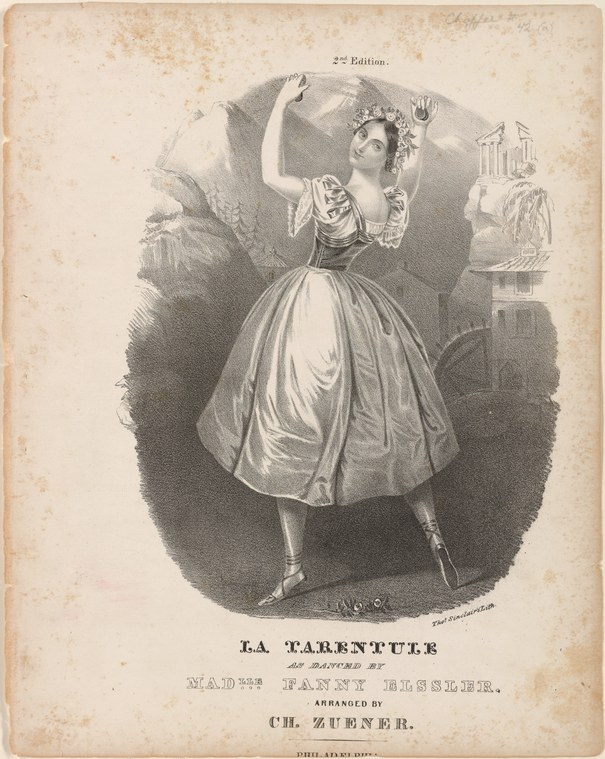
La tarentule as danced by Madlle. Fanny Elssler
Unknown artist
- Collection:
- Prints depicting dance
- Source:
- New York Public Library
- Rights:
- Public domain — free to use, share and adapt.
- Recorded as:
- Public Domain
Elssler's tarantella was one of the signature performances of the Romantic ballet era and influenced how the dance was subsequently staged and taught. This print is one of the few contemporary visual records of how she actually danced it—not a posed portrait but an attempt to capture motion and personality. For historians of nineteenth-century dance technique and theatrical practice, it is primary evidence of a lost performance tradition.
What you are looking at
A young woman in Romantic-era theatrical dress stands alone against a darkened, rocky background, her body caught in a moment of energetic movement. She wears a white muslin skirt of mid-calf length with a fitted bodice and short puffed sleeves trimmed with lace; her dark hair is crowned with flowers and her feet are in soft ballet slippers. Her right arm is raised expressively above her head while her left arm extends outward; her torso twists and her weight appears to shift through her legs in a moment of rapid, impassioned turning. To her left in the middle distance stands a classical Greek temple or ruin, rendered in pale stone and contributing to the scene's romantic, antiquarian mood. The engraver has used strong tonal contrasts—deep shadow surrounding the figure and illuminating her face and the full volume of her skirt—to create a sense of dramatic isolation and intensity.
The dancing
A single female dancer dominates the composition. Her posture is one of dynamic rotation: the torso is lifted and twisted, the raised arm frames the head in a classical pose while the supporting leg bears weight through what appears to be a turned-out position. The extended left arm and the apparent weight shift through the hips suggest rapid footwork below the skirt line—likely quick patterning typical of Italian character dances. The body is fully engaged in upward extension rather than a horizontal line, giving the impression of elevation and emotional intensity rather than social grace.
The dance depicted
This is a theatrical representation of the tarantella, the Italian folk dance that entered Romantic ballet as a character piece displaying virtuosity and emotional abandon. The tarantella was especially associated with soubrette roles in mid-nineteenth-century ballet. Fanny Elssler (1810–1884) was the leading exponent of this dance on the European stage; her performance of the tarantella was legendary and she danced it in works including *La Tarentule* (a ballet with choreography by Jean-Auguste Vestris, premiered 1839). The image captures the essential character of her interpretation: rapid footwork (implied by the whirl of the skirt), a lifted and expressive upper body, and a union of technical display with emotional dramatization that was her hallmark. The print documents how this particular star danced this particular role.
How it was made
This is a lithograph or fine engraving, likely produced in the 1840s as a commercial theatrical print. The image shows the precise, linear mark-making and tonal ranges characteristic of mid-nineteenth-century reproductive printmaking. The technique allowed wide circulation of images of famous dancers to an urban, theater-going public; prints like this were sold individually or collected in series, and they served as both souvenirs and advertisements for performers and works. The inscription at the bottom identifies both the work and the dancer, anchoring the image to theatrical history rather than treating the figure as generic.
About this work
This is a second-edition print documenting Fanny Elssler's celebrated performance of the tarantella in *La Tarentule*. It belongs to the tradition of Romantic-era theatrical portraiture, which captured the appearance and signature poses of the era's most admired dancers. Unlike the formal frontispiece engraving or the posed theatrical photograph, this image freezes a moment of intense action, showing the dancer mid-turn with the full technical and emotional engagement that defined her reputation. The work sits at the intersection of dance documentation, celebrity culture, and the reproductive print industry of the nineteenth century.
How to look at it
Attend to the moment chosen: the artist has captured not a static pose but a turning moment, with the skirt caught in mid-flare and the dancer's body actively engaged in rotation. Notice how the raised arm and lifted torso convey both control and emotional intensity—this is not a gentle social dance but an energetic, almost frenzied movement. The dark background and the isolation of the figure emphasize the dancer herself rather than a social setting or ensemble, making this a portrait of individual virtuosity. The temple in the background signals the Romantic taste for historical and exotic settings, but the focus remains on the figure and the impression of speed and abandon.
The artist
The artist is not recorded. This was produced as a commercial print by a publisher (the imprint is not fully legible here), most likely in Paris or London, the major centers of theatrical print production. Prints of celebrated dancers were a competitive business in the 1840s, and multiple artists and publishers produced images of the same performers and roles. The quality of the work and the care taken with the dance imagery suggest it was produced by a competent theatrical illustrator, though individual attributions for such prints are often lost.
The period
The tarantella entered European culture through travel and ethnographic curiosity in the eighteenth century, but it became a staple of Romantic ballet in the 1830s–1840s as choreographers sought to incorporate national character dances and folk idioms into theatrical works. The tarantella offered exciting technical possibilities—rapid footwork, turning, and quick directional changes—and strong narrative potential (the dance was traditionally associated with a woman under the spell of a spider's bite, dancing to exhaustion or cure). Elssler's performance in *La Tarentule* was part of this broader movement to make ballet a vehicle for both technical display and dramatic characterization, and to celebrate the dancer's individual artistry. Theatrical prints of this kind were a dominant medium for circulating images of dancers and building fan communities around celebrated performers.
Where it lives
This print is held in the New York Public Library's collection of prints depicting dance. It is a second edition, as marked on the print itself, suggesting the work was popular enough to warrant reprinting. It is a commercial theatrical print, one of hundreds produced in the 1830s–1850s to capitalize on the fame of celebrated performers.
Dance in this work
Questions about this work
Who was Fanny Elssler?
Fanny Elssler (1810–1884) was an Austrian dancer and one of the two most celebrated ballet dancers of the Romantic era (the other being Marie Taglioni). She was known for her technical brilliance, dramatic intensity, and mastery of character dances. She performed across Europe and the Americas and was a celebrity in her time, commanding high fees and devoted audiences.
What is the tarantella?
The tarantella is a rapid, spirited dance from southern Italy, traditionally danced as a solo or couple dance to a 6/8 rhythm. It entered theatrical dance as a character dance that allowed performers to display footwork, turning ability, and emotional expression. In Romantic ballet, it became a signature display for soubrette and demi-caractère roles.
Why print images of dancers?
Theatrical prints served multiple purposes: they were souvenirs sold to theatergoers, advertisements for upcoming performances, and collectible images for fans. Before photography became common, they were the primary way images of famous performers circulated. They helped build celebrity culture around dancers and made performances accessible to people who could not attend live theater.
How can you tell she is dancing a tarantella and not another dance?
The inscription on the print explicitly identifies the work as 'La Tarentule' and names Elssler as the dancer. The dance itself is also recognizable by convention: the rapid footwork (implied by the swirling skirt), the solo female dancer in theatrical dress, the moment of turning and emotional intensity, and the Italian folk-dance context were all standard visual markers of the tarantella in nineteenth-century theatrical imagery.
More dance artwork





