49 works in this view — arrow keys or swipe to move between them.
Dance in Art
Festivities and spectacles
Unknown artist
- Collection:
- Prints depicting dance
- Source:
- New York Public Library
- Rights:
- Public domain — free to use, share and adapt.
- Recorded as:
- Public Domain
This image preserves the visual culture of pre-modern festive performance—a world in which elaborate movement, costume, and spectacle were central to the exercise of power and the marking of community occasions. For historians and dancers, it shows how the predecessors of modern ballroom and theatrical dance inhabited public space, mixed social classes, and blended elite and folk traditions. The engraving's circulation as a print means it shaped how festival culture was remembered and imitated across Europe.
What you are looking at
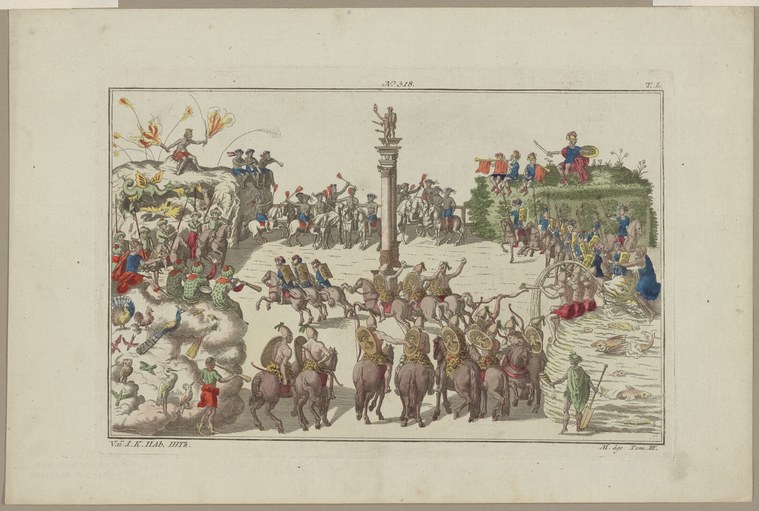
A teeming carnival or festival scene rendered in hand-colored engraving, crowded with hundreds of figures across multiple zones of activity. In the foreground, mounted horsemen and pedestrians surge around a tall decorative column or monument; at the left, a massive grotesque head or carnival float towers over the crowds, its mouth agape and festooned with figures and ornament. The right side shows a fortified structure or viewing stand packed with spectators. The middle distance teems with processional movement—costumed figures, musicians, and performers threading through dense ranks of onlookers. The entire composition vibrates with movement: some figures dance in loose groupings, others process in formation, still others gesture, leap, and cavort. The palette emphasizes reds, yellows, greens, and flesh tones against a pale ground, with the chaotic density of bodies creating an almost overwhelming impression of synchronized festivity and controlled mayhem.
The dancing
The dancers and performers visible throughout occupy no single formal frame or hold; instead they scatter across the composition in varied postures—some with arms raised, others bending or leaping, still others in processional step. Costume varies widely: some wear recognizable court dress, others grotesque masks or exaggerated silhouettes. The mounted figures sit upright in formal seats; on foot, bodies incline, rotate, and extend with the freedom of carnival rather than ballroom precision. Groupings range from solitary leaping figures to loose bands of three or four moving together, suggesting spontaneous rather than choreographed ensemble action.
The dance depicted
This is a carnival or festive pageant scene rather than a single dance form. The image depicts the kind of coordinated public spectacle—combining processional movement, acrobatic display, costumed performance, and crowd participation—that characterized European court and civic festivals from the Renaissance through the eighteenth century. The gestures, costumes, and compositional scatter suggest elements of court masque, folk processional, and improvisatory street performance. The mounted figures and heraldic display suggest aristocratic patronage; the grotesquerie and chaos suggest popular festival culture. Without inscription or clear date, the specific tradition cannot be narrowed further, but the visual evidence points to elite-sponsored public festivity that mixed courtly decorum with carnivalesque excess.
How it was made
The work is a hand-colored engraving or etching, recognizable by its fine parallel line work creating tone and shadow, the precision of the architectural and figural outlines, and the deliberate application of watercolor or pigment over the printed line. The technique allowed for wide circulation as a print—multiple impressions could be pulled from the same plate—making such festival images a form of documentary and commemorative art. The fineness of the engraved detail and the labor of hand-coloring suggest this was a relatively expensive production intended for a educated, leisured audience of collectors and patrons with interest in court culture and spectacle.
About this work
This hand-colored engraving documents a major festive or carnival spectacle, likely a court-sponsored pageant of the sixteenth to eighteenth century. The composition is a visual encyclopedia of festive performance modes—processional movement, acrobatic display, mounted ceremony, masked performance, and crowd participation—rendered in dense, energetic detail. It belongs in a gallery of dance in art because it captures the forms and occasions of courtly and popular movement outside the ballroom or theater stage, showing how dance and festive gesture pervaded civic ceremony, carnival, and aristocratic display. The work is also a document of how dance looked to artists and patrons of its era: not isolated in the studio or theater, but embedded in social spectacle, costume, music, and collective action.
How to look at it
Scan the image systematically from left to right and front to back, following the movement of distinct groups rather than the whole crowd at once. Notice how the artist used costume and positioning—the mounted figures, the grotesque heads, the raised arms—to create visual rhythm and guide the eye across the space. Attend to the variety of footwork and body positions: some figures step in formation, others leap or bend, still others stand or gesture. The lack of a single focal point or synchronized group teaches us something important about how European festive performance worked—it was fundamentally heterogeneous, mixing elite ceremony with popular play, and the engraver chose to show that heterogeneity as the work's central meaning.
The period
The style and execution suggest a sixteenth- to early-eighteenth-century engraving, an era when festival and pageantry were central to courtly life and civic identity across Europe. Court festivals—combining music, dance, elaborate costume, and allegorical spectacle—served as displays of power and occasions for innovation in movement and design. Engravings and etchings of such events were popular as commemorative and instructional images, allowing distant viewers to witness and learn from celebrated spectacles. The composition's debt to Renaissance and Baroque traditions of festival imagery places it in a lineage stretching back to Leonardo da Vinci's designs for court performances and forward to the elaborate court ballets of Louis XIV.
Where it lives
The work is held in the Prints collection at the New York Public Library, catalogued as depicting dance and spectacle but with limited additional documentation. As a hand-colored engraving, it is one of many such prints produced across Europe in the early modern period for collectors and scholars interested in festival culture and the arts of court life.
Dance in this work
Questions about this work
Is this showing a specific historical event?
The image appears to be a general representation of festival spectacle rather than a documentation of a single occasion, though it may have been inspired by a celebrated court pageant. The lack of clear inscription or provenance makes identification difficult. Such engravings often circulated as idealized models of how festivals should look and move, rather than as eyewitness records.
What kind of dancing is shown?
The image mixes several modes of movement—processional, acrobatic, gestural, and balletic—rather than depicting a single dance form. Performers move in loose groups, in formation, or as individuals, suggesting the improvisatory and heterogeneous character of festival performance. Some gestures resemble courtly propriety; others suggest folk or carnival excess.
Why are there so many people?
Festive spectacle was a public event drawing crowds of spectators and participants across social classes. The engraver's decision to render hundreds of figures emphasizes that these were communal occasions, moments when the rigid hierarchies of courtly society were loosened and rearranged through costume, role-play, and collective movement.
How was this image used?
As a hand-colored engraving, this work would have circulated among educated collectors, court patrons, and artists interested in festival design and the arts. Such prints served as documentation, inspiration, and entertainment—allowing viewers to study spectacle from afar and imagine participating in or staging similar events.
More dance artwork





