49 works in this view — arrow keys or swipe to move between them.
Dance in Art
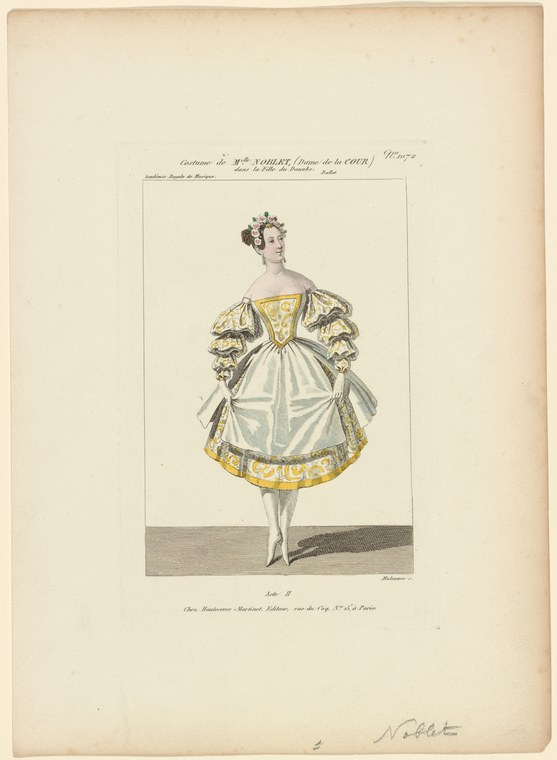
Costume de Melle. Noblet, (Dame de la cour) dans La fille du Danube, ballet, Académie Royale de Musique. Acte II
Unknown artist
- Collection:
- Prints depicting dance
- Source:
- New York Public Library
- Rights:
- Public domain — free to use, share and adapt.
- Recorded as:
- Public Domain
This is a named record of a specific ballerina's costume in a specific ballet, made contemporary with the original production. Such images are rare—most surviving costume documentation is anonymous or undated—and this one allows historians to connect visual evidence of theatrical design directly to a known dancer and choreographic work. For the study of Romantic ballet costume and performance practice, it is a document of high evidentiary value.
What you are looking at
A young woman in theatrical costume stands in a formal three-quarter pose against a plain ground. She wears a voluminous white silk dress with a fitted bodice trimmed in gold braid and decorated with what appears to be jeweled ornaments or embroidery across the front. The skirt is wide and gathered, falling to mid-calf, with a deep gold border at the hem. Her sleeves are notably full and puffed at the shoulders, pulled tight at the forearm—a silhouette characteristic of 1830s–1840s Romantic ballet costume. She wears an ornate tiara or diadem on her dark hair, which is parted and arranged close to her head. Her feet are positioned in a relaxed stance rather than a balletic position; her posture is upright and dignified, befitting a court lady. The image is a hand-colored engraving or lithograph, rendered with fine line work and selective hand-coloring in gold and skin tones against cream paper.
The dancing
A single figure occupies the frame, standing with weight evenly distributed on both feet in a neutral stance. Her arms hang naturally at her sides with a slight curve to the elbows. The shoulders are relaxed and level. There is no elevation, turn-out, or balletic frame evident; the pose is that of a standing woman in costume rather than a dancer mid-movement. The posture conveys nobility and stillness rather than dynamic action.
The dance depicted
This is a costume study for a female dancer in *La fille du Danube* (The Daughter of the Danube), a Romantic ballet first performed at the Académie Royale de Musique in Paris in 1836, with music by Adolphe Adam. The inscription identifies this as the costume worn by Mlle. Noblet in Act II, playing a lady of the court. Noblet was a leading ballerina of the Romantic era. The image documents theatrical dress rather than capturing movement; the dancer is presented in formal attire as she would appear on stage rather than in a balletic attitude. The full skirt and gathered sleeves are typical of Romantic ballet costume design of this decade, designed to enhance the visual spectacle and suggest the ethereal, otherworldly character associated with the genre.
How it was made
This is a hand-colored engraving or lithograph, established by the fine parallel line work visible in the background shading and the precise, uniform outlines of the figure and costume. The coloring—gold on the trim and bodice, pink on the face and neck, light wash on the skirt—was applied by hand after printing, a standard practice for theatrical costume documentation of the period. This technique allowed for rapid, affordable reproduction and distribution of costume designs to audiences, other performers, and theatrical archives, making it a commercial as well as documentary object. The print was likely published in Paris and circulated among patrons of the Opéra and the broader European theater world.
About this work
This work is a costume record for a named ballerina in a specific Romantic ballet, documenting both the historical design of theatrical dress and the performer who wore it. It belongs to a tradition of theatrical documentation that flourished in early 19th-century Paris, where the Opéra was a center of European cultural prestige and ballet was an essential part of the season's attractions. Costume studies like this one served multiple audiences: they preserved designs for future productions, circulated knowledge of fashionable theatrical aesthetics, and celebrated the dancers who became famous in particular roles. The work is valuable to dance historians both as a primary source on Romantic-era costume construction and as evidence of how ballerinas were marketed and remembered in their own time.
How to look at it
This is not a snapshot of movement but a formal presentation of costume and persona. Notice the stillness: the artist has chosen to show the dancer in repose, allowing the cut and ornament of the dress to be read in full. Attend to the proportions—the shocking width of the skirt relative to the narrowness of the torso, the puff of the sleeves—which created a silhouette of almost architectural drama on stage. The hand-coloring is selective and economical; gold is used to draw the eye to the ornamental trim that would catch stage light. The dancer's face is serene and frontal, inviting recognition: this is a portrait of Mlle. Noblet as much as a record of her costume.
The artist
The artist is not recorded in the catalogue. The style is consistent with Parisian theatrical print-makers and costume documentarians of the 1830s, who produced hand-colored engravings and lithographs for the Opéra and for commercial sale to the theater-going public. The inscription on the print indicates it was bound into or distributed as part of a series documenting the ballet and its cast.
The period
The Romantic ballet emerged in Paris in the late 1820s and came into full flowering in the 1830s–1840s. *La fille du Danube* (1836) was one of the canonical works of the movement, created during the era when Marie Taglioni, Fanny Elssler, and other celebrated ballerinas danced ethereal, supernatural heroines in white tutus. Costume design became increasingly refined and symbolically loaded during this period: white fabrics, gathered skirts, and delicate ornament signified otherworldliness and nobility. The rise of lithography and hand-colored engraving made theatrical imagery more accessible than ever before, and Parisian printmakers produced thousands of costume studies, stage scenes, and portraits of dancers. These images were consumed as fashion, celebrity merchandise, and artistic documentation simultaneously.
Where it lives
Held in the New York Public Library's Prints collection as part of its holdings of dance-related imagery and theatrical ephemera. The work is catalogued as a costume study for a French Romantic ballet, part of the substantial collection of early 19th-century Parisian theatrical prints acquired by the library over the course of the 20th century.
Dance in this work
Questions about this work
Who was Mlle. Noblet?
Clementine Noblet (later Clementine Noblet-Taglioni) was a French ballerina prominent in the Parisian ballet world of the 1820s–1830s. She danced major roles in Romantic ballets and was known for her technique and dramatic presence. She appears in multiple contemporary prints and accounts of the Opéra and was celebrated in the theatrical press of her day.
What was *La fille du Danube*?
A three-act Romantic ballet choreographed by Jean-Baptiste-Anatole Petipa to music by Adolphe Adam, first performed at the Académie Royale de Musique in Paris on 17 August 1836. It tells the story of a water sprite and her human lover, in the style and sentiment of contemporary Romantic opera. The ballet was successful and was danced throughout Europe.
What does 'Acte II' mean, and why is it important?
Act II indicates this is the costume Noblet wore in the second act of the ballet. Different acts often involved different costumes and character transformations; knowing the act helps historians understand the narrative context and the visual progression of the work. It also helps match the print to other documentation of the same production.
How was a print like this made and distributed?
The artist drew or transferred a design onto an engraved or lithographic plate, which was then printed on paper. Professional colorists or apprentices then hand-applied watercolor or gouache to each print, making each one unique despite the printed base. These were sold to audiences leaving the theater, displayed in print shops, and collected by theater enthusiasts and costume historians. Prices were modest enough that middle-class fans could afford them.
More dance artwork





