49 works in this view — arrow keys or swipe to move between them.
Dance in Art
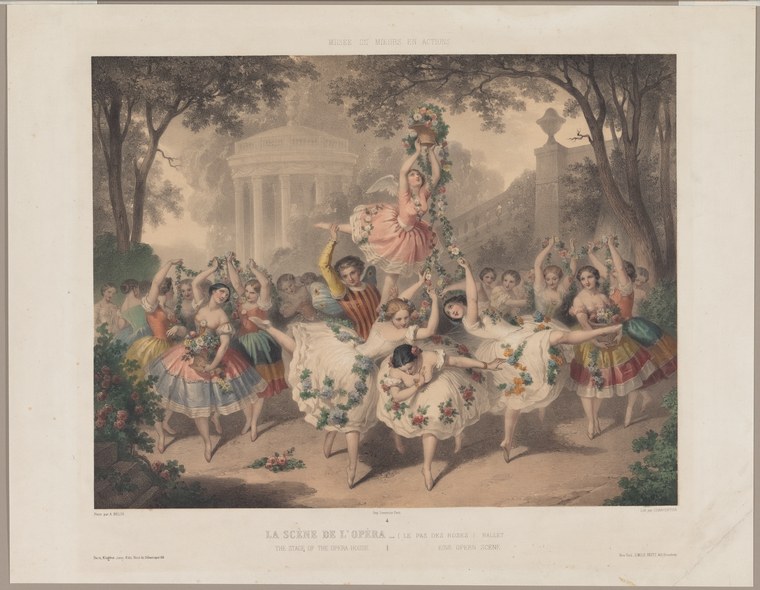
La scène de l'Opéra (Le pas des roses) ballet
Unknown artist
- Collection:
- Prints depicting dance
- Source:
- New York Public Library
- Rights:
- Public domain — free to use, share and adapt.
- Recorded as:
- Public Domain
Romantic ballet is known to modern viewers primarily through texts and photographs; visual records from the 1840s–1860s that document actual productions are rare. This print preserves the visual scale, costume, and scenic design of a celebrated pas as it was actually performed and marketed to audiences. For historians of nineteenth-century ballet, theatrical spectacle, and the evolution of the corps de ballet, such images are primary documents of what 'Romantic' looked like in practice.
What you are looking at
A grand outdoor fête unfolds before a classical pavilion in a sunlit garden. Twenty or more dancers in pastel silks and gauze—women in pink, pale yellow, and white; men in colored tunics and tights—arrange themselves in a loose group scattered across a cleared ground. They hold flower garlands aloft, their arms raised in celebratory gestures. In the center, two women in voluminous white skirts perform what may be the pas itself, their bodies angled toward one another. The whole scene is framed by tall shade trees; the pavilion's dome glows pale in the diffused light. The mood is one of Romantic pastoral—festive, outdoor, daylit, intimate in scale despite the crowd. There is no visible orchestra, though a performance is clearly underway.
The dancing
The dancers are posed with theatrical formality: many stand on one leg with the other raised or extended, arms lifted to frame garlands and wreaths of flowers, in attitudes suggesting accomplished technique. The two central figures in white maintain an implicit connection across the open ground. Posture is upright and elongated throughout. The arms are characteristically deployed in the Romantic manner—high, rounded, airy—and the drapery of the skirts suggests movement arrested mid-turn or mid-elevation. The visible footwork is minimal, but the overall carriage speaks to trained ballet dancers.
The dance depicted
This is almost certainly a scene from a Romantic-era ballet, most likely from the mid-nineteenth century. The title *La scène de l'Opéra (Le pas des roses)* indicates a 'scene from the Opera'—specifically the Rose Pas, a showpiece embedded in a larger work. The grouping, the garden setting, the flower imagery, and the technical poses all place this within the vocabulary of Romantic ballet as it was performed in Paris in the 1840s–1860s. Such spectacle scenes, with multiple dancers in coordinated but not rigidly synchronized tableaux, were typical of the grand divertissement or finales in operas and ballets of that era. No specific choreography can be read from a still image, but the pose and grouping suggest the classical vocabulary of pirouettes, elevations, and port de bras that defined the style.
How it was made
This is a hand-colored lithograph, as can be determined from the printing texture, the characteristic flattened perspective of lithographic prints, and the supplementary hand-coloring in pastels and watercolor that gives the figures their delicate tints. Lithography was the dominant medium for theatrical imagery in the mid-nineteenth century and reached a wide audience through commercial publication and sale. The technique allowed rapid reproduction of scenery and costume designs, and these prints circulated among theatre patrons, dancers, and collectors as records of celebrated performances. The hand-coloring here is skilled, with soft washes and careful preservation of the white paper for highlights, suggesting this was a premium commercial product.
About this work
A hand-colored lithographic record of a scene from a Romantic-era ballet or opera, likely French and datable to the mid-nineteenth century on stylistic grounds. The image documents a grand divertissement or finale involving multiple dancers in a formal garden setting, centered on a pas de deux or pas de trois performed to the music indicated by the title. This is the kind of theatrical ephemera that formed the primary visual record of ballet in the Romantic period—a print sold to audiences as a souvenir of performance, capturing not the actual movement but an idealized and compositionally harmonious vision of the stage. It belongs in a history of dance because it shows what Romantic spectacle looked like, how many bodies could be arranged on stage, how color and costume mattered, and how the individual pas was nested within a larger ensemble tradition.
How to look at it
Note the pyramid composition, with the pavilion as a distant focal point and the dancers arrayed in a loose, rising mass toward the viewer—a compositional strategy that conveyed both grandeur and intimacy. Observe how the two central figures in white, though at rest or in a formal pose, carry the viewer's eye: they are the pas, and the surrounding dancers are the supporting ensemble. The flower garlands are not incidental ornament but the subject itself—a *pas des roses* made visible. The elevated poses and the soft modeling of the bodies show how lithography could achieve painterly effects while remaining a reproductive medium; the hand-coloring is delicate enough to suggest movement without depicting it.
The artist
The artist is not recorded in the catalogue. The style and execution suggest a professional theatrical lithographer working in Paris during the mid-nineteenth century, when the production of colored ballet and opera prints was a specialized and competitive trade. The print shows technical competence in composition and color harmony, and the inscription indicates it was published as a commercial print for sale to theatre patrons.
The period
This work dates to the golden age of Romantic ballet in Paris, when the Opéra and smaller theatres mounted large ensemble spectacles that combined dance, decor, costume, and narrative into unified artistic statements. The divertissement—a self-contained scene of dancing often loosely tied to plot—became the expected vehicle for technical display and visual spectacle. Lithographic prints documenting these scenes became a standard mode of publicity and commemoration, allowing patrons who had seen the performance to own an image of it, and allowing those who had not to imagine it. The painting of theatrical scenes in oils was still common, but lithography's speed and reproducibility made it the dominant medium for dance documentation in this period.
Where it lives
This print is held in the New York Public Library's collection of prints depicting dance, where it is catalogued under the title *La scène de l'Opéra (Le pas des roses) ballet*. No accession number, artist attribution, or date of publication is recorded in the available metadata. It is one of many such theatrical prints acquired by the NYPL as visual documentation of performance history.
Dance in this work
Questions about this work
Is this a real scene from a real ballet?
Almost certainly yes. The specificity of the title, the professional printing, and the style all point to this being a documented scene from an actual Romantic-era ballet or opera, most likely performed in Paris between roughly 1840 and 1870. However, without further research into the NYPL's provenance records or nineteenth-century Paris theatre archives, the exact work, date, and theatre cannot be established from the image alone.
Who danced this?
Unknown. The print does not identify the dancers. However, a pas des roses grand enough to warrant a commercial print likely featured the star dancers of the company—the étoiles or prima ballerinas of the Opéra or a major Parisian theatre. Contemporary reviews or playbills might identify them, but that information is not visible in the image.
What does 'pas des roses' mean?
A pas is a structured dance for one or more dancers, often embedded in a longer work. *Pas des roses* translates as 'dance of the roses,' suggesting that the choreography or narrative involved flowers, which we can confirm from the garlands visible in the image. Such titled divertissements were standard in nineteenth-century ballet and opera.
Why is this a lithograph and not a painting?
Lithography was faster and cheaper to produce than oil painting, and could be hand-colored to approximate a painting's appearance. It allowed a theatre to create hundreds of saleable prints from a single scene in the weeks following a performance's premiere, while oil paintings were unique and expensive. For a commercial theatrical audience, lithography was the medium of record in this era.
More dance artwork





