49 works in this view — arrow keys or swipe to move between them.
Dance in Art
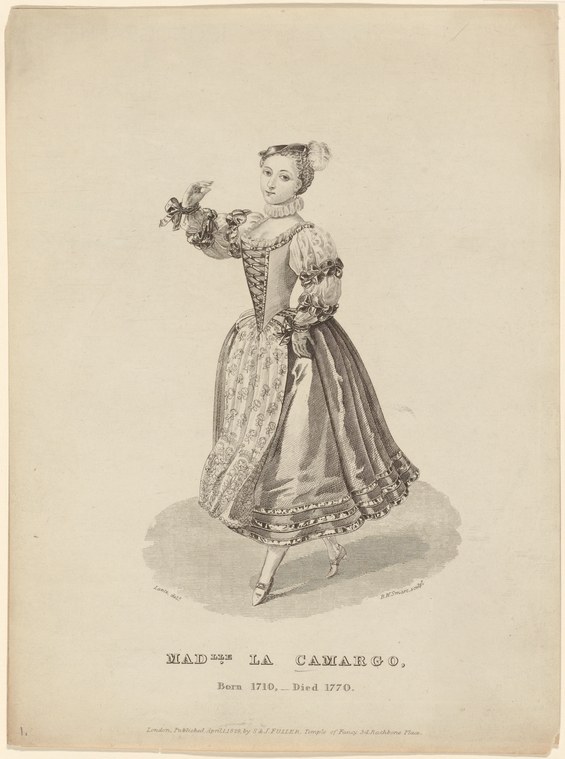
Madlle. La Camargo, born 1710, - died 1770
Unknown artist
- Collection:
- Prints depicting dance
- Source:
- New York Public Library
- Rights:
- Public domain — free to use, share and adapt.
- Recorded as:
- Public Domain
Camargo is a pivotal figure in the history of ballet: she expanded the technical vocabulary available to female dancers and challenged the prevailing aesthetic of the period, which valued the extension and grace of the torso and arms over the visibility of legwork. For historians and dancers, this portrait provides evidence of how early 18th-century ballet was dressed and presented to the public. For artists and printmakers, the work exemplifies the commercial portrait tradition that made performers famous and circulated their image across Europe.
What you are looking at
A single female dancer is shown in three-quarter view against a plain background, posed mid-performance in an attitude suggesting arrested motion. She wears an elaborate early 18th-century court costume: a richly patterned bodice with lacing, voluminous skirts with decorative hem details, and puffed sleeves gathered at the wrist. Her hair is pinned up in the fashion of the period. Her left arm is raised and extended gracefully to the side, holding what appears to be flowers or foliage, while her right arm hangs naturally. Her weight appears to be on her back leg, with the front leg extended in a balletic line, and she stands en relevé or on the balls of her feet. The figure is rendered with fine linear detail typical of 18th-century printmaking, with light shading to suggest volume and a soft shadow beneath her feet grounding her on the stage.
The dancing
The dancer stands in a refined, upright posture characteristic of court dance of the period. Her extended arm and lifted leg suggest a move from the vocabulary of theatrical dance—the position resembles an arabesque or attitude, though executed in the lighter, less turned-out style of early 18th-century performance. Her facial expression is composed and formal. The overall frame is open and linear rather than compact; there is no closed hold or partnering visible, and the emphasis is on the elegant line of the body and the extension of the limbs.
The dance depicted
This is a portrait of a professional dancer, almost certainly representing the style of French court dance and early theatrical ballet as it was performed in the 1730s–1750s. The dancer depicted is Marie-Anne de Cupis de Camargo (1710–1770), identified in the inscription. Camargo was a celebrated ballerina of the Opéra de Paris, renowned for her technical virtuosity, particularly her jumping and footwork—abilities that were then considered remarkable and unusual for female dancers. The costume and pose reflect the fashion of courtly ballet of the period, and the raised arm and extended leg echo the positions documented in later Romantic-era ballet technique, though the execution here appears lighter and less formally codified. The image does not depict an actual narrative moment but rather a portrait pose displaying the dancer's refined bearing and the elegance of her chosen art.
How it was made
This is an engraving, likely an intaglio print, rendered in fine lines with careful cross-hatching for tonal depth. The technique allowed for sharp detail in the costume and facial features, and the print would have been distributed to a wide audience—such portrait engravings of celebrated performers were popular in Paris and across Europe. The maker is not recorded in the catalogue, but the style and subject suggest a commercial publication from Paris, probably dating to within a decade or two of Camargo's death (1770). The inscription below the figure, in French, serves as a caption and suggests this was a formal commemorative or promotional print.
About this work
This is an engraved portrait of Marie-Anne de Cupis de Camargo, one of the most celebrated ballet dancers of the 18th century, shown in performance dress and pose. The work captures the aesthetic and technique of early theatrical ballet—a moment when dancing was beginning to evolve from courtly entertainment toward a distinct professional art form. Camargo's fame rested partly on her technical innovation: she was among the first women to perform jumps (petits allègements and grands allègements) and quick footwork on stage, and to wear a shortened skirt (to the knee) that revealed her feet and legs. This portrait preserves a visual record of her bearing and costume as they were understood by her contemporaries.
How to look at it
The viewer should attend to the dancer's feet and leg—they are pointed and extended in a way that emphasizes the technical sophistication of the pose. Note the delicacy of the arm gesture: it is not stiff or mannered, but appears to flow naturally from the extended position of the leg. The costume detail, particularly the shortened skirt and the articulation of the bodice, reflects the practical modifications Camargo made to show off her technical abilities. The neutral background and formal pose are typical of theatrical portrait engravings of the period and serve to isolate the dancer's body and bearing from any narrative context, allowing the viewer to focus on her beauty and technical skill.
The artist
The artist is not recorded. The print was published in London, as indicated in the imprint at the base of the plate, but the engraver's name does not appear. Portrait engravings of dancers and performers were a profitable commercial trade in London and Paris during the 18th century, and such works were often produced without attribution to the engraver, particularly if they were copies or adaptations of earlier designs. The style and finish suggest professional training and a publisher with access to a well-known subject.
The period
This portrait dates from the mid-18th century, a transformative moment for ballet. The period saw the transition from the heavily ornamented court dances of Louis XIV's era toward a lighter, more technically demanding theatrical form. Camargo's innovation—her introduction of visible, virtuosic footwork—coincided with broader aesthetic shifts toward speed, athleticism, and the display of the female body in motion. In printmaking, the circulation of theatrical portraits was at its height; such images were collected by the public and served both as souvenirs of live performance and as advertisements for the performers themselves. The inscription and commemorative nature of this portrait suggest it was issued after Camargo's death, or possibly near the end of her career, as a way of preserving her memory for audiences who might not have seen her perform.
Where it lives
This work is held in the Prints collection at the New York Public Library. The inscription identifies it as published in London ("London. Published [date and printer] by S.J. Fuller, Temple of Fancy, 34 Rathbone Place"), suggesting it was a commercial print circulated in Britain, likely based on a French original or a drawing made from life.
Dance in this work
Questions about this work
Who was Camargo?
Marie-Anne de Cupis de Camargo (1710–1770) was a French prima ballerina of the Opéra de Paris, renowned for her technical innovations. She was among the first female dancers to perform visible jumps and quick footwork on stage, and she wore a knee-length skirt rather than the full-length skirts of earlier dancers, making her feet and legs visible. She was celebrated across Europe and became a symbol of a new, more athletic style of dancing.
What is she doing in this portrait?
She is posed in a performance attitude—a refined, upright stance with one leg extended and one arm raised, holding flowers. It is not a depiction of an actual moment from a specific dance, but rather a formal portrait pose that displays her graceful bearing, the elegance of her costume, and the refined technique of 18th-century ballet. The flowers may refer to her as a muse of the dance or may simply be a conventional portrait accessory.
Why is this print important?
It is one of the few visual records of how a celebrated 18th-century ballerina looked on stage, how she dressed, and how she held her body. It also documents a pivotal moment in the history of dance, when women's dancing began to emphasize speed, elevation, and visible footwork. For art historians, it exemplifies the commercial print trade in theatrical portraiture that made performers famous across Europe.
Where does this print come from?
It was published in London, according to the imprint on the plate. The engraver is not named. Such prints were often based on French originals or earlier drawings and were reprinted in London for the British market. The work is now held in the New York Public Library's collections.
More dance artwork





