49 works in this view — arrow keys or swipe to move between them.
Dance in Art
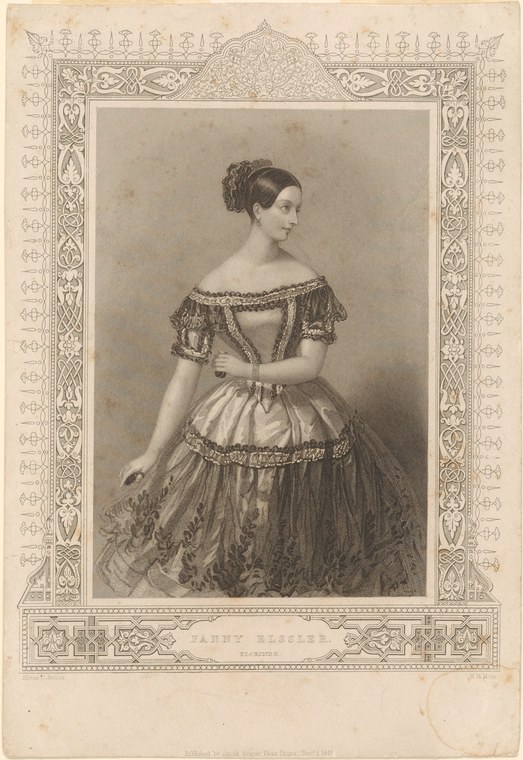
Fanny Elssler. Florinde
Unknown artist
- Collection:
- Prints depicting dance
- Source:
- New York Public Library
- Rights:
- Public domain — free to use, share and adapt.
- Recorded as:
- Public Domain
This image is crucial visual evidence of how Romantic ballet dancers were dressed, how they positioned their bodies, and how they were marketed to the public in the mid-nineteenth century. For historians of dance costume, the ornamental hem treatment and bodice construction are precisely documented; for those studying theatrical celebrity and fandom, the engraved portrait format reveals how a performer's image was commodified and circulated. The fact that this souvenir survives at all tells us that Florinde was a role of significance and that Elssler's fans considered the image worth preserving.
What you are looking at
A three-quarter-length portrait of a woman in theatrical dress, shown in profile facing left. She wears an off-shoulder Romantic-era costume with short puffed sleeves and a fitted bodice; the skirt is voluminous, gathered high at the waist, and decorated with a deep border of dark ornamental trim along the hem. Her dark hair is arranged in an elaborate upswept style typical of the 1840s, with ringlets and braids gathered at the crown. The figure is posed with one arm raised gracefully and the other at her side, suggesting arrested movement or a moment of choreographic stillness. The background is plain and neutral, focusing all attention on the costume and carriage of the body. An ornate decorative border frames the image—a hallmark of mid-nineteenth-century theatrical prints—with elaborate scrollwork and repeated motifs suggesting this is a formal souvenir of a stage performance.
The dancing
The dancer's posture is upright with a lifted, elongated line through the torso. Her raised arm extends with the elbow slightly bent, the hand positioned delicately at approximately shoulder height, suggesting the graceful port de bras characteristic of Romantic ballet. The weight appears centered and poised, with no visible strain, conveying the balletic ideal of effortless elevation. The off-shoulder neckline and the way the fabric drapes across the shoulders emphasize the openness of the upper body and the freedom of arm movement essential to the style.
The dance depicted
This is almost certainly a portrait of Fanny Elssler, one of the most celebrated ballerinas of the Romantic era (1810s–1840s), in the role of Florinde. The title suggests this is a specific character from a ballet, likely from a work created for or danced by Elssler in the 1830s–1840s. The costume and pose conform entirely to the visual grammar of Romantic ballet: the shallow skirt hemmed just below the knee, the off-shoulder bodice, the refined arm placement, and the overall silhouette that privileges the display of the dancer's line and carriage. The formal portrait genre—a theatrical souvenir—tells us this was a celebrated performance role significant enough to warrant commercial distribution to the public.
How it was made
This is a steel engraving or possibly a lithograph, recognizable from the fine parallel lines (hatching and cross-hatching) used to model form and create tonal gradations, and the crisp, linear quality of the frame and decorative border. The technique of engraving allowed for high-resolution reproduction and wide circulation; theatrical prints in this format were affordable enough for amateur collectors and fans to purchase, making them among the first mass-produced celebrity merchandise. The quality of execution and the ornate framing indicate this was a commercial theatrical souvenir of some prestige, aimed at the middle-class public who followed London and European stage productions.
About this work
This is a formal theatrical portrait print of a Romantic-era ballerina in character costume, frozen at a moment of poised grace rather than active motion. The work documents the visual codes of 1830s–1840s ballet: the distinctive silhouette, the refined carriage, the off-shoulder neckline, and the carefully posed arm that suggests movement without depicting it. As a steel engraving, it is a mass-produced souvenir designed to circulate among the theater-going public, preserving the memory of a celebrated stage role and allowing audiences to own an image of a star performer in a way no private sketch could achieve.
How to look at it
Notice the way the artist has frozen the figure at the moment of perfect stillness rather than mid-leap or mid-turn. This is the standard convention of Romantic ballet portraiture: the dancer is shown at maximum elegance and poise, not maximum exertion. Pay close attention to the costume details—the specific cut of the bodice, the height of the skirt, the border trim, the way the sleeve sits—as these are documentary evidence of how dancers actually dressed. The pose of the raised arm with its gentle, controlled curve is not a naturalistic gesture but a deliberately schooled one, reflecting years of training in the port de bras of ballet.
The period
The 1830s–1840s were the height of Romantic ballet in Europe. This was the era of Marie Taglioni, whose Sylphide (1832) established the aesthetic of weightlessness, ethereal femininity, and the pointe shoe as essential to the vocabulary of serious ballet. Fanny Elssler was Taglioni's great rival and represented a different branch of Romantic style: more earthed, more sensual, celebrated for her *cachucha* and Spanish dances. Theatrical prints in this period became a major form of celebrity distribution, paralleling the rise of lithography and steel engraving as commercial technologies. Prints of dancers were among the most popular theatrical souvenirs, and portrait engravings like this one made dancers' images available to the middle-class public in a way that had been impossible before.
Where it lives
This work is held in the New York Public Library's collection of prints depicting dance. It appears to be a mid-nineteenth-century theatrical souvenir print, one of thousands produced to meet the demand of opera house and ballet audiences for mementos of celebrated performances and favorite performers. The ornate border and high production quality suggest it was an upper-tier commercial print, likely sold at the theater or through print sellers.
Dance in this work
Questions about this work
Who was Fanny Elssler?
Elssler (1810–1884) was an Austrian-Italian ballerina and one of the two greatest dancers of the Romantic era, rivaling Marie Taglioni. She was celebrated for her technical virtuosity, her earthy sensuality, and her mastery of character dances, particularly the *cachucha*. She performed across Europe and America and was one of the first dancers to achieve international stardom and celebrity.
What is Florinde?
Florinde was a specific role or character in a ballet performed by Elssler, likely in the 1830s–1840s. Without access to a complete Elssler repertory, we cannot definitively identify the ballet, but the title suggests a romantic or pastoral character consistent with Romantic-era ballet themes.
Why was she shown off-shoulder?
The off-shoulder bodice was a standard feature of Romantic ballet costume, adopted from operatic and theatrical dress of the period. It displayed the upper body, shoulders, and arms—the primary means of expression in ballet—and evoked a classical or exotic aesthetic appropriate to the Romantic imagination of distant or mythical settings.
How do I know this is an engraving rather than a lithograph?
The fine hatching and cross-hatching visible throughout the image, the crisp lines of the border, and the overall linear quality are characteristic of steel or copper engraving. Lithographs typically have softer tonal transitions and a crayon-like quality. The technique is confirmed by the fineness of detail achievable in this print.
More dance artwork





