49 works in this view — arrow keys or swipe to move between them.
Dance in Art
Pauline Duvernay
Unknown artist
- Collection:
- Prints depicting dance
- Source:
- New York Public Library
- Rights:
- Public domain — free to use, share and adapt.
- Recorded as:
- Public Domain
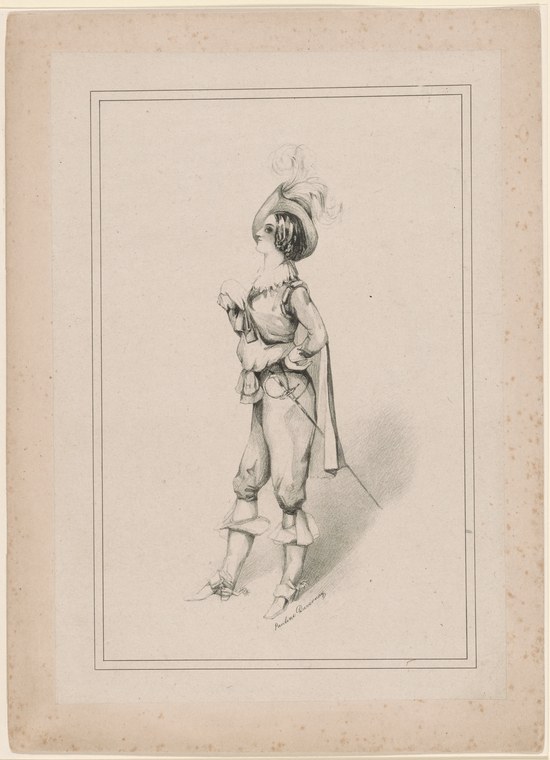
Pauline Duvernay was one of the great dancers of the Romantic era, and this portrait is a direct visual record of her appearance and the technical ideal of Romantic ballet. For dancers and historians, it provides rare documentary evidence of how a celebrated performer of that period embodied the aesthetic—the posture, the proportion of costume, the refined port de bras—that defined the style. It bridges the gap between written description and visual reality in a period before photography was common in theater.
What you are looking at
A single female dancer is shown in profile, standing on the balls of her feet in a poised, upright stance. She wears a classical Romantic-era ballet costume consisting of a fitted bodice with short sleeves, a knee-length skirt with horizontal pleats or flounces, and what appears to be tights or stockings. Her hair is styled in an elaborate upswept arrangement typical of the 1830s–1840s, gathered at the crown with decorative elements. Her arms are positioned gracefully, one raised and one lowered in a classical port de bras. The drawing employs fine pen and ink line work with subtle shading to model the figure's form and create depth, particularly in the shadow cast behind the figure. The composition is spare and elegant, focusing entirely on the dancer against a plain ground with a simple rectangular frame.
The dancing
The dancer stands in a classical ballet position with weight centered and lifted through the torso, rising onto the balls of her feet in what appears to be a relevé or similar elevation. Her port de bras is graceful and controlled, with one arm curved upward in a gentle arc and the other held lower, creating a harmonious line from fingertips through the extended leg. The posture demonstrates the upright carriage, elongated neck, and refined arm placement that define Romantic ballet technique. There is no partner; this is a portrait of a solo dancer.
The dance depicted
This is a portrait of Pauline Duvernay, a principal dancer of the Romantic ballet era, most likely from the 1830s–1840s. The image captures her in a characteristic pose that would have been recognizable to her contemporaries—a moment of poised readiness rather than dynamic action, which was standard in theatrical portraiture of this period. Duvernay was known for her technique and her roles in the Romantic ballet repertoire, and this drawing documents the precise classical vocabulary and costuming of that era. The costume, pose, and execution all align with Romantic ballet as performed in Paris and London during the height of that movement.
How it was made
This is an ink drawing, likely pen and ink with fine cross-hatching for shading. The technique is precise and controlled, characteristic of theatrical portraiture and costume studies made for publication or archival purposes. The clean line work and careful modeling of form suggest it was either drawn from life or from a well-observed memory or sketch. The simplicity of the composition and the professional execution indicate this was a formal portrait study, possibly intended for reproduction as a print or for a theater archive. The drawing style and presentation are consistent with early-to-mid-19th-century theatrical documentation.
About this work
This is a pen-and-ink portrait drawing of Pauline Duvernay, a major Romantic ballet dancer, shown in a classical ballet pose and costume of the 1830s–1840s. The work documents both the dancer herself and the precise visual vocabulary of Romantic-era ballet technique—the carriage, the arm placement, the silhouette created by the costume. It belongs in a dance archive not as a narrative scene but as a portrait of a celebrated performer at the height of the Romantic ballet movement, providing visual evidence of how the greatest dancers of that era stood, moved, and were dressed on stage. The drawing's clarity and economy make it an invaluable document of Romantic ballet practice and stardom.
How to look at it
Attend to the dancer's posture: notice how she rises through the body, elongating the spine and extending through the neck, and how her arms create continuous curved lines that express the refined port de bras of classical ballet. The costume details—the pleated skirt, the short sleeves, the hair arrangement—are all significant historical documents of how Romantic ballerinas were dressed and adorned. The artist has chosen a moment of stillness and composure rather than action, which was the convention for theatrical portraits; this pose would be recognizable to her contemporaries as the classical attitude of a great dancer at rest or between movements. The fine line work and careful shading demonstrate that this was a professional study, likely made to preserve a record of a celebrated performer.
The artist
The artist is not recorded in the catalogue. The execution and style are consistent with early-to-mid-19th-century theatrical portraiture, and the work may have been created by a theater artist, costume designer, or figure draftsperson whose name is not preserved. Such portrait studies were common in theater archives and were often not attributed in early catalogs.
The period
Pauline Duvernay danced during the height of the Romantic ballet movement (c. 1830–1850), an era that saw the rise of ethereal, pointe-work-based choreography and the cult of the ballerina as the central figure on stage. During this period, dancers were celebrated celebrities, and their likenesses were widely disseminated through prints, lithographs, and drawings. This drawing dates from that era and reflects both the technical refinement and the celebrity culture surrounding Romantic ballet. Theater portraiture of this period combined documentary precision with idealization, capturing both the dancer's likeness and the aesthetic values of the age.
Where it lives
The work is held in the New York Public Library's collection of prints depicting dance, part of the broader theater and performing arts holdings. It is catalogued by subject (Pauline Duvernay) rather than by artist, indicating that the dancer's identity and fame were its primary reference point for archivists.
Dance in this work
Questions about this work
Who was Pauline Duvernay?
Pauline Duvernay (c. 1811–1894) was a French dancer and one of the major stars of the Romantic ballet era. She danced leading roles in Paris and London during the 1830s and 1840s, including roles in significant works of the period. She was celebrated for her technique, beauty, and stage presence, and her name was a major draw for audiences during the height of Romantic ballet.
What does the pose tell us about Romantic ballet?
The upright carriage, the rise onto the balls of the feet, the graceful port de bras, and the refined upper-body placement all exemplify the aesthetic of Romantic ballet: an emphasis on lightness, elongation, and controlled elegance. The dancer appears poised and ethereal, embodying the values that defined the style and the era's fascination with the ballerina as an idealized figure.
Is this from life or a copy?
We cannot determine from the image alone whether the artist drew Duvernay directly or worked from another source. The technique and finish suggest professional execution, but the absence of artist attribution leaves this question open. It is clearly a formal portrait study, created with precision and care.
Why is this drawing in a dance collection?
This is both a portrait of a celebrated performer and a visual document of Romantic ballet technique and costume. It preserves evidence of how the dancers of that era moved, dressed, and were seen by their public—information that is otherwise available only through written description or later memory.
More dance artwork





