49 works in this view — arrow keys or swipe to move between them.
Dance in Art
Le bouquet de perles: Valses brillantes
Unknown artist
- Collection:
- Prints depicting dance
- Source:
- New York Public Library
- Rights:
- Public domain — free to use, share and adapt.
- Recorded as:
- Public Domain
This print documents a lost or obscure Romantic ballet and preserves the visual conventions of mid-nineteenth-century ballet aesthetics: the narrative logic of the supernatural female corps, the arabesque as the signature of classical ballet heroism, the tutu as the costume that made the female dancer's leg visible and virtuosic. For historians, it is evidence of how Romantic ballet was marketed to the public through lithography; for dancers, it is a record of the poses, framing, and aesthetic principles that defined the era.
What you are looking at
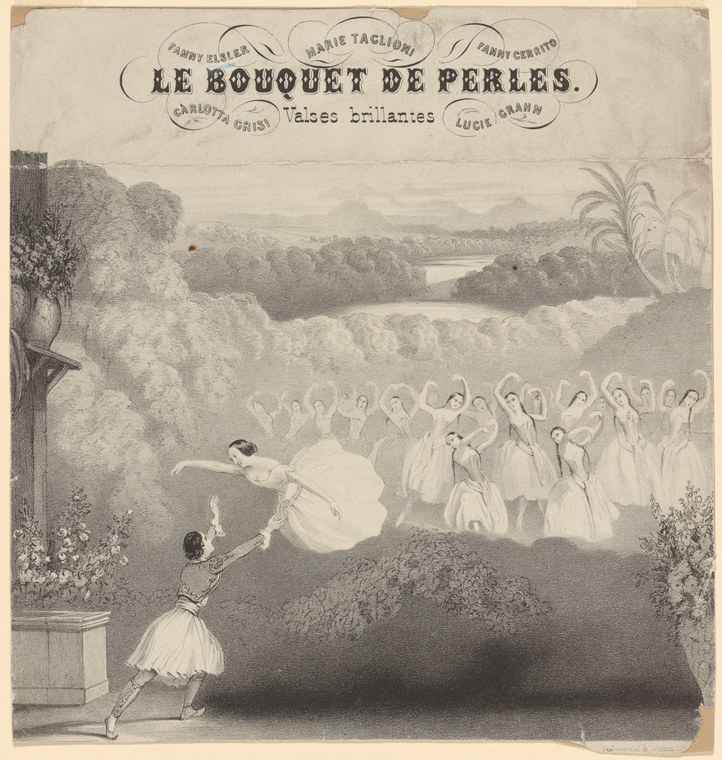
A moonlit garden scene from a nineteenth-century theatrical or ballet production. In the foreground, a solo female dancer in a flowing white romantic tutu lunges dramatically rightward, her body extended in a deep arabesque or attitude, her arms raised in classical port de bras. Behind her, a corps of female dancers in identical white tutus stands in a loose, staggered formation across the middle ground, many with raised arms in poses of wonder or reverence. The setting is a landscaped garden with rolling hills, scattered trees, and a body of water visible in the distance under moonlight. The composition uses deep perspective to emphasize the soloist's separation from the chorus. The print's aesthetic—the ethereal quality of the white figures against darker shaded areas, the romantic landscape, and the title's reference to pearls—suggests this depicts a famous scene from the Romantic ballet repertory, possibly a vision or supernatural encounter.
The dancing
The lead dancer demonstrates classical ballet technique: a fully extended leg in a high arabesque or attitude position, the standing leg straight and turned out, both arms raised in a graceful frame typical of mid-nineteenth-century academic ballet. Her torso leans forward in the direction of motion, creating a diagonal line through the body. The corps dancers behind her assume various poses—many with arms raised, some in profile, others facing forward—creating a layered, ethereal effect. All dancers wear the characteristic Romantic tutu: knee-length bell-shaped skirts, fitted bodices, and what appear to be pointe shoes or soft ballet slippers. The spacing and stillness suggest a moment of tableaux or ensemble response rather than synchronized traveling movement.
The dance depicted
This almost certainly depicts a scene from a Romantic-era ballet, most likely a famous ensemble vision or supernatural encounter. The visual language—the nocturnal garden, the corps de ballet as spirits or otherworldly presences, the soloist as protagonist—is characteristic of Romantic ballets from the 1830s-1850s such as *La Sylphide*, *Giselle*, or *Le Spectre de la Rose*. The title *Le Bouquet de Perles* ('The Pearl Necklace' or 'Bouquet of Pearls') with the subtitle 'Valses brillantes' ('Brilliant Waltzes') does not correspond to a widely known ballet in the standard repertory, suggesting this may document a now-forgotten work, a divertissement, or a scene from a larger production. The waltz—a popular ballroom and theatrical dance form of the period—was frequently incorporated into Romantic ballets as both a structural and narrative device.
How it was made
This is a lithograph, identifiable by its characteristic soft-edged linework, subtle tonal gradations, and the way light is rendered through varying densities of stone grain rather than through line alone. Lithography allowed for rapid, inexpensive reproduction and wide circulation—this work was clearly a theatrical souvenir or promotional image. The technique permitted the artist to create atmospheric effects (the moonlight, the misty quality of the corps) that engraving alone could not easily achieve. The names printed at the top—Fanny Elssler, Marie Taglioni, Fanny Cerrito, Lucie Grahn—are among the most celebrated ballerinas of the Romantic era, suggesting this lithograph was marketed to capitalize on their fame, whether or not they actually performed this specific work.
About this work
This is a lithographed souvenir from the Romantic ballet era, depicting a supernatural or vision scene featuring a lead ballerina and corps de ballet in a moonlit garden. The work captures the visual and narrative aesthetic of mid-nineteenth-century ballet: the ethereal corps as otherworldly beings, the soloist as the human protagonist encountering the magical, the setting as liminal (garden, moonlight, water). The title and attributed dancers suggest this was a commercial print meant to commemorate a performance or capitalise on the celebrity of famous Romantic-era ballerinas. As an object, it is a historical record of how ballet was visualised, marketed, and consumed in the nineteenth century—not a work of fine art, but a piece of popular theatrical culture.
How to look at it
Attend to the posture and extension of the lead dancer: the fully turned-out leg, the lifted chest, the arms held in a classical frame. This pose encapsulates what Romantic ballet audiences understood as beauty and virtuosity. Notice how the lithographic technique creates atmosphere through tone and shading rather than line—the moonlight, the misty distant landscape, the ethereal quality of the corps—all effects that photography and engraving could not easily replicate. The composition uses the raised arms of the corps to create vertical repetition and a sense of otherworldly strangeness. This was a commercial print designed to evoke the experience of the theatre for those who could not attend, or to commemorate a performance for those who did.
The artist
The artist is unknown. The lithograph was created in Paris (the artistic and commercial centre of ballet during this period) and credits four of the most celebrated ballerinas of the Romantic era in its header, suggesting it was produced by a publishing house specializing in theatrical and ballet imagery. The names—Elssler, Taglioni, Cerrito, Grahn—were among the most bankable names in European dance, and their appearance was a marketing tactic rather than necessarily a record of their actual involvement in the performance.
The period
The Romantic ballet (c. 1830–1860) placed emphasis on the female dancer, ethereal beauty, and supernatural or exotic narratives. The waltz, originally a controversial ballroom dance, had become fashionable in theatrical contexts by the 1840s–1850s. Lithography had recently become affordable and technically sophisticated enough to serve as a major medium for theatrical promotion. This print dates to the height of this era, when Paris was the centre of ballet innovation and European ballerinas toured extensively. The visual language of the corps as spirits or magical beings (as in *Giselle*, first danced in 1841) had become a standard narrative and aesthetic device.
Where it lives
The work comes from the New York Public Library's collection of prints depicting dance. It is a mass-produced lithograph, the type of object that circulated widely in the nineteenth century as a souvenir or promotional item. The catalogue record contains minimal information, suggesting it was acquired as part of a larger collection without detailed research.
Dance in this work
Questions about this work
Is this *Giselle* or *La Sylphide*?
Possibly, but the title *Le Bouquet de Perles* with the subtitle *Valses brillantes* does not match either of these canonical works. It may document a now-forgotten ballet, a divertissement within a larger production, or a retitled or misremembered work. Without additional documentation, the specific ballet cannot be confirmed.
Did Fanny Elssler or Marie Taglioni actually dance this?
The names at the top of the print are marketing devices. Lithograph publishers routinely printed the names of famous dancers whether or not they performed a specific work, to boost sales. There is no evidence that these particular dancers performed *Le Bouquet de Perles*.
What does the title mean?
*Le Bouquet de Perles* translates to 'The Bouquet (or Necklace) of Pearls'; the subtitle *Valses brillantes* means 'Brilliant Waltzes.' The title suggests the work may have featured a waltz or waltzes as a central structural or narrative element, common in Romantic-era ballets.
How was this print made?
This is a lithograph—a print created by drawing on a stone with a greasy crayon, then treating the stone with acid so that ink adheres to the drawn areas but not the undrawn ones. Lithography was cheaper and faster than engraving and allowed for softer, more atmospheric effects. This made it ideal for theatrical souvenirs and promotional images.
More dance artwork





