49 works in this view — arrow keys or swipe to move between them.
Dance in Art
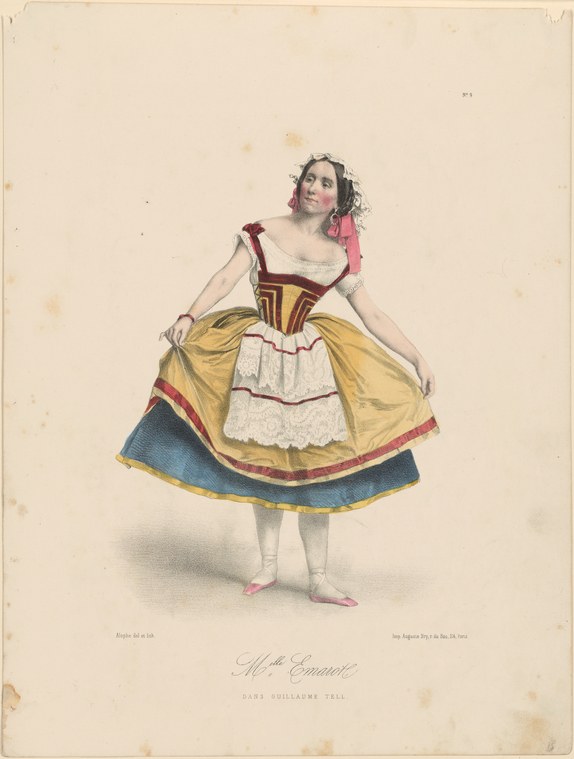
Melle Emarot dans Guillaume Tell
Unknown artist
- Collection:
- Prints depicting dance
- Source:
- New York Public Library
- Rights:
- Public domain — free to use, share and adapt.
- Recorded as:
- Public Domain
This work provides rare visual evidence of how Romantic-era ballet dancers actually dressed and moved in character roles, and records the career of a named performer whose stage work would otherwise leave no trace. It illustrates the division between classical and character dance in the 1840s–1850s and confirms that pointe work was integral to character roles, not reserved for classical variation alone.
What you are looking at
A young woman in elaborate mid-19th-century theatrical costume stands alone against a plain background, gazing upward with a wistful expression. She wears a corset-style bodice in deep burgundy with white trim, a white lace apron, and a full skirt layered in gold and blue with red ribbon banding at the hem. A pink ribbon is threaded through her dark hair. Her stance is relaxed but graceful, with her weight on one leg and her skirt lifted slightly at one side to reveal white stockings and pink ballet slippers. The composition isolates her as a portrait of a specific performer in a specific role, lit evenly from the front with subtle shading to suggest dimension.
The dancing
A single female figure stands in a three-quarter pose with weight shifted to her left leg, right leg slightly relaxed. Her arms hang naturally at her sides with hands visible and relaxed. She wears soft ballet pointe shoes and stands in a posture that suggests trained carriage—upright but not rigid, the torso aligned. Her gaze is directed upward and to the side, creating a moment of reverie rather than active movement. The pose suggests she is being observed between actions rather than mid-motion.
The dance depicted
This is a theatrical ballet dancer, almost certainly portraying a character role in a Romantic-era ballet. The costume—peasant-inspired with apron and full skirt, rather than a classical ballet tutu—and the upward gaze suggest a heroine in distress or longing, typical of narrative ballets from the 1830s–1860s. The identification as 'Melle Emarot dans Guillaume Tell' indicates this is a role in Auber's opera *Guillaume Tell* (William Tell), which was adapted for ballet and pantomime during this period. The soft pointe shoes, trained posture, and theatrical presentation of a named performer confirm this is a record of a specific dancer in a celebrated role rather than a generic dance scene.
How it was made
This is a hand-colored lithograph, identifiable from the printing technique visible in the stone texture, registration of colors (separate passes for gold, blue, red, and flesh tones), and the characteristic soft edges of lithographic line work. The inscription at the base indicates publication information, typical of theatrical star portraiture from the 1840s–1850s. Lithography's capacity for subtle tonal modeling and wide distribution made it the ideal medium for promoting named performers and specific roles to theater audiences and collectors. The hand-coloring suggests an impression of some value, meant for sale to admirers of the performer or patrons of the theater.
About this work
This is a lithographic portrait of a Romantic-era ballet dancer in character costume, dating to the mid-19th century. It documents both the visual culture of theatrical dance and the celebrity of the performer 'Melle Emarot,' whose name and role were marketable enough to warrant a colored print. The costume—a narrative character dress rather than classical ballet attire—and the pointe shoes reveal the evolution of ballet technique during the Romantic period, when trained dancers moved fluidly between classical and character roles. The image belongs to a large category of theatrical portraiture that circulated among dance enthusiasts and theater patrons, serving as both documentation and promotion of celebrated performances.
How to look at it
Notice the contrast between the trained posture—upright, centered, the weight carefully placed—and the costume detail of the full skirt and apron, which signal 'character' rather than classical ballet. Observe how the artist has rendered the pointe shoes prominently visible, confirming that even in character roles, the dancer was en pointe. The upward gaze and the relaxed but posed stance suggest a moment between actions: the artist has frozen a moment of characterization, not of virtuosity, presenting the dancer as an actress who also dances, rather than a dancer executing technique.
The artist
The artist is not recorded. The work is attributed to the publisher or printmaker information visible in the inscription, suggesting it was produced by a commercial lithographic workshop specializing in theatrical portraiture. Such portraits were typically made from life sketches or memory by studio artists working in high volume for theater audiences.
The period
This lithograph dates to the height of the Romantic ballet movement (c. 1830–1870), when narrative ballets drawn from European folklore and literature dominated the stage. Auber's *Guillaume Tell* premiered as an opera in 1829 and spawned ballet and pantomime adaptations; character roles like this one—the peasant heroine or displaced maiden—were central to Romantic ballet dramaturgy. During this period, named dancers were celebrities of the first order, and colored lithographs of them in costume were collected like theatrical cards or photographs today. The technical advances in lithography made such portraits affordable and widely distributed, creating a visual record of performance culture that would otherwise be lost.
Where it lives
The work is held in the Prints Collection of the New York Public Library. It is part of a series of hand-colored lithographic theatrical portraits, likely French in origin given the French inscription and the currency of such portraiture in Paris during the 1840s–1850s. It is catalogued as a dance-related print but lacks specific publication information.
Dance in this work
Questions about this work
Who was Melle Emarot?
Emarot was a dancer known for character roles in mid-19th-century European ballet and pantomime, including the stage adaptation of *Guillaume Tell*. No detailed biographical information survives beyond theatrical records and images such as this one. She was celebrated enough to have theatrical portraiture published in her name, indicating a successful career during the Romantic era.
Was *Guillaume Tell* a ballet or an opera?
Auber's *Guillaume Tell* premiered as a grand opera in Paris in 1829. However, the story was adapted for ballet and pantomime during the 19th century, and dancers like Emarot performed character roles within or alongside these productions. Theatrical works often crossed genres, and a single narrative could be presented as opera, ballet, or pantomime in different productions.
Why is she en pointe in a peasant costume?
During the Romantic era, pointe work was not limited to classical roles. Trained dancers used pointe technique in character ballets and narrative roles to elevate even 'common' characters into the realm of theatrical fantasy. Pointe shoes signaled a trained, professional dancer; the costume signaled the character and story.
What is a hand-colored lithograph?
A lithograph is printed from stone or metal using a chemical process that makes oil-based ink adhere to certain areas. Hand-coloring means an artist applied watercolor or gouache to the black-and-white print by hand after printing, allowing for precise color control and subtle effects. This was labor-intensive and reserved for higher-value prints meant for collectors.
More dance artwork





