49 works in this view — arrow keys or swipe to move between them.
Dance in Art
Miss Fairbrother
Unknown artist
- Collection:
- Prints depicting dance
- Source:
- New York Public Library
- Rights:
- Public domain — free to use, share and adapt.
- Recorded as:
- Public Domain
These lithographed 'Sketches at the Ballet' are among the most direct visual evidence we have of how Romantic ballet actually looked in performance—the silhouettes, proportions, poses, and props in real productions rather than idealized paintings. For a dancer or movement historian, they answer concrete questions: how high could dancers actually jump or extend? what was the typical weight distribution? how did the enormous skirts affect balance and line? The work also documents Miss Fairbrother, a performer now largely forgotten outside specialist literature, rescuing her from anonymity and anchoring her existence in popular theatrical culture.
What you are looking at
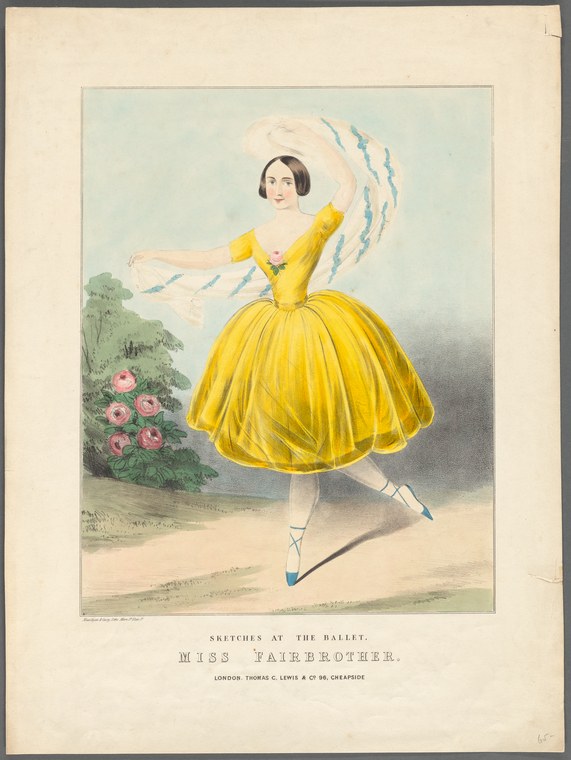
A young woman in a brilliant yellow ball gown stands in an outdoor setting, caught mid-motion in a graceful pose. She wears a fitted bodice with short sleeves and a massively full skirt with deep vertical pleats that create strong striations of light and shadow, emphasizing the volume and movement of the fabric. Her dark hair is crowned with a large white bonnet trimmed with blue ribbons that flutter behind her head, and she holds a matching parasol aloft in her right hand, its handle and canopy also adorned with blue. She stands on the balls of her feet with her left leg extended behind her in an attitude or arabesque, her body angled gracefully as if captured at the apex of a leap or sustained lift. A flowering shrub with pink roses sits at the lower left; the background is rendered in soft gray and blue tones suggesting sky and distance. The entire composition is contained within a decorative border, with the title and publisher information below.
The dancing
A single figure, a young female dancer, is poised on demi-pointe or relevé, her body weight concentrated on her right foot while her left leg extends behind her in a lifted arabesque position. Her torso inclines forward slightly, creating a clean line from her extended left leg through her spine and head. Her arms are raised and extended—the right arm lifts the parasol overhead while the left arm reaches across her body, both contributing to an overall sense of elevation and grace. The positioning suggests control, strength, and the balletic training characteristic of the Romantic era.
The dance depicted
This is a theatrical ballet figure, most likely from the Romantic period (1830s–1840s) when such imagery was commercially produced as 'Sketches at the Ballet'—a popular format for printed souvenirs and collectibles. The pose—extended leg, lifted weight, upright carriage—and the ethereal costume with its voluminous skirt, pale tones, and the emphasis on lightness and femininity are quintessential Romantic ballet aesthetics. The parasol, while unusual, functions as a prop that frames the body and emphasizes the dancer's line. The title identifies her as Miss Fairbrother, suggesting she was a known stage performer of the period, though nothing else appears in the inscription to specify which ballet this represents.
How it was made
This is a hand-colored lithograph, recognizable from the soft, luminous quality of the coloring—particularly the gradations in the yellow gown and the delicate handling of the gray-blue background. The lithographic process allowed for relatively rapid, affordable production of theatrical imagery, making these 'Sketches' accessible to a wide audience of ballet enthusiasts. The publisher Thomas McLean and others in London produced hundreds of such prints in the 1830s and 1840s, each capturing individual dancers or character types. The hand-coloring, executed with subtle gradation and attention to fabric texture, elevates the print above a simple reproduction and speaks to its circulation as a collectable item among middle-class theatregoers.
About this work
This hand-colored lithograph documents a celebrated moment from the Romantic ballet stage: a solo female dancer in the costume and pose that defined the era's aesthetic. It is neither a scene from a specific narrative ballet nor a character in dramatic action, but rather a portrait of a performer—Miss Fairbrother—presented in an idealized moment that showcases her technique and the ethereal beauty that Romantic ballet audiences craved. The image is one of a series of theatrical 'sketches' produced by London publishers as popular merchandise, capturing stars of the stage for admirers and collectors. The work is valuable as both a record of performance practice and a window into how dancers were marketed, celebrated, and consumed as public figures in the nineteenth century.
How to look at it
Attend first to the *pose*: this is not a moment of action or narrative but a held position—a perfect arabesque—frozen in time. It is the kind of pose a dancer would take at the end of a solo variation or at a moment of lyrical stillness, and the artist has chosen to capture it in its ideal state, with full extension and control. Notice the *parasol*: it is not merely a Romantic accessory but a compositional device that echoes the extended leg line and emphasizes the verticality and lift of the figure. Notice also the *footwork*—the raised heel and engaged foot suggest demi-pointe, the Romantic technique of dancing on the balls of the feet rather than in the turned-out, flat positions of classical ballet that would follow. The *expression* is calm and distant, not smiling at the audience: this is the Romantic convention of the ethereal, otherworldly dancer.
The artist
The artist is not recorded, which is typical for these commercially produced theatrical prints. The lithographs were printed and published by Thomas McLean of London (and others in the same enterprise), with designs by theatrical illustrators whose names often went uncredited. These were made-to-order mercantile products, designed to capitalize quickly on the fame of particular dancers and on the enormous popular appetite for ballet imagery in the 1830s–1840s. The relative anonymity of the artist is part of what makes these prints documentary rather than fine art—their value lies in what they show us about the stage, not in individual artistic vision.
The period
The 1830s–1840s were the height of the Romantic ballet era, when works like *La Sylphide* (1832) and *Giselle* (1841) established a new aesthetic centered on weightlessness, supernatural femininity, and poetic melancholy. Dancers rose higher on their toes, their costumes became lighter and more ethereal, and the ideal female body became one of ethereal grace rather than classical virtuosity. This shift in taste was reflected immediately in commercial merchandise: theatrical prints became one of the most popular art forms in London and Paris, outselling many 'fine art' prints. They served multiple functions—as souvenirs for theatregoers, promotional images for dancers and impresarios, and collectible portrait galleries. The emphasis on the individual named dancer (here, Miss Fairbrother) reflects the rise of the star system in early-nineteenth-century theatre.
Where it lives
This print is held in the New York Public Library's collection of prints depicting dance, part of its extensive holdings of theatrical imagery from the nineteenth century. It is catalogued as a lithograph by Thomas C. Lewis & Co., a London printer and publisher active in the theatrical print trade. The Library's collection includes hundreds of such 'Sketches at the Ballet' and similar theatrical portraits, many of them hand-colored originals, representing the major stars and character types of the Romantic and Victorian ballet stage.
Dance in this work
Questions about this work
Who was Miss Fairbrother?
Miss Fairbrother was a professional ballet dancer active in London during the 1830s–1840s, celebrated enough to warrant commercial prints in her image. Beyond her appearance in these theatrical sketches and in playbills, detailed biographical information is scarce in most readily available sources. She was one of many dancers of the Romantic era who achieved fame and popularity during their lifetime but whose legacies were often not systematically preserved in dance history.
What is she doing in this pose?
She is holding an arabesque—an extended leg position behind the body, with the supporting leg in relevé (on the balls of the feet). This is a moment of display and balance rather than motion, likely the kind of pose struck at the end of a solo variation or during a lyrical moment in a ballet. The parasol adds to the theatrical character of the moment, functioning as both a costume prop and a compositional element that extends her line.
Why are so many of these prints titled 'Sketches at the Ballet'?
The term 'sketch' signals that these are quick studies or portraits rather than elaborate narrative scenes—focused on the individual dancer and a characteristic pose rather than telling a story. The framing as 'sketches' also gave publishers artistic and commercial flexibility: they could be produced rapidly, in series, and marketed as collectible documentation of the stage. This format was hugely popular and profitable in the 1830s–1840s.
Is this a lithograph? How can you tell?
Yes, the printing technique appears to be lithography based on several clues: the characteristic soft, slightly granular texture of the stone surface, the way color has been applied in soft gradations rather than solid blocks, and the luminous quality of the hand-coloring. Lithography was the dominant technology for affordable color printing in this era and was the standard medium for theatrical prints.
More dance artwork





