38 works in this view — arrow keys or swipe to move between them.
Dance in Art
Red coat polka
Unknown artist
- Medium:
- Lithograph
- Dance:
- Polka
- Era:
- Late 1800s (Victorian Ballroom)
- Source:
- New York Public Library
- Rights:
- Public domain — free to use, share and adapt.
- Recorded as:
- public_domain
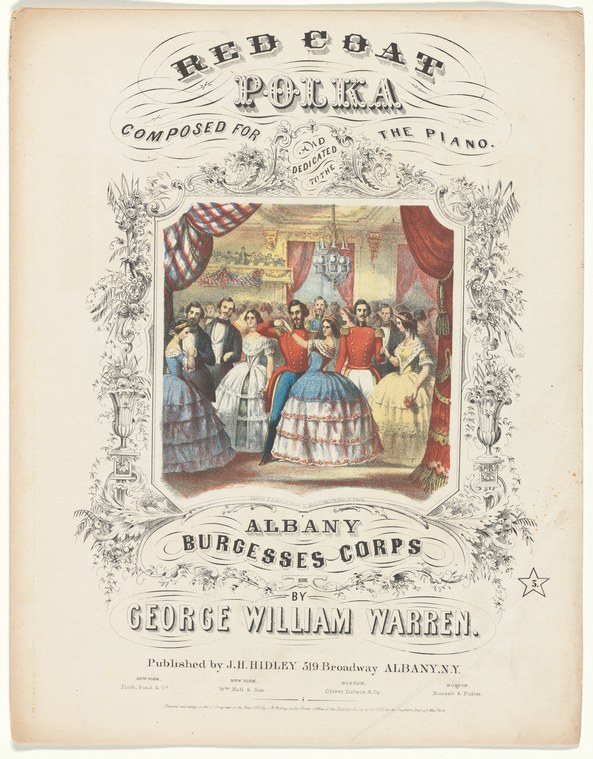
The polka was the most widespread and democratizing social dance of the nineteenth century, reaching far beyond court and aristocratic circles into middle-class and working-class ballrooms. This lithograph, published locally in Albany, shows us how the polka was actually danced and experienced: as a public event, a moment of exhibition, a focal point of civic celebration. For historians of dance and social life, such commercial prints are primary documents—they record popular practice with a directness that formal dance instruction manuals cannot match.
What you are looking at
A crowded indoor ballroom or assembly hall, rendered in hand-colored lithograph, captures a polka in full swing. The space is framed by elegant architectural elements—fluted pilasters and ornamental moldings—and hung with red and white drapery that frames the scene like a theatrical stage. At the center, a couple in close embrace mid-turn dominates the composition: the woman wears a voluminous white skirt with red trim or underskirt, caught in motion; the man wears a red coat (the "red coat" of the title), dark trousers, and has dark hair. Around them, arranged in depth, stand dozens of onlookers in formal dress—women in white gowns and bonnets, men in dark coats—creating a dense social crush. The figures recede toward a far wall where a military or civic gathering seems to be taking place. The lithograph's hand-coloring renders the woman's skirt with particular delicacy, the reds and whites suggesting the patriotic palette of the period.
The dancing
The central couple is locked in a closed ballroom hold, the woman's body tilted into a pronounced turn as her right leg extends, her skirt flying outward with the velocity of the movement. The man supports her weight with his left arm around her back, his posture upright but yielding to the rotation. The polka's characteristic hop-step action is implied in the woman's raised heel and the dynamic lean of both bodies. The surrounding figures are static or gently swaying, creating a sharp contrast that isolates the dancing couple as the focal point; this is a moment of exhibition within a social gathering.
The dance depicted
This is plainly a polka, one of the most fashionable social dances of the mid-to-late nineteenth century. The polka—a Bohemian couple dance in 2/4 time with a characteristic hop-step—swept European and American ballrooms from the 1840s onward and remained popular through the Victorian era. The image captures the energetic, playful spirit of the dance: the woman's skirt billows, the couple's bodies are animated and engaged with one another, and the social context of the ballroom (crowded with observers) emphasizes that polka-dancing was a public performance of courtship and social standing. The choice to title this "Red Coat Polka" and to feature that vivid garment suggests this may be an Albany militia or civic celebration, given the military uniforms visible in the background.
How it was made
This is a hand-colored lithograph, a reproductive printing technique that allowed rapid, affordable circulation of popular imagery. The work was printed from a stone (as indicated by the characteristic crayon marks and tonal washes visible in architectural elements and background), then colored by hand, likely in a workshop. Hand coloring gave lithographs a pictorial quality that engravings lacked, and the process was economical enough to allow mass production for the middle-class market. The publisher's imprint at bottom—"Published by J.H. Hidley, 359 Broadway, Albany, N.Y."—confirms this was a commercial product aimed at local or regional distribution, not a fine art print.
About this work
This is a cheerful commercial lithograph documenting a polka at what appears to be an Albany civic or military gathering, titled to feature the striking red military coat worn by the dancing man. The work belongs squarely in the Victorian ballroom tradition: it celebrates the polka at the height of its fashionable popularity, captures the dance's characteristic energy and the social context in which it was performed, and documents a specific regional celebration through the lens of a popular dance. The image is valuable precisely because it is unself-consciously documentary: it shows us not an idealized fantasy of the ballroom but a crowded, busy, genuinely social scene in which dancing is one activity among many—spectacle for those watching, pleasure for those in motion.
How to look at it
Attend first to the woman's skirt and the angle of her body: the artist has captured the exact moment of a sharp turn, when her weight shifts and her skirt swings outward. This is not a static pose but a kinetic instant, and the lithographer has used the swirl of fabric to suggest the speed and lightness of the movement. Notice how the central couple's dynamic energy is framed by the still figures around them—the polka was both a social dance and a display, meant to be watched. The red coat and white skirt create a visual focal point that guides the eye; the background's architectural formality and the crowd of onlookers remind us that this is a public, civic moment, not an intimate encounter.
The artist
The lithograph is credited to George William Warren, a name that appears on the title page. Warren is not recorded in the catalogue data beyond this attribution. His work as a lithographer was likely commercial—producing posters, sheet-music covers, and celebratory prints for local and regional distribution in upstate New York. The publisher, J.H. Hidley of Broadway, Albany, suggests a mid-nineteenth-century regional print business serving local commemorative and popular entertainment markets.
The period
The polka arrived in Europe from Bohemia in the 1830s and reached America by the 1840s, where it became the dominant ballroom dance for three decades. The dance's accessibility—it required no complex figures or courtly etiquette, only a willingness to hold one's partner and move with energy—made it revolutionary in a social sense. By the 1850s–1870s, lithographed sheet-music covers and dance prints featuring the polka were a staple of popular culture. This print sits at the intersection of two mid-nineteenth-century phenomena: the commercialization of dance through chromolithography and the celebration of civic and military events through public spectacle. The presence of military uniforms in the background suggests this commemorates an Albany militia gathering or similar patriotic occasion, and the polka—energetic, accessible, publicly performable—was the perfect vehicle for such entertainment.
Where it lives
The work is held by the New York Public Library. It is a commercially published lithograph, part of the NYPL's extensive collection of nineteenth-century American popular prints, sheet-music covers, and dance-related ephemera.
Dance in this work
Questions about this work
What is a polka and why was it so popular?
The polka is a Bohemian couple dance in 2/4 time with a characteristic hop-step rhythm. It arrived in European ballrooms in the 1830s and spread rapidly to America by the 1840s. Unlike earlier formal dances such as the quadrille or cotillion, the polka required no complex figures and little instruction—only a closed embrace and willingness to move energetically with one's partner. This accessibility made it revolutionary: it democratized ballroom dancing, allowing the middle and working classes to participate in fashionable dance culture.
How do we know this is a polka and not another dance?
The title explicitly identifies it as a polka. Visually, the closed couple-hold, the woman's characteristic turning motion with lifted heel, and the energetic forward momentum all accord with polka technique. The crowded ballroom setting is also typical of how polkas were performed and observed—as public, social events where spectators and dancers mingled in the same room.
Why does the military coat matter?
The title "Red Coat Polka" and the presence of military uniforms in the background suggest this commemorates a specific civic or militia celebration in Albany. Military dress balls and gatherings were common social events in the nineteenth century, and the polka was a standard entertainment. The red coat of the dancing man would have been eye-catching in the print and may have honored a particular officer or regiment.
What is a hand-colored lithograph?
A lithograph is a print made by drawing on a stone with a greasy crayon, then chemically treating the stone so that oil-based ink adheres to the drawn image and repels water from the blank areas. The image is then transferred to paper through a printing press. Hand-coloring means each print was colored afterward by hand, usually in a workshop, making it more affordable than fully painted artwork but more colorful than a plain black-and-white print. This combination made lithographs ideal for popular, commercial distribution.
More Polka artwork