49 works in this view — arrow keys or swipe to move between them.
Dance in Art
Le dieu et la bayadère: arranged for the piano forte
Unknown artist
- Collection:
- Prints depicting dance
- Source:
- New York Public Library
- Rights:
- Public domain — free to use, share and adapt.
- Recorded as:
- Public Domain
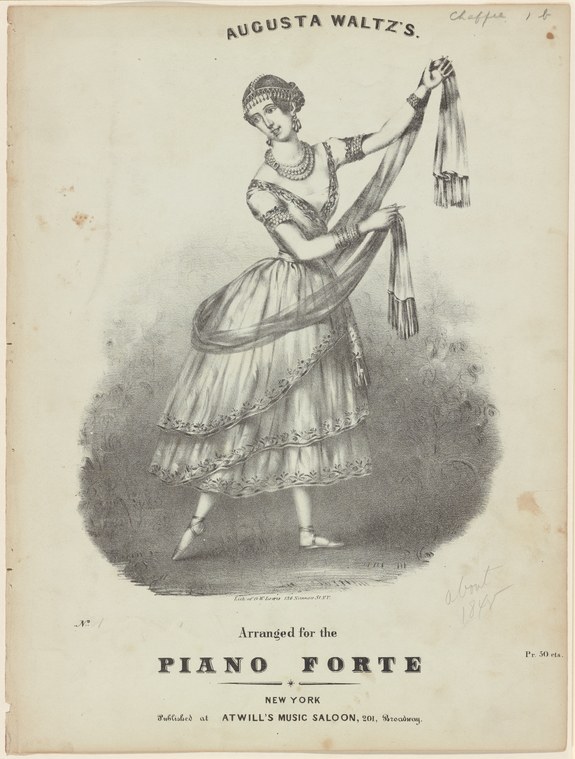
This work documents both the visual language of Romantic ballet and its circulation beyond the theater: the bayadere pose became a recognizable image type, and the music crossed from stage to parlor, democratizing access to theatrical dance culture. The print records an actual historical performance and its star, Augusta, making it valuable evidence for how Romantic ballet movement was codified and disseminated.
What you are looking at
A single female dancer dominates the composition, rendered in fine engraved line work against a neutral background. She wears a classical costume: a fitted bodice with decorative bands, a tiered skirt with scalloped hems and delicate embroidery, and a draped shawl or veil held aloft in her right hand. Her left arm curves gracefully across her body. She wears a small headdress or crown and stands en relevé on a single supporting leg, her free leg extended behind in an attitude. The figure is caught mid-movement, with the floating drapery suggesting swirl and momentum. The engraving technique creates soft modeling through fine parallel lines, giving the figure volume and a sense of elegant suspension. The work is titled as an arrangement for piano forte—indicating this was published as sheet music cover art.
The dancing
A single dancer in a classical pose with the body lifted and elongated. The supporting leg is straight and raised on the ball of the foot; the free leg extends behind in a graceful curve. The torso is held upright with one arm extended and the other drawn inward, creating a balanced, composed frame. The raised drapery in the extended hand breaks the classical symmetry with dynamic movement. The pose suggests training in the French or Italian academic tradition, with an emphasis on turnout, lift, and sustained line.
The dance depicted
This is most likely a Romantic-era theatrical dance, possibly from the famous ballet *Le Dieu et la Bayadère* (The God and the Bayadere), a vehicle for the celebrated dancer Augusta. The bayadere—a dancing girl of the Indian subcontinent—became a stock romantic figure in European ballet during the 1830s-1840s, embodying an exotic, sensual ideal. The pose and costume shown here are consistent with theatrical ballet of that period, though the engraving may conflate or simplify the actual choreography. The notation as a piano arrangement suggests this was marketed as a ballroom or drawing-room piece adapted from stage music, making it accessible to amateur musicians and dancing masters.
How it was made
This is a line engraving, rendered with fine burins to create the play of light and shade through parallel hatching. The technique allowed for precise detail in the costume and drapery while maintaining the tonal subtlety needed for a published print—a medium suited to mass reproduction. Engraving was the standard for high-quality music cover art and theatrical prints in the mid-19th century, suggesting this was a commercial publication by a publisher with access to skilled craftsmen. The legibility and finish indicate this was intended for a relatively affluent audience familiar with both ballet and music.
About this work
This is a music-cover engraving, likely from the 1830s or 1840s, promoting a piano arrangement of music from a Romantic-era ballet centered on the dancer Augusta and the character of the Bayadere. The image functions simultaneously as a theater advertisement, a musical commodity, and a record of stage costume and movement. It captures the aesthetic and social world of Romantic ballet—its exoticism, its celebration of female virtuosity, and its penetration into amateur musical and social practice. The engraving's precision and finish testify to the commercial value of dance culture at this historical moment: the image was worth the expense of fine engraving, and the arrangement was worth publishing for domestic performance.
How to look at it
Observe the precise moment the engraver chose: the dancer caught between positions, with the drapery still in flight. This is not a static pose but a comma of motion. Notice how the raised leg and extended arm create a diagonal line through the body, a compositional principle of Romantic ballet design. The floating shawl and the gentle curve of the extended leg convey an ideal of weightlessness and grace that was central to the period's aesthetic. The fine engraving technique allows you to see the detail of the costume—the scalloped hem, the embroidered bands—which would have been visible from the stage gallery.
The artist
The artist is not recorded. The engraver would have been a skilled commercial craftsman employed by the music publisher (Atwell's Music Saloon, New York). The engraving style and finish are consistent with mid-19th-century New York music-publishing practice, where imported and domestic talent produced high-quality theatrical prints for a growing market.
The period
The 1830s-1840s were the height of Romantic ballet in Europe and America. Exotic locations and characters—particularly the odalisque, sylph, and bayadere—dominated the repertory, offering European audiences a fantasy of otherness and sensuality coded as both desirable and morally safe within the frame of theatrical spectacle. Female dancers achieved unprecedented celebrity and financial value during this period. Simultaneously, the piano was becoming central to middle-class domestic life, and arrangements of famous theatrical music allowed amateurs to own and perform versions of stage works. Augusta's fame was sufficient to justify publication of this sheet music in New York, indicating the reach of the transatlantic ballet market.
Where it lives
The print is held by the New York Public Library in the collection of prints depicting dance. It was published by Atwell's Music Saloon in New York, a commercial music publisher, suggesting circulation in the American market among music teachers, amateur pianists, and theater enthusiasts. The presence of an accession notation indicates it entered the library's collection through donation or purchase.
Dance in this work
Questions about this work
Who was Augusta and why was she important?
Augusta was a celebrated dancer of the Romantic era, known for roles in exotic ballets, particularly the bayadere character type. Her fame was sufficient to justify publication of music tied to her performances, indicating she was a star performer whose name alone could sell sheet music. The exact details of her career are not provided by the image alone, but the high-quality engraving testifies to her commercial value.
What is a bayadere and why did Romantic ballet love this character?
A bayadere is a dancing girl of South Asia, but in Romantic ballet it became a stock exotic character representing sensuality, grace, and otherness. European audiences were fascinated by Asia as a realm of fantasy and desire, and the bayadere allowed choreographers to stage that fantasy in a form that was artistically respectable and sexually charged. The costume and pose here are designed to suggest both classical refinement and exotic allure.
Why would a piano arrangement of ballet music be published separately from the ballet itself?
Sheet music arrangements made theatrical music available to amateur musicians and ballroom dancers who could never attend the theater or were inspired by what they had seen. A music teacher or a gentleman pianist could purchase this engraving, study the poses shown, and learn the music, bringing the world of high theatrical culture into the home. It was a form of cultural diffusion and a significant revenue stream for music publishers.
More dance artwork





