49 works in this view — arrow keys or swipe to move between them.
Dance in Art
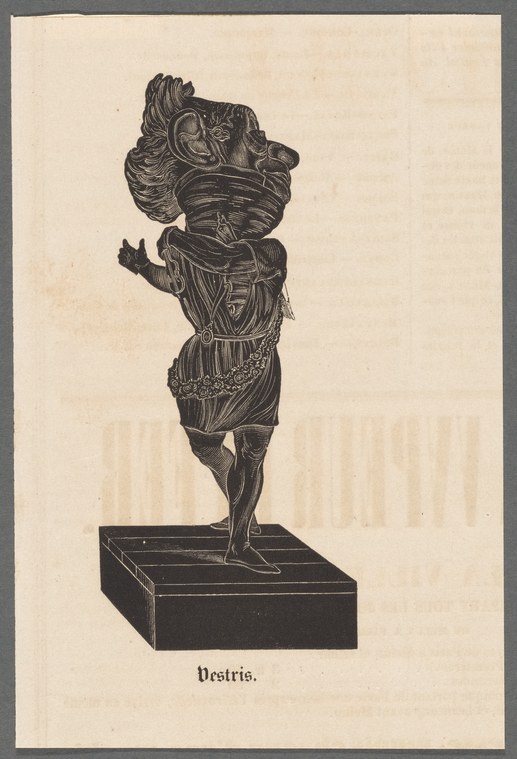
Vestris [depiction of a sculpture]
Unknown artist
- Collection:
- Prints depicting dance
- Source:
- New York Public Library
- Rights:
- Public domain — free to use, share and adapt.
- Recorded as:
- Public Domain
For historians of dance, this engraving documents how celebrated 18th-century dancers were visually memorialized—not as bodies in motion but as classical ideals. It shows the close alliance between neoclassical sculpture and theatrical performance during the era when ballet was establishing itself as a serious art form. The work is a rare surviving image of a canonical performer in a canonical role, offering insight into how professional dancers were understood, marketed, and remembered by their public.
What you are looking at
A standing male figure in classical dress is shown in three-quarter view against a plain cream background, mounted on a dark rectangular plinth. He wears a short, fringed skirt (pteruges) over fitted leggings and a decorated cuirass (breastplate), costume elements suggesting Greco-Roman or classical theatrical dress. His left arm is raised and extended outward in a gesture of address or presentation; his right arm hangs at his side. His head is turned slightly upward and to the left, and his abundant curled hair is styled in a period fashion. The figure's weight appears to be on his left leg, with the right leg slightly bent, creating a contrapposto stance. The entire composition is rendered as a black engraving on cream paper, with fine linear detail showing the texture of fabric, musculature, and ornamental details. The work is a sculptural study—a print after a three-dimensional sculpture rather than a direct representation of a dancer in motion.
The dancing
The single figure occupies the full height of the composition and stands in a classical contrapposto position that distributes weight asymmetrically. The raised left arm, with hand open and fingers extended, conveys oratorical or ceremonial address. The uplifted gaze and elevated arm create an impression of elevation or exaltation—the body is poised but not actively dancing. The sculptor has rendered the musculature with classical idealization, and the costume is historically informed but theatrical rather than documentary.
The dance depicted
This appears to be a print depicting a theatrical male dancer in the classical or neoclassical style—likely representing either a pantomime role or a heroic character from Greco-Roman drama as interpreted through 18th- or 19th-century theatrical convention. The name 'Vestris' suggests this is a portrait of a celebrated dancer, possibly Auguste Vestris (1760–1842) or another member of the Vestris family, who were dominant figures in European ballet and pantomime during the late 18th century. The costume and pose do not show active choreography but rather a heroic attitude—a moment of declaration or triumph. The figure is not mid-movement but rather posed as sculpture, suggesting this was a commemorative work celebrating a celebrated performer's role or reputation.
How it was made
This is a black engraving on paper, a reproductive medium that allowed wide circulation of theatrical portraiture in the 18th and 19th centuries. The technique is linear and detailed, with fine parallel lines (hatching) used to model form and create tonal depth. Engravings of this type were typically produced after sculptures, paintings, or drawings and served as affordable prints for sale to the theater-going public and collectors. The quality of the line work and the precision of the rendering suggest a professional engraver working from a well-known source, probably a sculpture or a painted portrait.
About this work
This engraving depicts a classical male figure in theatrical costume mounted on a plinth—a print after a sculpture commemorating a celebrated dancer, likely one of the Vestris family who dominated European theater in the late 18th century. The figure is posed in an attitude of classical heroism: weight shifted asymmetrically, left arm raised in a gesture of address, gaze lifted. It represents not a moment of choreography but a monument to a celebrated performer and the roles they embodied. The work belongs to a rich tradition of theatrical portraiture that celebrated dancers as sculptural ideals and recorded the visual memory of celebrated performances and performers.
How to look at it
The viewer should observe the classical contrapposto stance and the raised, oratorical arm gesture—conventions borrowed from ancient sculpture and Renaissance painting that were used to elevate the dancer's image to the status of classical hero. The slight upward tilt of the head and the direction of the gaze suggest aspiration or address to an invisible audience or deity. The rendering as sculpture rather than as a figure caught mid-choreography was deliberate: it memorializes the dancer as a timeless ideal rather than capturing transient movement. Note too the historical costume—the pteruges and cuirass—which suggest the dancer is shown in a specific famous role, probably a warrior or classical hero from pantomime or ballet d'action.
The period
This work dates from the era of neoclassicism in dance and the visual arts (roughly 1760–1830), when ballet emerged as a major theatrical genre and dancers achieved celebrity status. The Vestris family were among the first international dance superstars; Auguste Vestris was celebrated across Europe and commanded fees that rivaled those of opera singers. During this period, dancers were increasingly commemorated through engraved portraits, painted canvases, and sculptures, establishing visual conventions for representing heroic and idealized male dancers in classical dress. The costume and pose reflect Enlightenment ideals of beauty based on Greco-Roman antiquity, which dominated both neoclassical ballet and fine art.
Where it lives
This engraving is held in the New York Public Library's collection of prints depicting dance. It is part of a broader archival tradition of theatrical portraiture that documented the celebrity dancers and roles of the 18th and 19th centuries.
Dance in this work
Questions about this work
Who was Vestris?
The Vestris were a celebrated dynasty of dancers active in 18th- and 19th-century Europe. Auguste Vestris (1760–1842) was among the most famous male dancers of his era and danced across Europe, including at the Paris Opéra and London theaters. Members of the family were known for pantomime, ballet, and choreography. Without more specific documentation, this print may depict Auguste or another family member, but the inscription suggests it commemorates a specific celebrated performer.
Why is the figure shown in classical costume?
Neoclassicism dominated late 18th-century theatrical and visual culture. Dancers, especially male dancers playing heroic roles, were dressed in Greco-Roman costume inspired by ancient sculpture. This was part of a broader cultural movement to align modern performance and art with idealized antiquity. The costume signals both the dancer's status as a classical ideal and, possibly, a specific famous role he performed.
Is this an image of a real sculpture or an artistic invention?
The inscription 'Vestris' and the professional quality of the engraving suggest this was made after an actual sculpture or a well-known painted portrait of a celebrated dancer. Commemorative sculptures and painted portraits of famous performers were common in this era, and prints after them were widely sold. The three-dimensional rendering and the plinth base indicate the engraver was working from a sculptural source.
What does the raised arm mean?
The extended, open left arm is an oratorical or presentational gesture borrowed from classical sculpture and rhetorical tradition. It suggests address, declaration, or heroic exaltation—fitting for a celebrated male dancer shown in the guise of a classical warrior or hero. It is not an active dance position but rather a pose of authority and elevation.
More dance artwork





