49 works in this view — arrow keys or swipe to move between them.
Dance in Art
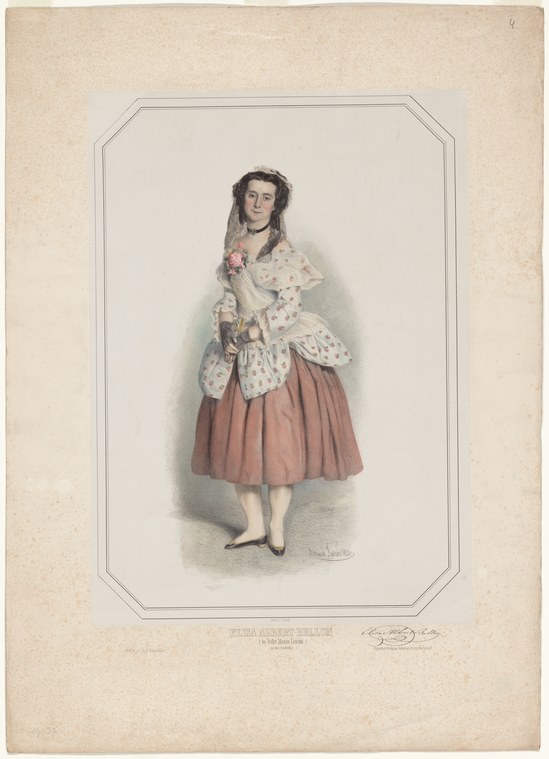
Elisa Albert Bellon im Ballet Manon Lescaut, in der Titelrolle
Unknown artist
- Collection:
- Prints depicting dance
- Source:
- New York Public Library
- Rights:
- Public domain — free to use, share and adapt.
- Recorded as:
- Public Domain
This is one of the few surviving images that document how Romantic ballet dancers were costumed and presented in the 1830s–1840s, a period from which moving images do not exist. It shows the precise detail of the white tulle bodice, the full skirt proportions, the floral accessories, and the theatrical mise-en-scène that defined the role. For historians and dancers studying Romantic ballet, this print is a primary record of the visual and material reality of performance.
What you are looking at
A young woman stands alone against a neutral background in a three-quarter pose, facing slightly toward the viewer's left. She wears a white fitted bodice with long sleeves and delicate spotted or patterned detailing, worn off the shoulders in the Romantic era fashion. The bodice is gathered at the waist and flows into a full skirt of soft terracotta or dusty rose, which falls to mid-calf and is rendered with careful gradation to suggest volume and movement. She holds a small bouquet of flowers in her right hand. A gauzy white veil or head covering, pinned with flowers, frames her dark hair. The figure is illuminated evenly from the front, creating soft shadows that model the form and fabric. The composition is a formal theatrical portrait, centered within a decorative octagonal frame, printed on cream paper with visible aging.
The dancing
The dancer is in a relaxed standing position with weight distributed evenly on both legs, positioned en face but rotated slightly to one side—a posture typical of theatrical portraiture rather than active dance. Her posture is upright but not rigidly formal; her arms hang naturally, one holding flowers. There is no indication of turnout, extension, or active balletic alignment. The pose captures a moment of stillness between movements or in character, the kind of presentation pose favored in mid-19th-century theatre portraiture.
The dance depicted
This is a theatrical portrait of a dancer in role as the heroine of *Manon Lescaut*, likely during the ballet's première or early production. The costume—the white Romantic-era bodice, full skirt, flowers, and veil—is consistent with the sentimental, tragic heroines of Romantic ballet (c. 1830–1860). The posture and presentation suggest a moment of character revelation rather than choreographic action. Without seeing active dancing, the work documents the visual language of mid-19th-century ballet through costume and theatrical staging rather than movement technique.
How it was made
This is a hand-colored lithographic print, characteristic of theatrical publicity and documentation from the 1830s–1840s. The artist (unrecorded in the catalogue) used soft gradations of color—pale blue-grays in the shadows, warm ochres and roses in the fabrics—to suggest dimensionality and the play of stage light. Lithography allowed rapid, affordable reproduction for distribution to theatregoers and collectors, making this the kind of souvenir that created the visual record of performers and roles before photography. The delicate hand-coloring suggests a mid-range theatrical print: not a cheap mass-produced item, but not a costly unique artwork either.
About this work
This hand-colored lithographic print documents Elisa Albert Bellon in the title role of *Manon Lescaut*, a work that likely dates to the 1830s–1840s based on costume and printing technique. It is a theatrical portrait in the format that dominated dance documentation before photography—a formal, posed image in character, designed for publicity and circulation among theatre audiences. The work is a primary source for understanding how Romantic ballet heroines were costumed, how dancers presented themselves to the public, and what visual language defined the tragic heroines of the era. It belongs in the Gallery of Dance in Art as evidence of how the Romantic ballet was created, marketed, and remembered through portraiture.
How to look at it
Observe the precision of the costume details: the spots or embroidery on the white bodice, the exact proportions of the full skirt, the arrangement of the veil and flowers. Notice that the pose is one of repose and character presentation rather than dynamic movement—this is how the role was imagined to be seen, not how it was danced. The soft hand-coloring, especially the subtle modeling of the fabric and the pale blue shadows, shows the care taken in theatrical portraiture of this quality. The octagonal frame and centered composition reflect the formality of theatrical documentation: this is not a candid image but a carefully composed artifact designed to preserve and publicize the performance.
The artist
The artist is not recorded. The print was published by a commercial theatrical print house, likely in Paris (where *Manon Lescaut* had its major productions) or possibly Berlin or Vienna. Mid-19th-century theatrical portraiture was a collaborative process: a performer sat for a sketch or was drawn from costume rehearsal, and a professional lithographer transferred the design to stone. The unrecorded artist was typical of the period—skilled but not individually credited, part of the machinery that produced hundreds of such images annually.
The period
By the 1830s–1840s, Romantic ballet was at its height in Europe. *Manon Lescaut* was adapted into several ballet versions during this period, with notable productions in Paris and across European capitals. The Romantic aesthetic emphasized ethereal, tragic heroines in gauzy white costumes, often playing young women of questionable virtue or social displacement—Manon fit the archetype perfectly. Lithographic portraiture of dancers had become a major industry by this time, following the success of images of Marie Taglioni and other stars. These prints were sold in theatre lobbies and by print sellers, creating a visual celebrity culture around individual dancers and roles.
Where it lives
The print is held in the New York Public Library's collection of theatrical prints depicting dance. The catalogue identifies it as a theatrical portrait but records no medium, date, artist, or edition information, which is typical for such works when their provenance in the collection is undocumented. It is a representative example of the mid-19th-century theatrical portraiture format that formed the primary visual record of Romantic ballet.
Dance in this work
Questions about this work
Was this drawn from life or from a costume sketch?
Almost certainly from a combination: the artist likely attended rehearsal or a performance, sketched the costume and pose, and may have worked from a costume fitting. The precision of detail and the posed, formal quality suggest a studio process rather than a quick life study. The artist was capturing the role and the costume as a complete visual statement, not the dynamism of performance.
How many versions of Manon Lescaut ballet existed?
Several ballet versions of the Abbé Prévost novel circulated in the 19th century. Without a recorded date or production attribution, this print cannot be definitively linked to a specific production. The costume style is consistent with productions from the 1830s–1850s across multiple European cities.
Who was Elisa Albert Bellon?
No information is recorded about this dancer beyond this portrait. She was likely a mid-rank or regional performer, notable enough to have her role documented in print but not celebrated enough to have left substantial biographical records. The theatrical print industry documented hundreds of such performers whose individual stories are now lost.
Why is the pose so still and formal?
Theatrical portraiture of this era privileged the visual presentation of costume, character, and beauty over the documentation of movement. The pose was designed to show the role as an image—the way audiences would remember the performer's appearance in the role—rather than to capture a moment of choreography.
More dance artwork





