49 works in this view — arrow keys or swipe to move between them.
Dance in Art
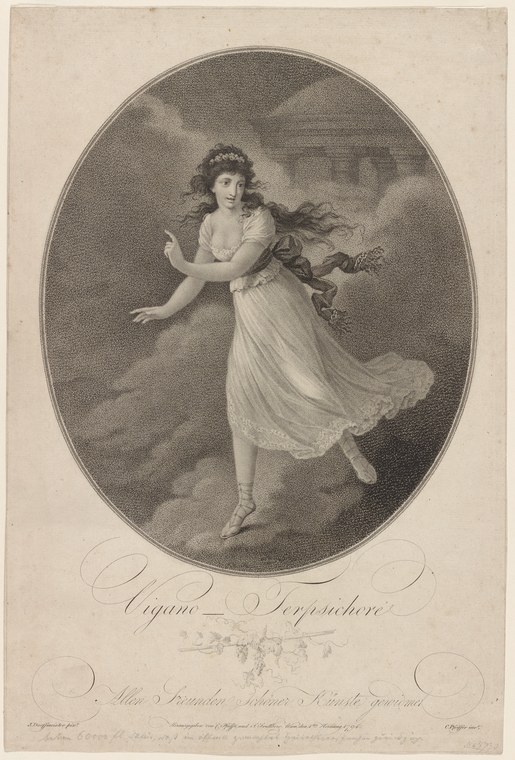
Vigano - Terpsichoré
Unknown artist
- Collection:
- Prints depicting dance
- Source:
- New York Public Library
- Rights:
- Public domain — free to use, share and adapt.
- Recorded as:
- Public Domain
This image captures the visual language through which Romantic ballet sold itself to its audience: the illusion of weightlessness, the association with classical culture, and the dancer as a conduit of something transcendent. For historians of dance technique and aesthetics, the pose reveals what artists understood—or imagined—about the balletic body in motion, and how the period valued the appearance of effortlessness over the display of technical virtuosity.
What you are looking at
A young woman in classical dress floats across a dark, atmospheric background in a moment of ethereal suspension. She wears a high-waisted white muslin gown with a low neckline, her dark hair crowned with a laurel wreath and streaming behind her. Her right arm extends outward in a gesture of abandon or invocation; her left arm curves across her torso. One leg extends behind her in a balletic line while the other appears to lift, her body tilted in a diagonal that suggests weightlessness. The composition is an oval vignette, a common format for neoclassical prints. At the base is a flowing script title and smaller text below. The darkness of the background throws the luminous figure into sharp relief, emphasizing the delicacy of her pose.
The dancing
A single female dancer caught in what appears to be a moment of airborne suspension or turning motion. Her body is in a strongly extended diagonal, with the supporting leg uncertain and both limbs participating in an upward or rotational impulse. The arm positions—one stretched outward, one drawn inward—create a spiraling, open frame rather than a closed balletic position. The pose suggests movement through space rather than a held position, with weight distributed ambiguously between the legs in a way that reads as momentary and dynamic. Her posture and the floating quality of the composition convey elevation and lightness rather than grounded technique.
The dance depicted
This is most likely a Romantic-era ballet imagery, possibly representing a specific character or mythological figure. The title references Terpsichore, the Muse of Dance in classical mythology, and the neoclassical styling (laurel wreath, muslin gown, classical drapery) suggests a heroic or allegorical subject common to late 18th and early 19th-century ballet. The floating, ethereal quality of the pose—with the apparent elevation and the emphasis on weightlessness—is consistent with the Romantic ballet ideal of the ballerina as a spiritual or supernatural being. The gesture and posture do not suggest a specific technical vocabulary so much as the aspiration toward defying gravity that characterizes Romantic ballet aesthetics. The work may document a role created by or for a particular dancer named Vigano, though the image alone does not confirm the choreography or performance context.
How it was made
This is an engraving or stipple engraving, evidenced by the tonal modeling achieved through dots and fine parallel lines rather than bold hatching. The technique was ideal for rendering the soft, atmospheric effects visible here—the gradual darkening of the background and the luminous quality of the figure's skin and drapery. Stipple engraving was a popular medium for theatrical portraiture and commemorative dance imagery in the late 18th and early 19th centuries because it could capture subtle gradations of light and the ethereal quality prized in Romantic ballet imagery. The print format and the oval vignette composition suggest this was a distributed image, likely a memento or promotional material associated with a dancer or production.
About this work
This engraving preserves an image of Romantic-era ballet in its visual ideals: a solitary female figure elevated, weightless, and rendered in classical costume. The work exemplifies the aesthetics of early 19th-century ballet through its emphasis on ethereality and its references to classical mythology via both the title and the iconography of the laurel wreath and muslin gown. The engraving format and oval frame mark it as a commemorative or promotional print, likely documenting a notable dancer or role. It belongs in a dance gallery as both a document of how choreography was visualized for audiences of the period and as evidence of the Romantic ballet's cultural elevation—transforming the dancer into a figure of myth and aspiration.
How to look at it
The artist has chosen to freeze the dancer in a moment of suspension or turning rather than in a grounded pose. Notice the diagonal tilt of the body and the ambiguity of which leg is supporting weight—this reading of movement as perpetual and dynamic rather than stationary is characteristic of Romantic aesthetics. Attend to the contrast between the luminous, delicate figure and the dark, almost mist-like background: the composition emphasizes the dancer as a vision or apparition rather than a performer on a stage. The oval vignette frames the figure as a medallion or cameo, elevating her to the status of a classical hero or deity.
The artist
The artist is not recorded in the catalogue. However, the engraving technique, the neoclassical styling, and the oval vignette format are consistent with commemorative dance prints produced in London and Paris in the late 18th and early 19th centuries by engravers including James Gillray, Thomas Rowlandson, and the Ackermann print workshops. The reference to Vigano in the title may indicate a connection to the Vigano family of dancers and choreographers prominent in European ballet during this period.
The period
This engraving dates stylistically to the transition between the late 18th and early 19th centuries, when ballet was undergoing a profound shift toward Romanticism. The neoclassical subject matter—the Muse of Dance, the laurel wreath, the mythological frame—reflects the period's deep engagement with classical antiquity as a source of artistic legitimacy. At the same time, the ethereal, floating quality of the pose anticipates the Romantic ballet of the 1830s and beyond, in which supernatural and otherworldly subject matter became dominant and the ballerina's apparent defiance of gravity became the central technical aspiration. This image sits at the threshold between Enlightenment rationality (the classical allusion, the allegorical clarity) and Romantic mysticism (the weightlessness, the emotional expressivity of the gesture).
Where it lives
This engraving is held in the New York Public Library's collection of prints depicting dance. It is an example of commemorative theatrical imagery and likely circulated as a memento or promotional material in the late 18th or early 19th century.
Dance in this work
Questions about this work
Who was Vigano and what does the title tell us?
The title references either a dancer or choreographer of the Vigano family, prominent in European ballet during the late 18th and early 19th centuries. The image is most likely a commemorative print honoring a specific performer or production, though the exact person and context cannot be confirmed from the visual evidence alone. The Viganos were known for their work in both ballet and pantomime.
Why is Terpsichore, the Muse of Dance, shown in this pose?
In the Romantic era, dancers were frequently cast as muses, nymphs, or supernatural beings to elevate the art form and suggest that performance transcended mere physical skill. The ethereal, weightless pose embodies the period's ideal of the ballerina as a creature of grace and spirit rather than earthly matter. The laurel wreath and classical drapery reinforce this mythological frame.
How can we tell this is ballet and not another dance form?
The costume—the high-waisted muslin gown, the bare feet, the classical styling—and the extended, balletic line of the extended leg are consistent with the ballet of the period. The floating pose and the emphasis on upward lift and weightlessness reflect ballet's technical and aesthetic priorities in the Romantic era. However, the image shows aspiration rather than execution, and does not depict a recognizable ballet step or position.
More dance artwork





