49 works in this view — arrow keys or swipe to move between them.
Dance in Art
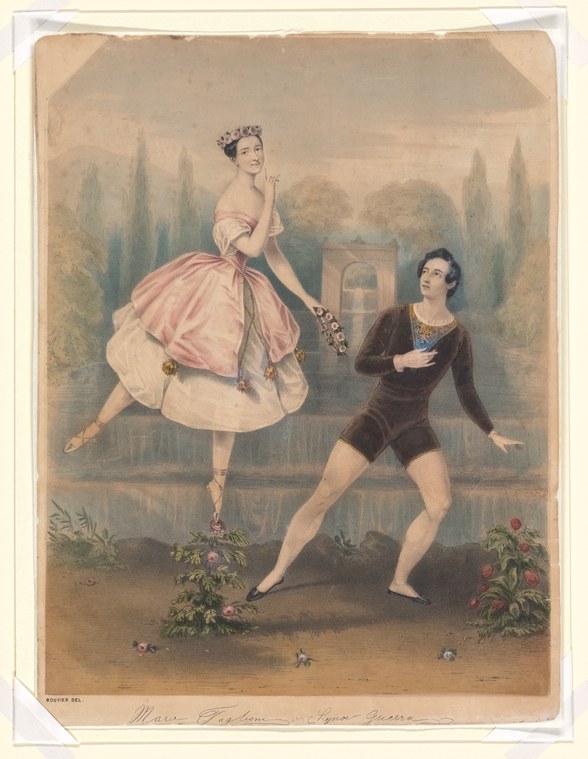
Marie Taglioni and Signor Guerra [facsimile signature]
Unknown artist
- Collection:
- Prints depicting dance
- Source:
- New York Public Library
- Rights:
- Public domain — free to use, share and adapt.
- Recorded as:
- Public Domain
Taglioni fundamentally changed what audiences expected from ballet technique and aesthetic, and this print captures the visual revolution she embodied. For historians, the image is documentary evidence of early-19th-century pointe work, port de bras, and the gendered roles of Romantic partnership. For dancers and choreographers, it remains a touchstone for understanding the technical ideals and visual grammar that Romantic ballet established and that still shape ballet training today.
What you are looking at
A theatrical pas de deux rendered in colored lithograph or hand-colored print, showing two dancers in a garden setting framed by tall cypress trees. The female dancer, identifiable as Marie Taglioni by the signature at bottom, wears a pink silk ball gown with a fitted white bodice and off-shoulder neckline, her hair crowned with flowers. She is caught mid-leap or elevation, her body arched and weightless, one leg extended behind her. Her male partner, labeled Signor Guerra, wears dark brown tights and a short dark tunic, positioned below and slightly behind her in an attitude of support or admiration. The background shows a formal garden with a stone archway or temple structure between the cypress trees, rendered in soft greens and blues that recede into atmospheric perspective. The foreground contains scattered flowers and plants in muted tones. The composition emphasizes the ethereal, impossible elevation of the female dancer—a visual signature of Romantic ballet.
The dancing
Taglioni is shown at the apex of a jump or sustained lift, her body achieving an arabesque-like extension with her supporting leg straight and her free leg bent behind her; her upper body arches backward in a line of extreme elegance. Guerra stands in a contrapposto stance with one leg bent, arms open in a gesture of presentation or wonder, his body oriented toward his partner. The spatial relationship suggests he is both partner and observer—supporting yet admiring. The extreme lift and the male dancer's gesturing arm position are consistent with the supported jumps and port de bras of early Romantic ballet.
The dance depicted
This is a scene from Romantic ballet, almost certainly depicting a moment from La Sylphide or another work in Taglioni's celebrated repertory. The image captures the essence of Romantic-era ballet technique: the female dancer elevated en l'air in an impossible, weightless pose that defies gravity, supported or presented by a male partner of secondary visual prominence. Taglioni (1804–1884) was the defining dancer of the Romantic movement, and this print documents the revolutionary technique and aesthetic—the pointe work, the ethereal port de corps, the sylph-like silhouette—that she popularized. The male dancer's role as supporter and admiring witness was central to Romantic ballet's gender dynamics.
How it was made
This is a hand-colored lithograph or colored engraving, likely produced as a theatrical souvenir print for circulation among audiences and the dance-going public. The technique allowed for rapid, relatively inexpensive reproduction and wide distribution—prints like this were sold at theaters and through print sellers across Europe. The soft, blended colors and the way light is modeled through tonal gradation are characteristic of color lithography of the 1830s–1850s. The artist has used the print medium to capture the theatrical lighting of the stage, the romantic garden backdrop, and the ethereal quality essential to selling Romantic ballet to its audience.
About this work
This is a commemorative theatrical print documenting Marie Taglioni in a pas de deux, almost certainly from La Sylphide or a similar work from the 1830s–1840s. It is a primary visual record of Romantic ballet at its peak—capturing not just the silhouette and costume of the era, but the specific technical achievement that made Taglioni legendary: her ability to appear weightless and otherworldly in sustained elevation. The print was created for public consumption, marketed to theater audiences as a memento of a transformative performance. It belongs in a dance archive as evidence of how Romantic ballet was understood and circulated during its own moment, and as proof of Taglioni's iconic status as the dancer who defined an era.
How to look at it
Pay attention to the moment the artist chose to freeze: not the beginning or end of a movement, but the apex—the split second when the dancer appears to defy gravity. This was the central technical and artistic goal of Romantic ballet, and the print captures it with precision. Notice also the garden setting with its cypress trees and temple—these signal the supernatural or dreamlike setting typical of Romantic ballet plots. The composition places Taglioni in the upper portion of the frame, making her appear to float above her partner and the ground, a compositional choice that reinforces the illusion of weightlessness. The soft color palette and the atmospheric recession of the background are the print medium's way of creating stage lighting and theatrical atmosphere on paper.
The artist
The artist is not recorded. The print bears a facsimile signature of either Taglioni or the publisher, but this does not identify the printmaker or lithographer. Prints of this type were typically produced by commercial theatrical print publishers in London, Paris, or Berlin, often designed by theater illustrators who worked from life drawings or from performances. The style and the presence of the facsimile signature suggest a professional theatrical print house, possibly in London where Taglioni was enormously popular.
The period
This print dates to the height of the Romantic movement in ballet, roughly 1830–1850. During this period, ballet underwent a radical aesthetic shift away from the classical court dance aesthetic toward a new emphasis on the ethereal, the supernatural, and the melancholic—genres that demanded new technical possibilities, especially sustained elevation and the illusion of weightlessness. Taglioni's perfection of pointe technique and her ability to make the impossible seem effortless made her the model for this new aesthetic. Simultaneously, prints and lithographs became the primary medium through which the theater public encountered and remembered performances, especially before photography. Colored prints like this one were mass-produced souvenirs, marketing tools, and documents all at once.
Where it lives
This is a hand-colored print held in the New York Public Library's collections of prints depicting dance. It is part of the documentary archive of theatrical dance in the 19th century, preserved as evidence of performance, publicity, and the visual culture of the stage.
Dance in this work
Questions about this work
Is this a realistic depiction of how Taglioni actually danced?
In its idealization, no—the extreme lift and weightlessness are heightened for dramatic and commercial effect, as was standard in theatrical prints. However, contemporary accounts and surviving film documentation confirm that Taglioni did achieve extraordinary elevation and sustained jumps that seemed impossible to audiences. The print captures the visual essence and effect of her technique, even if it exaggerates slightly. It is a document of how she was perceived and remembered.
Why is the male dancer so much less prominent?
This reflects the central gender dynamic of Romantic ballet: the male dancer's role was to support, present, and admire the female dancer, who was the focus and the vehicle for the supernatural or ethereal narrative. The male dancer's secondary visual position in the composition is not accidental—it expresses the choreographic and aesthetic priorities of the era.
What is Signor Guerra doing with his arms?
He is in a gesture of presentation or wondering admiration, a classic balletic port de bras. His open arms and upward gaze frame and honor his partner's leap. This pose was typical for male dancers supporting or partnering with the ballerina in a lift or solo moment.
How do we know this is Marie Taglioni?
The signature at the bottom of the print identifies her by name. The costume—the characteristic Romantic tutu, the pointe shoes, the ethereal silhouette—and the presence of a male partner also confirm that this depicts a professional ballet scene from the Romantic repertory, not a social dance. Taglioni was the most celebrated dancer of this type in the 1830s–1850s.
More dance artwork





