39 works in this view — arrow keys or swipe to move between them.
Dance in Art · 1624
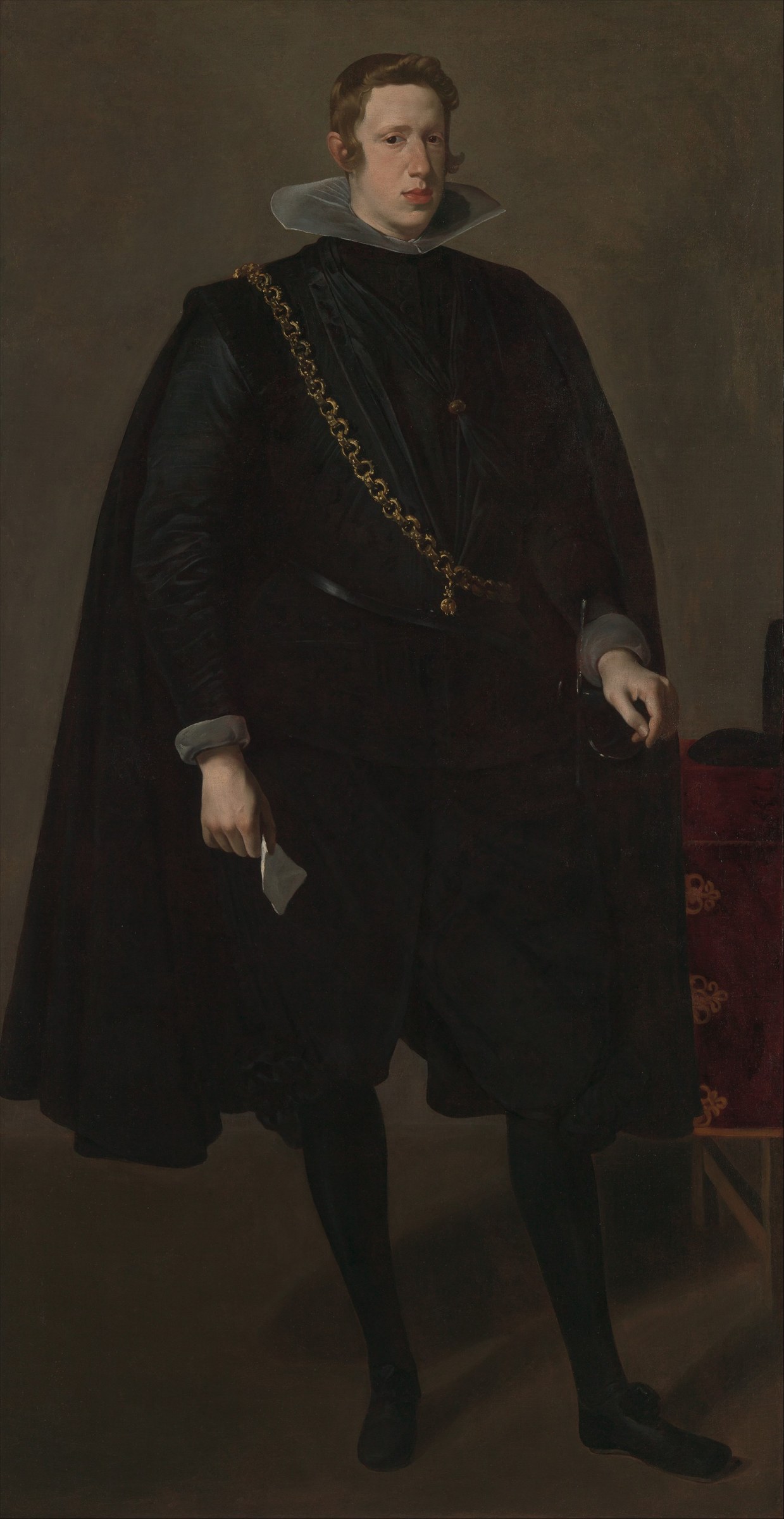
Philip IV (1605–1665), King of Spain
Velázquez (Diego Rodríguez de Silva y Velázquez)
- Medium:
- Oil on canvas
- Collection:
- European Paintings
- Source:
- The Metropolitan Museum of Art
- Rights:
- Public domain — free to use, share and adapt.
- Recorded as:
- public_domain
This work does not depict dance and should not be included in a gallery dedicated to dance in art. Its presence would dilute the collection's focus and mislead users searching for visual evidence of how dance was actually performed or choreographed.
What you are looking at
A young man stands alone in three-quarter view against a neutral brownish ground, turned slightly to his left. He wears the formal court dress of early 17th-century Spain: a floor-length black cape or cloak draped from his shoulders, a black doublet with fine detailing, and black hose. A white linen collar and white cuffs at the wrists provide sharp contrast. A heavy gold chain crosses his chest diagonally. His posture is upright and composed, his gaze directed away from the viewer. His right hand holds a small document or folded paper; his left arm hangs at his side. The painting is spare and frontal—no architectural setting, no companions, no narrative. The figure dominates the composition, rendered with the precise, cool realism characteristic of court portraiture. A corner of red fabric, perhaps a cushion or garment, appears at the lower right edge.
The dancing
The figure stands in a relaxed contrapposto, his weight evenly distributed, with no suggestion of active movement. His arms hang naturally, without the tension or positioning that would indicate any form of dance. His posture is formal and stationary—the bearing of someone being presented or recorded, not moving through space. There is no partner, no pair, no group. The body language is one of stillness and observation, not participation in motion.
The dance depicted
This is not a depiction of dance. The image is a formal court portrait of a nobleman, rendered with the visual conventions of official portraiture rather than the choreographic or narrative conventions of dance imagery. There is no movement, no musical setting, no group formation, and no gesture that suggests any dance genre. The figure is posed for commemoration, not captured mid-movement.
How it was made
Oil on canvas, in the restrained and penetrating manner of Velázquez's court portraiture. The technique involved careful underpainting, fine glazing, and precise rendering of textile surfaces to convey the weight and sheen of velvet, linen, and silk. The neutral background—a compositional device common in court portraiture—focuses all attention on the figure's presence and costume. Such paintings were prestigious commissions displayed in royal chambers and served as records of rank and relationship to the crown.
About this work
This is a formal court portrait, not a dance image. It records the appearance and status of a Spanish nobleman through the conventions of Early Modern portraiture: precise costume detail, upright posture, and isolation against a neutral ground. While dress and setting are historically important for understanding the court culture in which dance occurred, the portrait itself depicts neither dancers nor dance. Its inclusion in a gallery of dance in art would require either misidentification of the subject or a curatorial argument that court portraiture is part of the visual context of court dance—a contextual rather than direct relationship.
How to look at it
Attend to the precision of the costume—the weave of the fabric, the drape of the cape, the fall of the hose—which reveals Velázquez's technical mastery and the expense of royal dress. Notice the figure's frontality and stillness, which are the formal opposite of the dynamism and mobility required by dance. The portrait is designed to be apprehended in a single, sustained gaze, not read as a moment within motion.
The artist
Diego Rodríguez de Silva y Velázquez (1599–1660) was the leading court painter of Philip IV of Spain and one of the most technically accomplished portrait painters in European history. He served as Painter to the King and held a position of unusual influence at court. His portraiture combined unflinching realism with formal restraint, setting a standard for court representation that influenced European painting for centuries. He rarely depicted movement or narrative action; his genius lay in rendering presence, texture, and psychological stillness.
The period
The early 17th century was a period of extraordinary courtly display and dance in Spain and across Europe. Court dances—pavanes, galliards, allemandes, and the newly fashionable forms from Italy—were central to ceremonial life and courtship. Yet portraiture and dance imagery occupied different visual registers. Portraits documented appearance and status; dance imagery, when it occurred, appeared in prints, manuscript illustrations, and occasional paintings of festive or narrative scenes. This portrait belongs to the genre of isolated figure portraiture, a distinct tradition from dance documentation.
Where it lives
The work is held in the European Paintings collection of The Metropolitan Museum of Art in New York. It is a formal oil portrait from the holdings of a major encyclopedic museum.
Questions about this work
Why is this portrait in a gallery of dance in art?
It should not be. The work is a formal court portrait with no dance content. While the costume and setting document the courtly world in which dance was practiced, the painting itself depicts a stationary figure in repose, not a dancer or dancing scene. If it appears in this collection, it may represent either a cataloguing error or a curatorial decision to include contextual material on court culture—a choice that should be made explicit.
Could the figure's pose suggest any dance position?
No. The figure's weight is evenly distributed, his arms are at rest, and his body shows none of the tension, asymmetry, or readiness for motion that characterises even a paused moment in dance. The pose is the conventional formal stance of court portraiture, designed to convey authority and presence rather than movement or musicality.
What does the costume tell us about court dance of this period?
The black velvet cape, doublet, and hose document the formal dress worn at the Spanish court in the 1620s. Court dances of this era were performed in such garments—heavy fabrics that required control and grace in motion. However, a portrait alone cannot show how such dress moved or constrained movement; that would require either a dance scene or multiple figures in action.
More dance artwork