49 works in this view — arrow keys or swipe to move between them.
Dance in Art
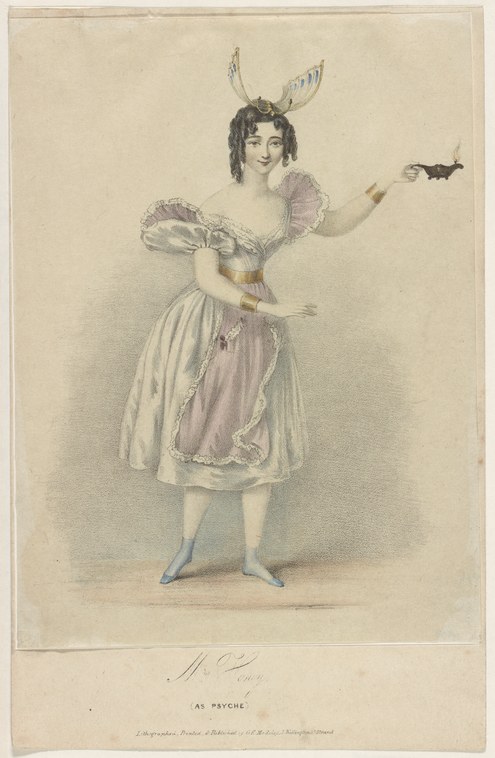
Mrs. Honey (as Psyche)
Unknown artist
- Collection:
- Prints depicting dance
- Source:
- New York Public Library
- Rights:
- Public domain — free to use, share and adapt.
- Recorded as:
- Public Domain
This image is a primary document of romantic ballet aesthetics and the visual culture of professional dance in the nineteenth century. It shows how a celebrated role was costumed, posed, and marketed to audiences, and preserves a moment of theatrical practice that exists now only in such prints and written descriptions. For anyone studying the history of ballet, romantic-era performance conventions, or the role of portraiture in dance history, this work is essential evidence.
What you are looking at
A young woman in theatrical dress stands alone against a neutral background, posed in a moment of graceful suspension. She wears a pale lavender or mauve dress with short puffed sleeves and a fitted bodice, its skirt caught mid-movement in billowing folds that suggest a spinning or turning gesture. The dress is trimmed with darker ribbon or ruching at the neckline and sleeves. She wears pale stockings and pointed shoes. Most striking is her elaborate headdress: a tall ornament with upright feathered or wing-like elements that frame her head, evoking mythological imagery. Her posture is upright and elegant, with one arm extended outward in a graceful arc and the other positioned at her side or torso. A small dark object—possibly a butterfly or prop—hovers in the space near her extended hand. The figure is rendered in soft tones of grey, pink, and lavender, with delicate shading that suggests dimensionality and movement frozen at a precise moment.
The dancing
The single dancer is shown at full length in a pose that combines stillness with the visual suggestion of motion. Her weight appears evenly distributed, with the body held in an upright, balletic alignment. The extended arm curves gracefully outward at approximately shoulder height, the wrist soft and the hand open—a vocabulary of classical feminine grace. The pose suggests rotation or the moment between steps, the billowing skirt serving as evidence of recent or imminent movement. There is no partnering; the dancer is presented as a soloist commanding the entire pictorial space.
The dance depicted
The image almost certainly depicts theatrical ballet of the early nineteenth century, specifically a romantic-era solo. The title references Psyche, the mythological figure from Ovid whose story was a common subject for ballet d'action of the period. The costume, headdress, and pose align with romantic ballet conventions: the light, ethereal dress; the delicate pointed shoes; the emphasis on feminine grace and otherworldly quality suggested by the wing headdress. The absence of a male partner and the focus on the soloist's emotional or narrative gesture indicate this is likely a moment from a theatrical narrative ballet rather than social dance. The woman identified as Mrs. Honey was a professional performer, though her specific biographical details and the context of this particular role remain unclear from the record.
How it was made
This is a hand-colored engraving or lithograph, rendered in soft pastels—pale lavender, grey, pink, and cream—on paper with a cream or buff ground. The technique allows for fine linear detail in the figure and dress while building volume and shadow through careful color application. The delicate handling of the figure and the emphasis on her pose and costume suggest this is a theatrical portrait—a common form of circulation for images of famous dancers in the romantic period. Such prints were typically issued in series, sold to audiences as souvenirs of celebrated performances, and distributed through print dealers in major theatrical centers. The softness of the coloring and the technical refinement suggest this is a high-quality production aimed at a genteel audience.
About this work
This is a theatrical portrait of a dancer named Mrs. Honey performing the role of Psyche, likely in a romantic-era ballet of the early to mid-nineteenth century. The image captures a single suspended moment from the performance: the dancer in a graceful, rotating pose, her billowing skirt and outstretched arm conveying both the physical vocabulary of classical ballet and the ethereal, otherworldly character her costume and headdress invoke. The work is a hand-colored engraving or lithograph, a form that allowed theatrical portraits to circulate widely among audiences and collectors interested in the major dancers and roles of the period.
As a document of romantic ballet and its visual conventions, the print preserves evidence of how the period imagined feminine grace, mythological narrative, and the alliance between ballet and the fine arts. The costume and pose—the wing headdress, the pale dress, the classical alignment of the body—constitute a visual language of romantic femininity that dominated theatrical dance for decades. The print belongs to a rich archive of such images, through which the aesthetic and technical achievements of dancers like Mrs. Honey were recorded and celebrated.
How to look at it
The print captures the dancer at a moment of apparent rotation or between steps, the billowing skirt and extended arm frozen in the act of movement. Notice how the artist has chosen a pose that is both perfectly balanced (allowing the figure to stand alone and centered in the frame) and visually suggestive of motion and grace. The upturned face, the soft modeling of the body, and the delicate color palette all work to create an impression of ethereal beauty and emotional interiority—the hallmark of romantic ballet representation. The headdress, with its wing-like elements, is the key to reading the figure as mythological; it transforms the dancer into Psyche, the classical heroine, rather than simply a woman in a ball gown.
The period
This print dates to the romantic era of ballet, roughly 1830–1860, when theatrical dance underwent a profound shift toward otherworldly, emotional, and narrative-driven subjects. Ballets such as La Sylphide (1832) and Giselle (1841) established the aesthetic now called romantic ballet: an emphasis on the female dancer as the central figure, often playing supernatural or tragic heroines; the use of pointe technique to enhance the appearance of weightlessness; and a vocabulary of costume and visual spectacle that evoked romantic painting and literature. Mythological subjects, including stories of Psyche, offered rich material for this aesthetic. The hand-colored engraving was the primary medium for disseminating images of famous dancers and roles to the theater-going public, serving much the function that photography and film would later assume. Such prints were issued by theatrical publishers, sold in print shops and theater lobbies, and collected by fans. They are now among the most vivid records of how nineteenth-century audiences saw and remembered dance.
Where it lives
The print is held by the New York Public Library in a collection designated "Prints depicting dance." It is a theatrical portrait in the tradition of nineteenth-century celebrity performance imagery, issued as a print for public consumption and collection.
Dance in this work
Questions about this work
Who was Mrs. Honey?
The catalogue record does not provide biographical information about the performer. She is identified only by this name and her role as Psyche. Mrs. Honey was a professional theatrical dancer of some renown, as evidenced by the commissioning of this portrait print, but her fuller biographical details are not currently recorded in the holding institution's metadata.
What is Psyche in dance?
Psyche is a character from classical mythology (Ovid's Metamorphoses) whose story of love, loss, and redemption was adapted into several theatrical ballets in the eighteenth and nineteenth centuries. The character allowed choreographers and dancers to explore themes of female agency, beauty, suffering, and transcendence—subjects central to romantic ballet. The mythological setting also justified the ethereal costume and the fantastical visual spectacle seen in this portrait.
What does the wing headdress mean?
The headdress is a theatrical convention signaling that the dancer represents a supernatural or mythological being. In the context of Psyche, it references the classical imagery of the winged figure—Psyche is often depicted with butterfly or moth wings in classical art. The headdress is both a costume element and a shorthand visual marker of the character's otherworldly status.
How common were these prints?
Hand-colored theatrical portrait prints were a major form of popular culture and fan merchandise in the nineteenth century. Publishers issued them in series, and wealthy patrons and theater enthusiasts collected them as records of celebrated performances. They functioned much as photographs and posters do today, allowing fans to own images of their favorite performers and roles.
More dance artwork





