49 works in this view — arrow keys or swipe to move between them.
Dance in Art
Bal de la Bastille
Unknown artist
- Collection:
- Prints depicting dance
- Source:
- New York Public Library
- Rights:
- Public domain — free to use, share and adapt.
- Recorded as:
- Public Domain
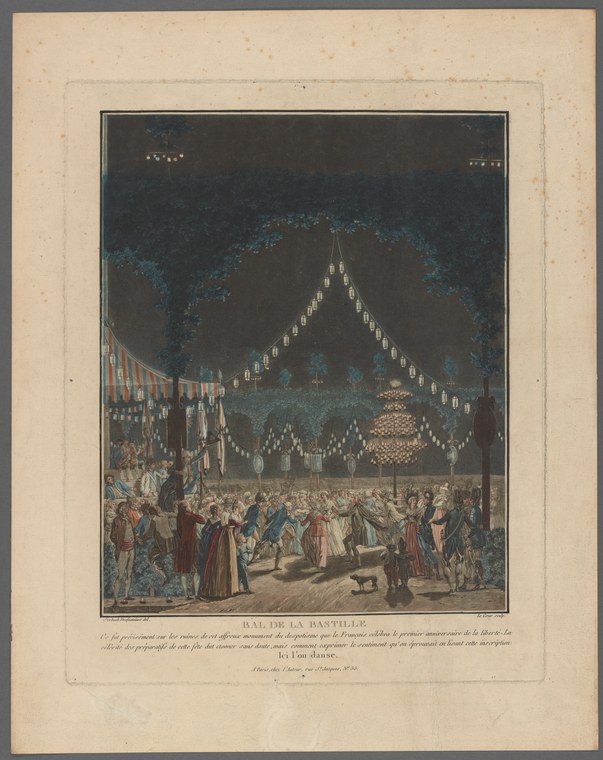
This engraving is one of few contemporary visual records of the scale and public character of revolutionary and post-revolutionary French celebrations. It shows that dancing was central to civic commemoration and public joy, and that the Bastille anniversary festivals were major events drawing entire communities into formal dress and social ritual. For historians of social dance, it documents the physical setting, architectural support, and crowd dynamics of late 18th-century ballrooms before the Regency and modern ballroom era.
What you are looking at
A crowded outdoor celebration fills a moonlit square, with hundreds of figures in 18th-century dress scattered across the foreground and middle ground. The scene is dominated by an elaborate temporary structure—a pavilion or ballroom with a peaked roof outlined in white lights or lanterns that create a dramatic triangular silhouette against the dark sky. The pavilion's interior glows warmly, suggesting it is lit by candles or oil lamps. Draped fabric and garlands decorate the structure. To the left, a building with regular windows and doors frames the scene. The crowd wears formal attire typical of the late 18th century: women in long gowns with full skirts and bonnets, men in coats and breeches. The figures are in motion, clustered in groups, suggesting simultaneous conversation, dancing, and circulation through the space. The engraver has rendered depth through atmospheric perspective and the density of the crowd, with distant figures smaller and less distinct. The moment captures a public festival in full swing—the kind of open-air celebration that was a major social event of the period.
The dancing
The figures are upright and formal in bearing, moving within the social constraints of late 18th-century dress and decorum. Women's long skirts restrict stride, and the full-skirted silhouettes suggest that any dancing would favour turning and swaying movements rather than vigorous footwork. Men stand or move with legs visible beneath their knee-breeches. Pairs and small groups are scattered throughout rather than organized in lines or sets, though the pavilion interior likely contained more formal groupings. The overall impression is one of promenade and social movement rather than structured choreography at ground level, with the pavilion serving as the dedicated dance space.
The dance depicted
This is an open-air public celebration—'Bal de la Bastille'—and the image documents the kind of festive dancing that took place outdoors in revolutionary or post-revolutionary France, likely during summer months in public squares. The title and context suggest this commemorated the storming of the Bastille (1789) or an anniversary of that event. The dancing would have consisted of contredanses, quadrilles, and other country dances that were the standard social dances of the period, performed both in the pavilion and in the open air. The engraving shows the social and celebratory context—the mingling, the temporary architecture, the public nature—rather than the specific choreography. Dancers would have faced partners or stood in sets, but the print's distance and crowding prevent clear reading of hold or footwork.
How it was made
This is a hand-coloured engraving or etching, identifiable by the fine lines, the delicate cross-hatching used for shading (visible in the sky and in the pavilion's depth), and the hand-applied watercolour wash that defines the figures and adds warmth to the scene. The technique allowed fine architectural detail in the pavilion structure and intricate rendering of the crowd. The colouring—blues and greens in the sky, warm yellows and reds in the costumes and lantern-light—was applied after printing, suggesting this was a commercial print intended for a broad audience. The size and complexity indicate this was a professional production, likely published in Paris.
About this work
This is a documentary print of a public open-air festival and dance celebration in late 18th-century France, commemorating the Bastille. The work captures not choreography but the social ritual and architectural spectacle of the event: the temporary pavilion, the formal dress, the mixed crowd of men and women moving in the moonlight. It belongs in a dance gallery not because it shows how a specific dance was performed, but because it documents the context and scale of popular social dancing during a transformative moment in French history, and shows how dancing functioned as public celebration and civic ritual. The print is a historical record of dance as social practice.
How to look at it
The viewer should trace the movement of the crowd: note how figures cluster and thin, how the pavilion draws people toward it, how the architecture frames and focuses the activity. The artist has chosen a moment of full festival activity—neither the opening nor the close—which allows the complexity of public social dancing to be read. The hand-colouring creates atmosphere and hierarchy: the pavilion glows as the focal point, while the surrounding figures are rendered in cooler, lighter tones. Look at the dress to understand the physical constraints on movement: the women's silhouettes, the formality of the men's stance. The engraving technique allows fine detail of faces and expressions at close range, while distant figures become part of texture and mass.
The period
The storming of the Bastille occurred on 14 July 1789, and the anniversary was celebrated publicly in France, particularly in the 1790s. Open-air summer festivals and public dances were common in French society before and after the Revolution, serving as occasions for social mixing and civic participation. The contredanse and quadrille—both country dances that did not require a dancing master's training—became the dominant social dances of the period because they suited public outdoor settings and democratic ideals. The temporary pavilion or 'pavilion of dance' was a standard structure for such events, providing shelter and a focal point. This engraving sits within a tradition of French celebratory prints documenting public festivals and processions.
Where it lives
This hand-coloured engraving is held in the Prints collection of the New York Public Library, described as 'Prints depicting dance'. It is a commercial print, likely published in Paris in the 1790s or early 1800s, and would have been affordable to middle-class households as a souvenir of the event or as a historical document.
Dance in this work
Questions about this work
What dance is being performed?
The print does not show the specific choreography in detail, but the period and context suggest contredanses and quadrilles, the standard social dances of late 18th-century France. These dances were ideal for outdoor public celebrations because they could accommodate mixed groups of dancers of varying skill and did not require expensive instruction.
When was the Bastille Ball held?
The Bastille was stormed on 14 July 1789. Public celebrations and dances on the anniversary became an established tradition. This print likely documents a festival from the 1790s or early 1800s, but the catalogue record does not specify which anniversary it commemorates.
Why is the pavilion lit up?
Temporary pavilions were built for public dances to provide shelter and a focal point for the celebration, and were typically lit by candles, oil lamps, or lanterns. The illumination served both practical and symbolic purposes: it extended the dancing into evening and marked the pavilion as the heart of the celebration.
More dance artwork





