49 works in this view — arrow keys or swipe to move between them.
Dance in Art
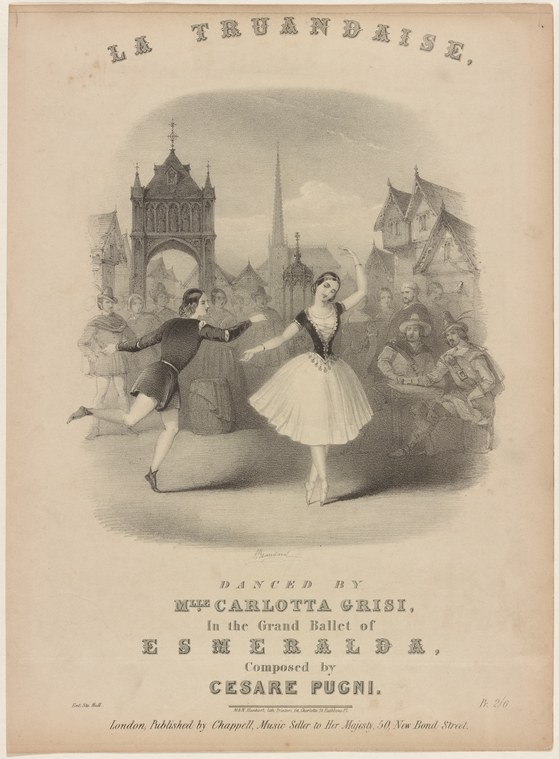
La truandaise, danced by Mlle. Carlotta Grisi, in the grand ballet of Esmeralda, composed by Cesare Pugni
Unknown artist
- Collection:
- Prints depicting dance
- Source:
- New York Public Library
- Rights:
- Public domain — free to use, share and adapt.
- Recorded as:
- Public Domain
Grisi was one of the three most celebrated ballerinas of the 1840s, and *Esmeralda* was among the most popular and frequently performed ballets of the century. This print documents not just a role but a specific interpretation by a dancer whose technique and dramatic presence shaped how European audiences understood ballet. The image also shows the apparatus of theatrical promotion and memory—how performances were captured, circulated, and kept alive in the public imagination before film.
What you are looking at
A theatrical scene set in a medieval or Gothic town, with pointed arch gateways and spires rising behind the figures. A male dancer in dark clothing leans dramatically backward with arms outstretched, while a female dancer in a white classical tutu stands upright beside him, her posture elegant and composed. The composition places them in the foreground, stage-center, with architectural elements and costumed figures (possibly townspeople or ensemble) visible in the soft-focus background. The light is diffuse, creating an atmospheric quality typical of mid-nineteenth-century theatrical printmaking. The engraving captures a moment of dramatic contrast: male exuberance and physical abandon set against female grace and restraint.
The dancing
The male figure is in a pronounced backbend or penché position with one arm reaching overhead and the other extended for balance—a display of male virtuosity and theatrical dynamism. The female dancer stands in a classical ballet posture with upright torso, the tutu held in elegant lines, her arms positioned in a restrained port de bras. The spatial relationship between them is intimate but not physically connected, characteristic of the supported adagio passages in mid-century Romantic ballet. The contrast in their physical language—his abandonment, her control—is central to the choreographic moment.
The dance depicted
This is a scene from *Esmeralda*, a full-length ballet choreographed by Cesare Pugni to a libretto by Jules-Henri Vernoy de Saint-Georgés (premiered in London, 1844). The title identifies the dancer as Mlle Carlotta Grisi, the celebrated Italian ballerina who originated the title role. *La truandaise* (the beggar woman or vagrant woman) is a character or variation within the ballet, likely performed in the second act. The image documents a moment of high Romantic ballet spectacle: pantomime-like drama combined with demi-caractère steps. Grisi was known for her dramatic intensity as well as her technical brilliance, and this engraving captures both the narrative content (a moment of social transgression or emotional vulnerability) and the balletic vocabulary of the period.
How it was made
This is a steel-engraved print, identified by the fine parallel hatching and tonal modeling characteristic of high-quality theatrical prints from the 1840s. The technique allowed precise reproduction and wide circulation; prints of celebrated dancers and roles were collected and displayed, functioning as both souvenirs and advertisement. The publisher's mark—'London. Published by Chappell, Music Seller to Her Majesty, 50 New Bond Street'—confirms this was a commercially distributed product aimed at a middle-class audience with access to London theatres. The print's finish and detail suggest it was made from a drawing by a theatre artist (possibly a scene painter or dance illustrator), not from direct observation, though the choreographic knowledge is accurate.
About this work
This engraving documents a celebrated performance by Carlotta Grisi in Cesare Pugni's *Esmeralda* (1844), one of the most successful full-length ballets of the Romantic era. The print captures the aesthetic and social world of mid-nineteenth-century theatrical dance: the Gothic medievalism of the libretto, the contrast between male and female movement vocabularies, and the star system that made individual dancers recognizable across Europe. The work survives as a record of how Romantic ballet was seen by its contemporary audience—not as we reconstruct it from notation, but as a theatrical spectacle combining narrative drama, architectural splendour, and virtuosic display.
For dance historians, this image is a primary source for understanding performance practice, costume, and the physical language of Romantic ballet as it was actually danced and witnessed. For a general reader, it opens a window onto a vanished theatrical world and the kind of fame that preceded photography.
How to look at it
The composition freezes a moment of physical contrast that is also a narrative moment: the male dancer's exuberant backward lean reads as both technical display and emotional surrender or passion, while the female dancer's upright composure can be read as dignity, restraint, or emotional distance. This is typical of Romantic ballet's vocabulary of gender—the man as active, the woman as object or ideal. Notice the architectural setting: the Gothic arch and spire are not mere decoration but plot (the ballet is set in medieval Paris), and they create a romantic, slightly ominous atmosphere. The soft focus of the background and the theatrical lighting (darks and lights rather than naturalism) are conventions of the period's theatrical printmaking. The engraver has chosen the moment of maximum dramatic contrast, not a passage of technical brilliance—a choice that tells you something about how audiences valued ballet.
The artist
Unknown. The print was published by Chappell, a London music and theatrical publisher, suggesting it was produced either from a drawing commissioned by the publisher or adapted from a scene-painter's design. The quality of the engraving suggests a professional hand, but theatre prints of this period often went unsigned and were treated as commercial rather than fine-art products. The artist may have been a dance illustrator or theatrical scene painter working in London in the 1840s.
The period
The 1840s were the height of Romantic ballet in Europe. *Esmeralda* (1844) came five years after the Paris premiere of *Giselle* (1841) and was created in direct response to its success—both ballets drawing on Victor Hugo's *Notre-Dame de Paris* and the Romantic appetite for Gothic mystery, social transgression, and supernatural elements. Carlotta Grisi had recently been celebrated in Paris and London, and the role of Esmeralda was created for her by Pugni, the leading ballet composer of the era. The print industry was at its peak; lithography and steel engraving made theatrical imagery widely available, and prints of celebrated dancers were collected like modern celebrity photographs. This was the moment when ballet became a genuinely international form, with the same roles and ballets performed across London, Paris, Milan, and Russia, and dancers becoming international stars.
Where it lives
This print is held by the New York Public Library, in its prints collection devoted to dance imagery. It is one of thousands of nineteenth-century theatrical prints in the collection, many depicting celebrated dancers and roles. The collection reflects the tastes of the era—documentary interest in performance, commemoration of individual dancers, and the commercial circulation of theatrical imagery.
Dance in this work
Questions about this work
Who was Carlotta Grisi?
One of the three greatest ballerinas of the Romantic era (with Taglioni and Cerrito), celebrated for both technical brilliance and dramatic intensity. She was born in Vicenza, Italy, trained in dance and pantomime, and became an international star, dancing in Paris, London, Milan, and Russia. She created or premiered major roles in *Giselle*, *Esmeralda*, and other canonical ballets. She was also known for her beauty and for a famous liaison with Théophile Gautier, the critic and librettist.
What is *Esmeralda*?
*Esmeralda* is a full-length Romantic ballet choreographed by Cesare Pugni in 1844, based on Victor Hugo's novel *Notre-Dame de Paris*. It tells the story of Esmeralda, a Gypsy dancer, and her entanglement with a medieval nobleman and a deformed hunchback. The ballet was enormously popular and frequently revived; versions of it remained in the Russian Imperial Ballet repertory into the twentieth century.
What does 'truandaise' mean?
*Truandaise* derives from French *truand* (vagabond, beggar). It refers to a character type or variation depicting a beggar woman, vagrant, or street dancer—a demi-caractère role combining pantomime with classical ballet technique. Such roles were showpieces for ballerinas, allowing display of both technical skill and dramatic or comic character.
How was this image made and distributed?
This is a steel-engraved print, a technique that allowed fine detail and long print runs. It was published by Chappell, a London music and theatrical publisher, and sold as a theatrical souvenir and advertisement. Prints like this were collected by theatre-goers, framed, and displayed in homes—functioning as both memento and celebrity merchandise.
More dance artwork





