49 works in this view — arrow keys or swipe to move between them.
Dance in Art
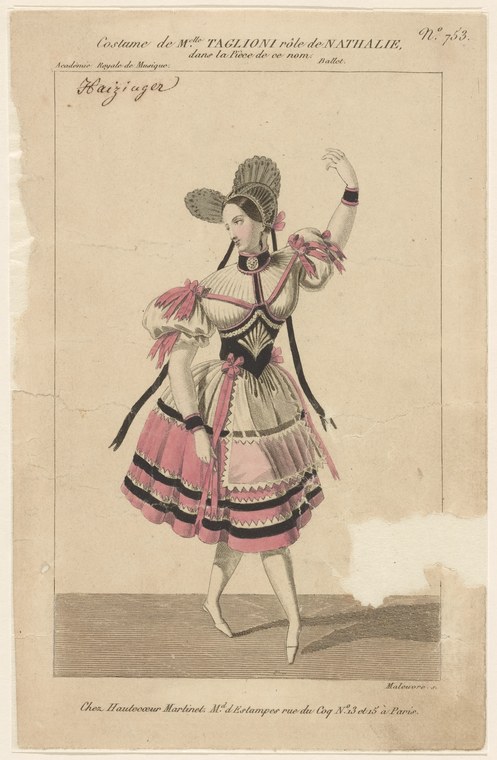
Costume de Melle Taglioni, rôle de Nathalie dans la pièce de ce nom, ballet, Académie royale de musique
Unknown artist
- Collection:
- Prints depicting dance
- Source:
- New York Public Library
- Rights:
- Public domain — free to use, share and adapt.
- Recorded as:
- Public Domain
Taglioni and *La Sylphide* are watershed moments in ballet history; this print is material evidence of what that breakthrough looked like in its own moment. For historians and dancers, it documents the actual proportions of the tutu, the placement of the headdress, and the postural ideal of the era—details that cannot be recovered from written sources alone.
What you are looking at
A single female dancer is shown in a three-quarter pose against a plain ground, her body turned slightly in profile. She wears an elaborate Romantic-era costume: a white corseted bodice with a black band across the torso, short puffed sleeves in pale pink with black trim, and a knee-length skirt composed of multiple tiers of graduated pink and white silk with black ribbon borders. A tall feathered headdress rises from her hair, and she wears a black choker at her throat. Her right arm is raised and bent, the hand gesturing expressively; her left arm is extended lower. She stands in a turned-out position with visible engagement of the supporting leg. The figure is rendered in hand-colored engraving, with delicate line-work defining the costume's construction and the dancer's musculature.
The dancing
One dancer is depicted in a sustained arabesque-like attitude, with weight clearly on the supporting leg and the free leg extended behind. The torso is upright and engaged, the shoulders held back. Both arms are raised in a Romantic port de bras—the upper arm lifted and the forearm bent—suggesting the dancer is mid-phrase or in a moment of emotional expression rather than locked in a static position. The turned-out stance and the lift through the core are consistent with early nineteenth-century ballet technique.
The dance depicted
This is Marie Taglioni, the dominant figure of Romantic ballet and creator of the role of Nathalie in the ballet *La Sylphide* (Opéra de Paris, 1832). The image documents her costume for that specific role. The short tutus, feathered headdress, and ethereal aesthetic became synonymous with the Romantic era of ballet. The pose—sustained, expressive, with the emphasis on lightness and verticality—embodies the vocabulary that made Taglioni a revolutionary figure. The image is a historical record of how this foundational work was costumed and danced in its premiere period.
How it was made
This is a hand-colored engraving on laid paper, likely a fashion or theatrical print from the 1830s distributed through commercial channels at the Académie royale de musique (the Opéra). The technique allowed for fine detail in the rendering of the costume's construction and lace work, and the hand coloring could be applied in runs, making the prints affordable enough for public sale. Such prints served as souvenirs and promotional objects, circulating images of celebrated dancers to a bourgeois audience who attended the opera or read dance criticism.
About this work
This is a documentation print of Marie Taglioni in her costume for Nathalie in *La Sylphide*, the ballet that defined the Romantic era. It is not a portrait of Taglioni per se, but a record of a specific theatrical costume and the dancer's body in a moment of technical and emotional expression. The print is a primary source for understanding how Romantic ballet was costumed, how the female body was positioned in space, and how a foundational work in dance history was made visible to the public of its time. Such prints were commercial objects, creating and sustaining the celebrity of the ballerina and the visual language of Romantic ballet across Europe.
How to look at it
Attend to the musculature and line of the supporting leg—the engraver has rendered the anatomical engagement that ballet demanded, suggesting the dancer is not merely posed but actively holding herself aloft. Notice how the costume is constructed to reveal and frame the body's movement: the short skirt, the absence of heavy decoration below the waist, and the transparent quality of the fabric. The feathered headdress draws the eye upward, emphasizing the lift of the figure. The raised arms and the tilt of the head suggest a moment of emotional abandon rather than cold technique—this is the Romantic ballet vocabulary made visible.
The artist
The print is uncredited in the catalogue record. It was likely produced by a commercial engraving firm working for the Opéra or for a Parisian print publisher. Such prints were made quickly to capitalize on the success of new ballets and the fame of their dancers; many circulated without attribution to the engraver or colorist.
The period
This print dates to the early 1830s, at the peak of the Romantic movement in ballet. Ballet had recently undergone a technical revolution: the introduction of the gas-lit stage, the development of pointe work, and the rise of the ballerina as the central figure in choreography. *La Sylphide* premiered in 1832 and was an immediate sensation, spawning demand for images of Taglioni and the ballet. The feathered headdress and ethereal costume reflected Romantic aesthetics—a longing for the otherworldly, the feminine, the unattainable. Commercial prints of celebrated dancers became a form of mass culture, similar to modern celebrity photographs.
Where it lives
The work is held in the New York Public Library's collection of prints depicting dance. It is a commercial print, one of many produced in the 1830s to document celebrated dancers and ballets. The original source and date of acquisition by the NYPL are not recorded in the catalogue.
Dance in this work
Questions about this work
Who was Marie Taglioni?
Taglioni (1804–1884) was a Swedish-Italian ballerina and the most celebrated dancer of the Romantic era. She revolutionized ballet technique and created *La Sylphide* with choreographer Filippo Taglioni (her father) in 1832. She was the first dancer to master pointe work and to make it central to a major ballet. Her fame was international; she danced in London, Russia, and across Europe.
What is *La Sylphide*?
*La Sylphide* is a two-act ballet first performed in Paris in 1832, choreographed by Filippo Taglioni for his daughter Marie. It tells the story of a Scotsman who falls in love with a forest spirit and loses his mortal bride. The ballet became the prototype of Romantic ballet and remains in the repertory today.
How were these prints distributed?
Prints like this were sold at the Opéra, in Parisian print shops, and by subscription. They were affordable enough for a middle-class audience to buy as souvenirs or to frame. They served as both promotional materials and a form of mass media, making the images of celebrated dancers widely known.
Why is the costume so short?
The short tutu became the standard for female ballet in the Romantic era because it allowed visibility of the dancer's legs and the footwork that was now central to ballet technique—especially pointe work. It also created a visual lightness and otherworldliness that matched Romantic aesthetics.
More dance artwork





