49 works in this view — arrow keys or swipe to move between them.
Dance in Art
Dancers on music covers
Unknown artist
- Collection:
- Prints depicting dance
- Source:
- New York Public Library
- Rights:
- Public domain — free to use, share and adapt.
- Recorded as:
- Public Domain
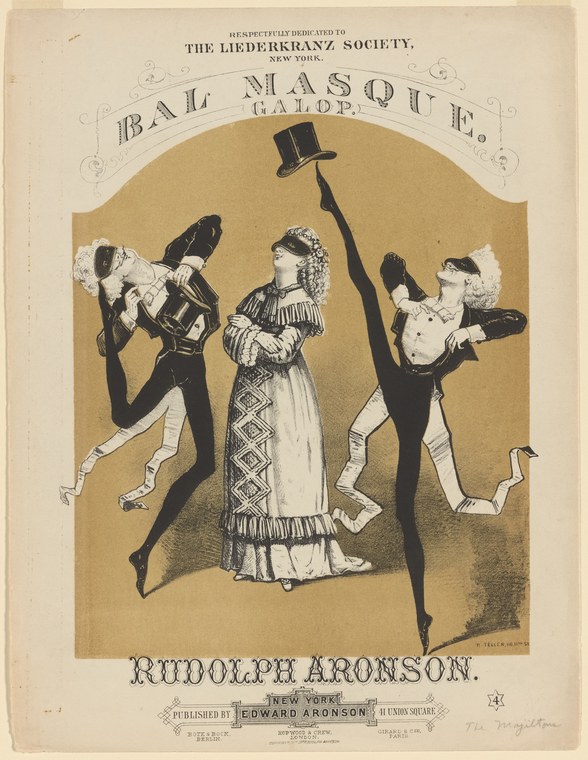
This image documents the understudied world of mid-19th-century American burlesque and comic theatrical dance, particularly as it was consumed by immigrant and ethnic communities. It shows that ballroom culture encompassed not only formal technique but also comic parody and acrobatic excess—a reminder that 'dance' in this period included forms we might now separate into circus, comedy, and theater.
What you are looking at
This is the cover of a ball masque program published by Edward Aronson in New York, dedicating the work to the Liederkrantz Society. The composition centers on a woman in an elegant white Empire-waist gown with black detailing, her hair crowned with a tiara or ornament, positioned between two men in black tailcoats and white stockings. Both men are depicted mid-leap or in exaggerated postures of theatrical exuberance—one on the left with his leg kicked high and arm raised, the other on the right in an inverted or backbend position, arm flourished upward. The woman stands composed and frontal between them, creating a stable visual axis. The background is a warm ochre or gold tone that flattens the space and focuses attention on the figures. The engraving style, with its crisp lines and dramatic contrasts of black and white, emphasizes the theatrical nature of the scene. The overall composition suggests a moment of festive entertainment rather than a formal ballroom dance—the men's acrobatic abandon and the woman's poised, almost bemused center suggest theatrical burlesque or comic performance.
The dancing
The two male figures are rendered in extreme positions suggesting acrobatic or comedic exaggeration rather than ballroom technique. The left figure's leg extension and the right figure's apparent inversion contradict the upright carriage and closed holds of formal ballroom dance. The woman maintains an erect, frontal posture with arms at her sides or gently positioned, her gaze directed outward. The spatial relationship—woman centered, men splayed on either side—suggests she is the object of theatrical attention or parody rather than an equal partner in a dance.
The dance depicted
This does not depict ballroom dance in its formal sense, despite the program's designation as a 'ball masque.' The exaggerated poses and acrobatic elements suggest either a burlesque or theatrical comedy number performed at a masquerade ball, or a comic illustration satirizing ballroom excess. The Liederkrantz Society was a German-American singing society based in New York, and this cover may represent entertainment at one of their society events. The style suggests mid-to-late 19th century popular entertainment with roots in theatrical traditions, possibly minstrelsy or music-hall comedy.
How it was made
This is an engraving (or lithograph with engraved elements) printed in black ink on cream paper with hand-applied or chromolithographic ochre toning in the background. The technique of line-engraving allowed for fine detail and crisp reproduction, making this affordable for mass circulation. The dedication and publisher information at the base, combined with the chromatic background, suggests a cover printed for distribution—likely folded into a program for the event or sold as a souvenir. The fineness of the linework and the balanced composition indicate a skilled reproductive engraver working from a design, though the original artist is not credited.
About this work
This cover for an 1880s-era ball masque program is a window into how theatrical and popular dance was understood and marketed to German-American urban audiences. It depicts not formal ballroom technique but rather comedic or burlesque entertainment—figures in exaggerated, acrobatic poses that parody or satirize the stiffness of conventional ballroom propriety. The Liederkrantz Society dedication suggests this was part of a cultural institution's social calendar, mixing music, performance, and dance in an evening's entertainment. The engraved medium allowed it to be circulated widely, making it both a historical record of the event and a product of the theatrical-entertainment market of its time.
How to look at it
Attend first to the poses: the men's bodies are rendered in positions that would be impossible or improper in formal ballroom dance, inviting a viewer to read the image as comic or parodic. Notice the woman's composed, frontal stance—she is the still point, while the men are the agents of theatrical excess. The ochre background and the printed frame (with its ornamental typography) anchor this as a consumer product—a cover designed to be seen and handled, not hung as fine art. The engraving's fine lines and high contrast create a sense of animation and energy that reinforces the comedic intent.
The artist
The artist is not credited on the cover. Edward Aronson is identified as the publisher and apparently as the dedicator of the work. The engraver's hand—skilled and practiced—is evident but anonymous, which was typical for reproductive prints of the period. The work was published in New York and distributed among the city's German-American cultural community.
The period
The 1880s-1890s were a period of flourishing popular entertainment in American cities, particularly for immigrant and working-class audiences. Burlesque theater, music-hall performance, and parodic dance forms coexisted with and often directly mocked the formal ballroom traditions of the elite. The chromolithographic and engraving techniques used here were at their peak of popularity and accessibility, allowing theatrical impresarios and societies to create affordable, reproducible promotional materials. The Liederkrantz Society and similar organizations mixed 'respectable' cultural activities (singing, formal events) with theatrical entertainment that often included comic or burlesque elements.
Where it lives
This print is held in the New York Public Library's collection of prints depicting dance. It functions as a primary source document—both a design object (a program cover) and a historical record of how a specific community in a specific city understood entertainment and dance in this period.
Dance in this work
Questions about this work
What is the Liederkrantz Society?
The Liederkrantz Society was a German-American male singing and social club founded in New York in 1847. It held concerts, balls, and masquerade events as part of its social calendar, often mixing musical performance with theatrical entertainment. The organization was part of the broader German-American cultural infrastructure in 19th-century New York.
Is this a formal ballroom dance?
No. While the event is called a 'ball masque,' the bodies depicted here are rendered in exaggerated, acrobatic, or impossible positions that suggest burlesque, comedy, or theatrical entertainment rather than formal ballroom technique. The image satirizes or parodies ballroom conventions rather than exemplifying them.
Who is the artist?
The artist who created the original design is not credited on the cover. Edward Aronson published and dedicated the work. The engraver—the skilled technician who cut or lithographed the design into printable form—is also not identified, which was standard practice for reproductive prints of the era.
How was this printed?
This is an engraving or lithograph printed in black line on cream paper, with the ochre/gold background applied either by hand or as part of a chromolithographic process. The technique allowed for inexpensive, reproducible copies suitable for distribution to society members or sale to the public.
More dance artwork





