49 works in this view — arrow keys or swipe to move between them.
Dance in Art
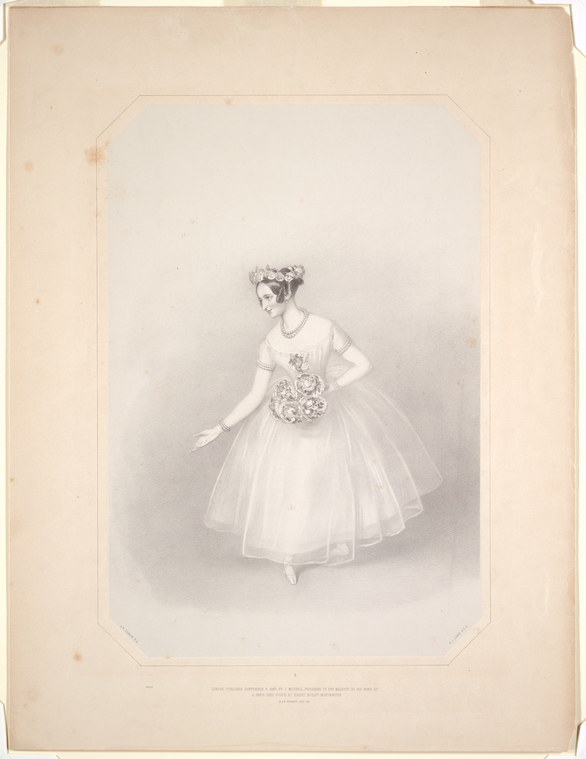
Souvenir d'adieu de Marie Taglioni
Unknown artist
- Collection:
- Prints depicting dance
- Source:
- New York Public Library
- Rights:
- Public domain — free to use, share and adapt.
- Recorded as:
- Public Domain
Marie Taglioni transformed ballet in the 1830s-1840s, making the ethereal, weightless female dancer the defining image of the art form—an image that persists today. This print preserves her silhouette and conveys the physical aesthetic she embodied: the pointed foot, the pale tutu, the elongated line. For dancers and historians, the image is both a technical document (showing how a master of the form stood and held herself) and a cultural artifact (showing how fame was built and circulated in the 19th century).
What you are looking at
A single female dancer is presented in three-quarter view against a plain, light background, rendered in soft graphite with subtle shading that suggests depth. She wears a white short-sleeved dress with a fitted bodice decorated with embroidered or appliquéd flowers at the center, and a voluminous skirt of layered tulle that falls to mid-calf. Her dark hair is arranged in an upswept style typical of mid-19th-century fashion. She holds a small bouquet of flowers in her left hand at waist height, while her right arm extends gently downward. Her posture is upright and graceful, with her weight seemingly balanced on her right leg while her left foot appears to be pointed and lightly touching the ground. The composition is a formal portrait study, centered on the page within a ruled rectangular frame.
The dancing
The dancer stands in an elegant, elongated line characteristic of Romantic-era ballet training. Her torso is held erect with shoulders relaxed and level; her arms are positioned with softness rather than tension, one hand holding flowers and the other extended in a gentle, open gesture. The left leg appears to be in a slight point or extension, suggesting the controlled turnout and line expected of a trained ballet dancer. Her neck is lengthened and her gaze directed off to the middle distance. The overall frame conveys stillness and repose rather than the moment of active movement—a pose held for presentation rather than a captured instant of choreography.
The dance depicted
This is a portrait of a Romantic ballet dancer, almost certainly representing Marie Taglioni or a dancer in her tradition, given the inscription 'Souvenir d'adieu de Marie Taglioni' (Farewell memento of Marie Taglioni). The image documents the aesthetic of early-to-mid 19th-century ballet: the pale, ethereal presentation; the short tulle skirt (the romantic tutu); the pointe work implied by the extended foot; and the refined, elongated body line. The flowers and the formal dress suggest this is a commemorative image, possibly issued after a notable performance or retirement. Taglioni was the defining dancer of the Romantic ballet period and revolutionized the art form; this print preserves her visual legacy and the silhouette that became iconic.
How it was made
This is a lithographic or finely detailed engraved print, rendered in grayscale with careful tonal modeling. The technique allowed for soft gradations of light and shadow, particularly evident in the rendering of the tulle skirt, where layers of cross-hatching and stippling create the illusion of translucent fabric. The ruled border and formal composition suggest this was a commercial print, likely distributed as a souvenir or promotional image. The fineness of the line work and the careful reproduction of detail indicate this was intended for a educated or affluent audience—ballet followers and collectors of theatrical ephemera. The portrait format and inscription mark it as a commemorative object, part of a wider 19th-century practice of collecting images of celebrated performers.
About this work
This is a commemorative portrait print of a Romantic-era ballet dancer, almost certainly Marie Taglioni or created in her honor, dating to the mid-19th century. The image documents the visual language of Romantic ballet at its height: the ethereal aesthetic, the short white tutu, the trained posture, the refined line. It belongs in a gallery of dance art as both a historical record of how a revolutionary dancer presented herself and a artifact of how theatrical performance was consumed and remembered by the public. The print testifies to Taglioni's cultural dominance—the inscription 'farewell' suggests she was celebrated enough to warrant a memorial souvenir, a status few performers of any era achieve.
How to look at it
Look at the dancer's posture and line: the elongation of the neck, the alignment of the spine, the carriage of the arms. Notice how the artist has rendered the tulle skirt—the layered, translucent quality achieved through fine cross-hatching and tonal variation. Observe the pointed left foot, which signals the technical training and turnout expected of a Romantic ballerina. The formal, centered composition and the flowers held in her hand suggest this is not a dance in motion but a static presentation of a dancer's refined carriage and beauty—a portrait, not a narrative scene. This reflects the 19th-century concert tradition in which ballet dancers were presented as idealized figures as much as virtuosos.
The period
This print dates to the height of Romantic ballet, likely 1840s-1850s. Marie Taglioni had retired from the stage in 1847, so the inscription 'adieu' (farewell) may commemorate that retirement or a final celebrated performance. The image embodies the Romantic aesthetic in dance: the emphasis on weightlessness, the supernatural or fairy-tale quality conveyed by the pale costume, the focus on the female dancer as the central subject. In the broader visual culture of the period, theatrical portraiture—especially of ballet dancers—was a thriving commercial genre; prints of celebrated performers were collected and exchanged as fashion items and souvenirs. The lithographic technique made such prints affordable and reproducible, democratizing access to the images of star performers.
Where it lives
The work is held in the New York Public Library's 'Prints depicting dance' collection, indicating it was selected and preserved as a significant document of dance history. It is a commercial print, likely one of many thousands produced and distributed to fans and collectors during or after Taglioni's performing career.
Dance in this work
Questions about this work
Who was Marie Taglioni?
Marie Taglioni (1804–1884) was a Swedish-Italian ballerina who revolutionized ballet in the 1830s-1840s. She was the first major star to perform en pointe regularly and credibly, and she epitomized the Romantic ideal of the ethereal, weightless female dancer. Her career helped define the Romantic ballet aesthetic and influenced dance for generations. She retired from performing in 1847.
What does 'souvenir d'adieu' mean?
'Souvenir d'adieu' translates as 'farewell memento' or 'farewell keepsake.' This print was likely issued to commemorate Taglioni's retirement or a final, celebrated performance. Such commemorative prints were common in the 19th century and were collected as mementos of a performer's career.
What is a Romantic tutu?
The Romantic tutu, visible in this image, is a bell-shaped skirt of layered tulle that falls to mid-calf or just below the knee. It differs from the later classical tutu (which is much shorter and horizontal) and the contemporary tutu. The Romantic tutu was designed to enhance the illusion of weightlessness and ethereality central to Romantic ballet aesthetics.
Why is she holding flowers?
In 19th-century ballet and theatrical portraiture, flowers were a common attribute of female performers, signifying grace, beauty, and femininity. They were also a literal part of performance—audiences threw flowers to celebrated dancers as a sign of appreciation. The bouquet in this portrait emphasizes Taglioni's status as a beloved and admired performer.
More dance artwork





