49 works in this view — arrow keys or swipe to move between them.
Dance in Art
Ancient Greek and Roman dancing in prints
Unknown artist
- Collection:
- Prints depicting dance
- Source:
- New York Public Library
- Rights:
- Public domain — free to use, share and adapt.
- Recorded as:
- Public Domain
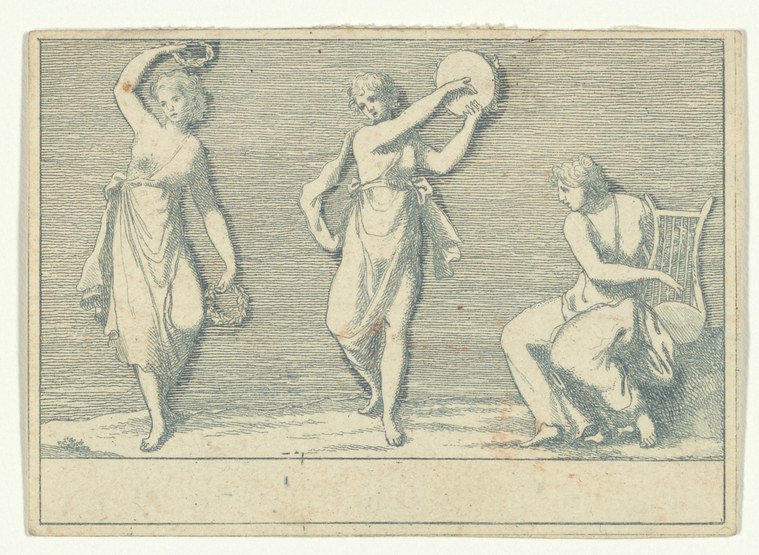
This engraving documents a moment when European artists and choreographers became obsessed with reconstructing ancient dance—a fantasy that shaped theatrical dance, costume, and pedagogy for over a century. The central figure's impossible suspension reveals that historical accuracy mattered less than the aesthetic ideal; this print is as much a manifesto for neoclassical beauty as a record of dance.
What you are looking at
This engraving depicts three female figures in classical dress arranged across a shallow stage space. The leftmost figure stands in profile, her body twisted in a graceful contrapposto pose, one arm raised above her head in an arc. The central figure, most animated, is captured mid-leap or suspension, her legs extended and body in flight, one arm raised with fabric or a garment billowing. The rightmost figure is seated or crouching on what appears to be a low seat or platform, her body folded forward in a pose of repose or contemplation, her hair falling forward. All three wear simple draped garments in the neoclassical style—light, unconstrained tunics or chitons that expose the shoulders, arms, and legs. The background is plain, rendered with fine parallel hatching lines typical of engraving, giving no architectural context. The composition emphasizes the plasticity and geometry of the human body.
The dancing
The three dancers demonstrate classical body positions: the left figure uses a simple standing frame with one arm extended overhead, creating a vertical line; the central figure is suspended in air with extended limbs and no apparent grounded support, suggesting a moment of weightlessness; the right figure abandons upright posture entirely, folding into the seated platform. The poses are isolated rather than relational—no couples, no closed holds, no interaction between the bodies. The weight appears deliberately unnatural and sculptural rather than functional.
The dance depicted
This work illustrates ancient Greek or Roman dance as understood through neoclassical aesthetics, likely early 19th century. The image depicts the classical ideal of female grace through isolated poses drawn from sculpture rather than continuous movement. The absence of male dancers, the emphasis on individual sculptural positions, and the draped neoclassical costume suggest this is an educated European fantasy of antiquity rather than a documentation of actual practice. The central airborne figure—impossible to achieve through historical Greek or Roman technique—reveals that the artist's priority was beauty of form over verisimilitude.
How it was made
This is an engraving, identifiable from the fine parallel hatching lines used to model form and create tonal variation, the sharp definition of outlines, and the overall monochromatic black-and-white palette. The technique is line-based: form emerges from density and direction of incised lines rather than wash or color. Engravings of this quality circulated widely in the early 19th century as reproductive prints, making classical imagery accessible to educated audiences who could not own paintings. The small scale and worn edges suggest this is a page from a bound collection or album.
About this work
This engraving presents ancient Greek and Roman dance as a gallery of classical poses rather than as a kinetic practice. It belongs to a widespread 18th- and early 19th-century tradition of imaging antiquity through the body—a period when neoclassicism dominated taste in visual art, theater, and dance itself. The work uses dance not to show how people moved, but to display idealized forms: the suspended body as sculpture, the draped garment as a study in geometry, female beauty as a series of frozen attitudes. It is an artifact of how Europeans understood and wished to imagine the classical past, using the body as the medium.
How to look at it
Attend to the impossibility of the central figure's levitation—this is not a document of technique but an idealization. Notice how the engraver has used line weight and hatching density to suggest musculature and fabric texture without sacrificing clarity of outline. The three figures read as studies in contrasts: vertical, horizontal, diagonal; standing, suspended, seated. The absence of a stage, props, or male dancers strips away narrative in favor of pure form.
The period
This work emerges from the late 18th- and early 19th-century neoclassical movement, when Greek and Roman antiquity became the dominant source for visual and performing arts across Europe. In dance, this period saw the rise of ballet d'action and the abandonment of the French Court style in favor of 'natural' movement and classical drapery. Engravings like this one circulated as educational and aspirational images, shaping how dancers understood their bodies and costumes. The three-figure composition echoes classical relief sculpture, suggesting that the engraver worked from or was influenced by archaeological sources.
Where it lives
This engraving is held in the New York Public Library's Prints collection, part of a series documenting representations of ancient dance. The work's title in the record—'Ancient Greek and Roman dancing in prints'—suggests it may be part of a larger suite or album of classical dance imagery.
Dance in this work
Questions about this work
Is this what ancient Greek dance actually looked like?
No. This is a neoclassical fantasy created in the early 19th century, when European artists had no reliable evidence of ancient movement. The central figure's airborne pose is physically impossible and reveals that the artist prioritized beauty and idealization over historical accuracy. Real ancient Greek dance involved more grounded movement, male dancers, and often competitive or ritual contexts that this image ignores.
Why are the figures in such strange, isolated poses?
The artist has arranged the bodies as studies in classical form—each pose references ancient sculpture. The three positions (standing with raised arm, suspended, seated) show variety of line and silhouette rather than a continuous dance. This approach reflects neoclassical aesthetics, which valued the idealized human form over narrative or movement flow.
What is the engraving technique showing?
Fine parallel lines (hatching) create shading and texture, allowing the engraver to suggest musculature, drapery, and form without using color. The crisp outlines and high contrast made these prints easy to reproduce and distribute widely, making classical imagery accessible to middle-class viewers and dancers.
More dance artwork





