49 works in this view — arrow keys or swipe to move between them.
Dance in Art
Pauline Duvernay
Unknown artist
- Collection:
- Prints depicting dance
- Source:
- New York Public Library
- Rights:
- Public domain — free to use, share and adapt.
- Recorded as:
- Public Domain
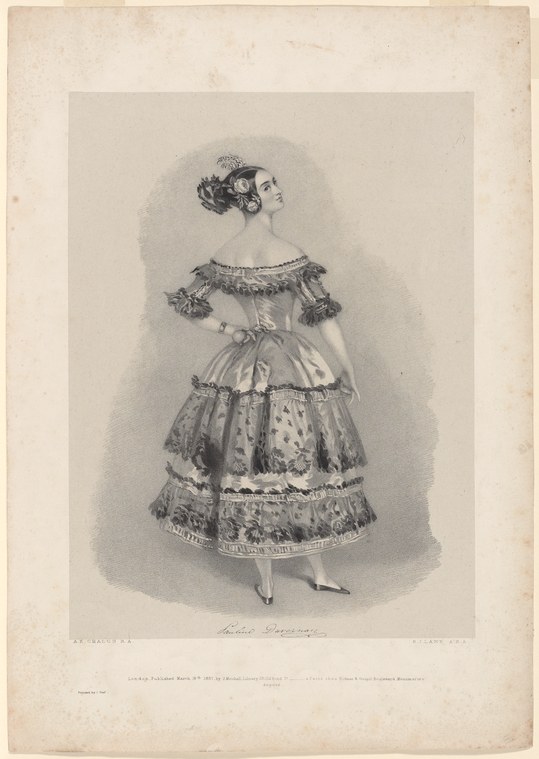
This print is a direct visual record of how a major Romantic-era ballerina was dressed and presented to the public, capturing both the costume design and the performer's stage presence during ballet's most celebrated period. For historians of dance and costume, it reveals the construction, decoration, and silhouette of mid-century theatrical dress in precise detail.
What you are looking at
A young woman stands in three-quarter profile against a plain background, wearing an elaborate mid-19th-century ball gown. The dress comprises multiple tiers of ruffled skirts in what appears to be silk or satin, decorated with spot patterns or embroidery, gathered at the waist and falling to mid-calf. The bodice is off-shoulder with short puffed sleeves trimmed in lace or fringe, and a decorative collar or bertha sits at the neckline. Her hair is styled in the fashionable ringlets of the 1840s–1850s, arranged close to the head with ornamental combs or jewels. She wears pointed-toe flat slippers in the balletic style of the period. The figure is rendered with careful attention to the texture and volume of the fabrics, using light wash and fine line work to convey the shimmer of silk and the precision of decorative stitching. The composition is frontal and posed, presenting the costume rather than capturing movement.
The dancing
The dancer is shown in a stationary pose with her weight evenly distributed and her body turned slightly to the left. Her arms hang naturally at her sides. There is no indication of a dance position, hold, or active step—this is a portrait of a performer in costume rather than a moment captured mid-performance. The posture is upright and formal, typical of theatrical costume portraiture of the era.
The dance depicted
This is a theatrical costume study, likely for a Romantic ballet of the mid-19th century. The style of dress—the layered, tiered skirt, the off-shoulder neckline, and the overall silhouette—is consistent with the romantic tutus worn by ballerinas of the 1840s–1850s, though it is longer and more modest than the later classical tutu. The flat slippers suggest ballet rather than social dance. Pauline Duvernay was a celebrated French ballerina of the Romantic era, and this print documents her stage costume. No specific ballet is titled, and the image shows costume and presence rather than technique or choreography.
How it was made
This is a lithographic or engraved portrait print, rendered in black ink on paper with careful tonal modeling to suggest the volume and texture of the fabrics. The technique allows fine detail in the costume elements—the pattern of the skirt, the lace trim, the ringlets of hair—while maintaining clarity of line. The single-figure format and the refined finish suggest this was a commercial theatrical print, likely issued for sale to admirers of the dancer or the public who had seen her perform. The style and quality indicate a professional printmaker, possibly working from a drawing or painting.
About this work
This is a lithographic costume portrait of Pauline Duvernay, a prominent French Romantic-era ballerina, printed in the mid-19th century. It documents the dress of the period—the elaborate, multi-tiered silk skirt, the bare shoulders, and the balletic pointe work of the era—and presents the dancer as a figure of theatrical glamour and artistic prestige. The print belongs to a tradition of theatrical portraiture that circulated among the opera-going public and recorded the iconic costumes and personae of celebrated performers. It is a historical document both of Romantic ballet aesthetics and of the commercial culture of celebrity that surrounded the ballerina.
How to look at it
Attend to the construction of the skirt: the multiple tiers of ruffles and the spotted or embroidered pattern are key details of Romantic-era ballet costume design. Note the bare shoulders and short puffed sleeves, which were standard for female dancers of the era and allowed freedom of movement in the upper body and arms. The flat ballet slippers and the formal posture are distinctive—this is not social dress but theatrical costume, designed to be seen from the audience at distance. The print itself is a commercial product, made to circulate the image of the performer to the public.
The artist
The artist is not recorded in the catalogue. The quality and finish of the print suggest a professional theatrical printmaker working in Paris or London, likely in the 1840s–1850s when Duvernay was at the height of her fame. Such prints were a standard product of the theatrical trade, and many were issued without attribution to the engraver or lithographer.
The period
This print dates to the height of the Romantic ballet, roughly 1840–1860, when dancers like Pauline Duvernay, Marie Taglioni, and Fanny Essler were celebrated as international stars. The theatrical fashion visible here—the off-shoulder dress, the layered skirt, the emphasis on lightness and ethereality—reflects the aesthetic ideals of Romantic choreography, which sought to create an illusion of weightlessness and otherworldliness. Commercial prints of dancers in costume were a major form of mass entertainment and celebrity culture during this period, sold at theaters and through print shops to fans and collectors.
Where it lives
This print is held in the New York Public Library's collection of prints depicting dance. It is catalogued as a theatrical costume portrait print from the mid-19th century, without recorded artist, date, or publication information beyond the holding institution.
Dance in this work
Questions about this work
Who was Pauline Duvernay?
Pauline Duvernay (1813–1894) was a French ballerina of the Romantic era, celebrated for her technique and stage presence. She performed throughout Europe and was a contemporary of Marie Taglioni and other stars of Romantic ballet. She was known for her roles in ballets such as *La Sylphide* and *Giselle*.
Why was she dressed like this?
This costume reflects the aesthetic of Romantic ballet, which sought to create an ethereal, otherworldly quality. The off-shoulder neckline and tiered skirt allowed maximum visibility and freedom of movement, while the elegant fabrics and trimmings conveyed luxury and theatrical glamour. This was the standard dress for female ballet dancers during the 1840s–1850s.
Is this a photograph or a drawing?
This is a print—most likely a lithograph or engraving—made from a drawing or painting. The fine line work and tonal modeling are characteristic of professional theatrical prints of the period, which were mass-produced and sold to the public.
More dance artwork





