49 works in this view — arrow keys or swipe to move between them.
Dance in Art
Ancient Greek and Roman dancing in prints
Unknown artist
- Collection:
- Prints depicting dance
- Source:
- New York Public Library
- Rights:
- Public domain — free to use, share and adapt.
- Recorded as:
- Public Domain
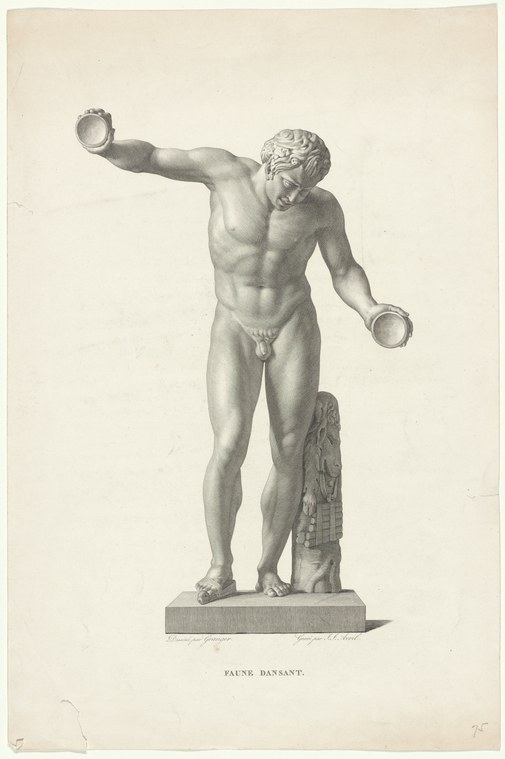
The inscription 'Faune Dansant' reveals how Renaissance and later European viewers read classical sculpture as inherently dance-like or performative—seeing in contrapposto and torsion the essence of graceful movement even in a static figure. For historians of dance pedagogy and courtly deportment, this image documents which classical poses were considered worthy of imitation and circulation among educated patrons and artists.
What you are looking at
A nude male figure stands in contrapposto on a rectangular plinth, his weight shifted to his right leg while his left hangs relaxed. His torso twists subtly, the right shoulder drawn back and the left advanced. Both arms are extended at shoulder height, the right arm raised and the left lowered, each holding a spherical object—likely meant to represent a globe or ball. His head turns to gaze toward his raised right side, creating a unified spiral of tension through the body from ankle to crown. The figure wears a wreathed crown and stands against a plain background; at the base of the plinth sits a draped fabric or cloak bundle, the only other element in the composition.
The dancing
This is a single sculpted male nude in classical contrapposto, not a dance figure in the modern sense but a demonstration of weight distribution and torsional balance. The pose embodies the Renaissance principle of figura serpentinata—a gentle S-curve through the body created by opposing upper and lower body movements. The raised and lowered arms, holding spheres, suggest either an allegorical representation or a study in anatomical weight and counter-weight rather than active choreography. The gaze follows the raised arm, unifying the composition through directional focus.
The dance depicted
This is not a depiction of dance in the theatrical sense. The image appears to be an academic study of the male nude in classical contrapposto, likely after an antique sculpture or inspired by Renaissance revival principles. While contrapposto and serpentinata principles underpin Renaissance and later courtly dance posture—particularly the idealized deportment expected in historic-baroque and historic-renaissance contexts—this figure is static and demonstrative rather than caught mid-movement. The spheres may reference classical iconography (Fortuna, Atlas, or a personification) rather than any actual dance prop or gesture.
How it was made
This is a fine-line engraving, likely 18th or 19th century, executed with careful cross-hatching to render volume and shadow across the musculature. The technique allowed for precise anatomical detail and wide reproduction, making it suitable for circulation among artists, antiquarians, and collectors of classical studies. The inscription 'FAUNE DANSANT' (Dancing Faun) at the base suggests the print was catalogued or titled as a dance representation, though the formal stillness and the presence of the spheres complicate that reading. The engraving's finish and the precision of the line work indicate a professional academic or antiquarian production.
About this work
This is an engraved study of the male nude in classical contrapposto, likely copied from or inspired by an antique sculpture, with the title 'Faune Dansant' (Dancing Faun) inscribed beneath. The image sits at the intersection of classical revival, academic anatomy, and the documentation of antique sculpture that flourished from the Renaissance onward. Although titled as a dance figure, the work is fundamentally a demonstration of idealized male beauty and bodily proportion according to classical principles—principles that did inform the deportment and weight-distribution expected of dancers in formal European contexts. It belongs in a dance archive as evidence of how classical posture was understood and taught, and as an example of how antique sources (whether sculptures, written descriptions, or earlier prints) were recycled to model bodily ideals.
How to look at it
Observe how the artist has frozen the figure in a pose of maximum torsional balance—the kind of stance that conveys both rest and potential energy, as if the figure might shift or step at any moment. The spheres in the hands are ambiguous: they may be attributes of a classical personification rather than props used in actual dancing. The title 'Faune Dansant' invites the viewer to read the pose as inherently choreographic, even though the figure is silent and still; this interpretive move was central to how Renaissance scholars and artists recovered and reanimated classical sculpture.
The period
This print belongs to the tradition of classical revival and anatomical study that began in the Renaissance and intensified through the 17th and 18th centuries. The circulation of engravings after antique sculpture served as a visual curriculum for artists, dancers, and courtiers learning idealized human proportion and bearing. During the baroque and neoclassical periods, antique contrapposto was the gold standard for graceful posture, and copies of celebrated sculptures (from the Medici collection, the Vatican, and other European princely collections) were used as models for both artistic training and courtly deportment. The identification of a static sculpture with the dancing faun reflects the Romantic-era tendency to read classical subjects through the lens of movement and vitality.
Where it lives
This is an engraving held in the New York Public Library's prints collection. The catalogue record indicates it is part of a group of prints depicting ancient Greek and Roman dancing, though the record provides minimal additional detail. The print's inclusion in such a series suggests it was understood by its cataloguer as documentary evidence of classical dance practice or as a classical-revival representation of dance.
Dance in this work
Questions about this work
Is this actually a dancing figure?
Not in any active sense. The figure is in classical contrapposto, a standing pose that conveys balance and potential energy. The title 'Faune Dansant' encourages us to see the pose as dance-like, but the figure is static. The identification of contrapposto with grace and movement was so strong in Renaissance thought that even a resting antique sculpture could be read as inherently choreographic.
Why are there spheres in the hands?
These are likely classical attributes—symbols identifying the figure as a specific deity or personification (Fortuna, Atlas, or a triumph-bearing figure). They are not the kinds of props used in historical dance, though the ambiguity between attribute and prop is part of how classical imagery was adapted and reinterpreted.
What is the relationship between this pose and historical dance?
Contrapposto and the S-curve (serpentinata) of the body were fundamental to Renaissance and baroque courtly deportment. Dancers were trained to stand and move with this kind of weight-shift and spinal twist, understood as the mark of aristocratic grace. This print served as a model for that ideal posture.
More dance artwork





