49 works in this view — arrow keys or swipe to move between them.
Dance in Art
Bolero dancers
Unknown artist
- Collection:
- Prints depicting dance
- Source:
- New York Public Library
- Rights:
- Public domain — free to use, share and adapt.
- Recorded as:
- Public Domain
This image is a primary source for understanding the physical ideal of the male Romantic ballet dancer—his costume, carriage, and technique—at a moment when ballet was becoming the dominant form of theatrical dance. Male dancers in this era were often sidelined in favor of the ballerina, and prints like this one are among the few surviving records of their training, appearance, and professional presence on stage.
What you are looking at
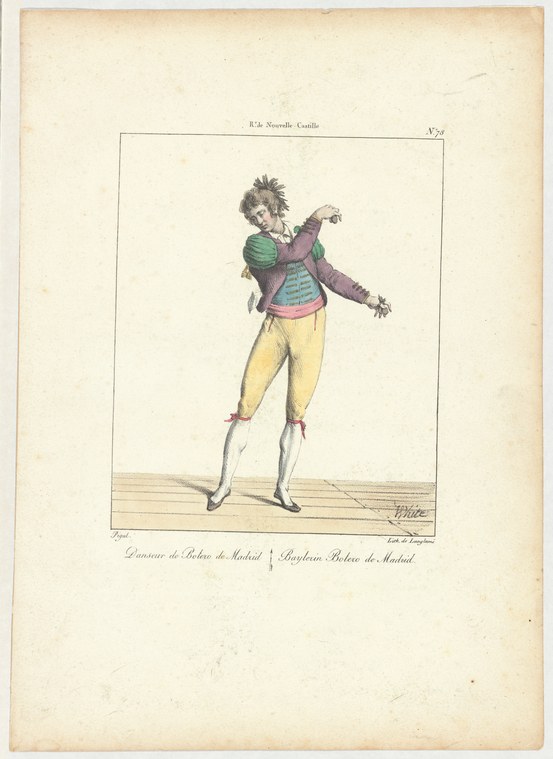
A single male dancer is depicted in a three-quarter pose against a plain background, his body turned to display both frontal and lateral views. He wears a striking costume of the early 19th century: a purple-pink jacket with horizontal green stripes across the chest and waist, a pink belt, and pale yellow breeches that extend to the calf, where they meet white stockings and pointed dancing shoes. His dark hair is styled in the Romantic era fashion, swept upward and back. His left arm extends diagonally across his body with an elegant gesture, while his right arm hangs more naturally at his side; his weight appears shifted onto his back leg in a posed attitude rather than a captured moment of movement. The figure stands on a shallow stage platform suggested by a light wash of shadow beneath his feet. The composition is typical of early 19th-century dance instruction prints: a single idealized dancer frozen in a characteristic position that demonstrates the line and technique of the period.
The dancing
The dancer stands in an elegant contrapposto stance, with weight favored on the back leg and the body held in the upright, refined carriage required of Romantic-era male dancers. The extended left arm traces a curved line across the body, demonstrating the port de bras (arm carriage) central to ballet technique; the hand is held with fingers extended and refined. The right leg is slightly forward, with the foot pointed in the turned-out position (turnout) fundamental to ballet. The posture emphasizes verticality and aristocratic bearing, with the spine extended and the head held with dignity—a single male dancer, posed rather than in motion.
The dance depicted
This is almost certainly a male Romantic ballet dancer, depicted in a characteristic pose from the 1830s–1850s. The costume—particularly the jacket with horizontal striping, the pale breeches, and the overall silhouette—is consistent with male ballet dress of the Romantic period, when male dancers served primarily as partners and supported the ballerinas who dominated the stage. The refined port de bras, the turnout, and the upright posture are all diagnostic of ballet technique as it was taught and performed during this era. The inscription mentions Bolero dancers, suggesting this figure may represent either a character role (possibly Spanish-inflected) or a dancer performing both ballet and theatrical dance of the period, when such boundaries were less rigid than later. The pose itself is didactic: it teaches the viewer the ideal line and carriage expected of a professional dancer.
How it was made
This is a hand-colored engraving or possibly an aquatint, typical of early 19th-century dance instruction and theatrical imagery. The technique allows for fine linear detail in the figure's costume and musculature while the plain background keeps focus on the dancer's form. The color—applied by hand after printing—is bright and somewhat flat, consistent with the commercial prints distributed to dance students, theater enthusiasts, and the wider public during the 1830s–1850s. Such prints were affordable, reproducible, and designed for circulation; they served both as art objects and as practical teaching aids or souvenirs of celebrated dancers or roles.
About this work
This is a portrait of a male Romantic-era ballet dancer, rendered as an idealized instructional image in the manner typical of early 19th-century dance prints. The figure wears the characteristic costume of the period—striped jacket, pale breeches, white stockings—and demonstrates the refined carriage, turnout, and arm position required of professional ballet dancers. The work belongs to a large category of commercial dance prints that circulated in Europe and North America during the Romantic period, serving at once as souvenirs of celebrated dancers, advertisements for theatrical productions, and teaching aids for students of dance. Its presence in the NYPL collection situates it among the documentary and commercial imagery that records how Romantic ballet was actually performed and how dancers were expected to present themselves to the public.
How to look at it
Attend to the dancer's carriage: the lengthened spine, the turned-out legs, and the refined port de bras are all markers of professional ballet training and the aristocratic ideal that Romantic ballet upheld. The pose is not a moment of action but a demonstration of ideal form—what a student or admirer should aspire to replicate. Notice the costume's specific elements: the striped jacket was fashionable and eye-catching on stage, the pale breeches were conventional for male dancers, and the whole ensemble creates a silhouette that emphasizes the dancer's verticality and control. The artist has chosen to show the dancer nearly stationary, allowing the viewer to study line and carriage without the distraction of motion.
The period
This print dates to the Romantic era of ballet, roughly 1830–1860, when the art form underwent a profound transformation. The rise of the ballerina—epitomized by dancers like Marie Taglioni—shifted focus away from male dancers, who became primarily partners and character performers rather than featured soloists. Theatrical dance was expanding beyond ballet to include national character dances and pantomime; the reference to 'Bolero dancers' in the inscription suggests this figure may represent a hybrid role combining ballet technique with Spanish or theatrical idiom. Commercial dance prints flourished during this period as a new form of popular entertainment, allowing the public to own images of celebrated dancers and roles. The costume and styling visible here are consistent with the historical record of how dancers actually dressed and carried themselves in the theater of the 1830s–1840s.
Where it lives
This work is held in the NYPL's collection of prints depicting dance. The inscription and format indicate it is a commercial dance print, the kind produced and distributed throughout Europe and North America in the early 19th century.
Dance in this work
Questions about this work
Why does the title say 'Bolero dancers' when this looks like classical ballet?
In the early 19th century, the boundaries between ballet and theatrical character dance were more fluid than they later became. A dancer might perform both classical ballet and character roles such as Spanish or national dances. The 'Bolero' reference may indicate either that this figure performed a Spanish-influenced role in a particular ballet or that the print documents a dancer known for both ballet and bolero dancing. The costume and technique shown are clearly ballet, but the title suggests a hybrid or character role.
What does the inscription at the bottom say?
The French inscription reads approximately 'Danseur de Bolero de Madrid' and 'Danseur Bolero de Madrid'—roughly 'Dancer of the Madrid Bolero' or similar, indicating that this figure is a bolero dancer, possibly one known for performing Spanish or Madrid-inflected character roles. The specificity suggests this may be a portrait of a named dancer or a role created in a specific production.
How do I know this is meant to teach ballet technique?
The turned-out legs, the refined port de bras (arm carriage), the upright spine, and the pointed foot are all diagnostic of ballet training and technique. The pose is a static display of correct form rather than a moment of action—exactly the kind of instructional image that would have been used by dance teachers to show students the ideal carriage and line. The high quality of the engraving and the plain background focus all attention on the dancer's body.
Why is this dancer posed alone and so formally?
Male Romantic-era dancers were often depicted solo in this manner, demonstrating their technical prowess and ideal carriage. In theatrical performance, male dancers were increasingly marginalized in favor of the ballerina, so prints like this one served to assert their continued importance as skilled professionals. The formal, didactic pose was also practical: it allowed publishers to market the print both as a souvenir of a celebrated dancer and as a teaching aid.
More dance artwork





