49 works in this view — arrow keys or swipe to move between them.
Dance in Art
Adèle Dumilâtre (dans Eucharis)
Unknown artist
- Collection:
- Prints depicting dance
- Source:
- New York Public Library
- Rights:
- Public domain — free to use, share and adapt.
- Recorded as:
- Public Domain
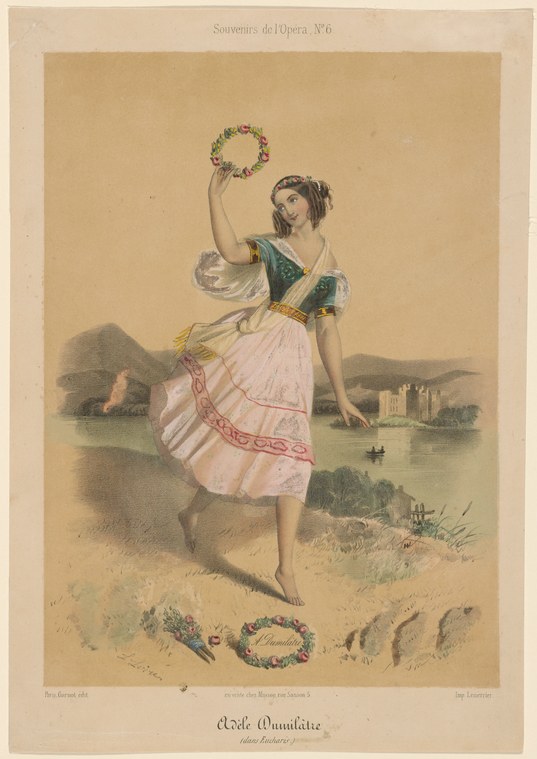
Adèle Dumilâtre was a major Romantic-era ballerina, and this print preserves a named role and a visual record of how she was presented to audiences. The image also demonstrates the crucial role of lithographic prints in mid-nineteenth-century dance culture: these were the photographs of the Romantic ballet era, the way dancers' fame was circulated and their performances preserved in memory.
What you are looking at
A young woman in Romantic-era theatrical dress stands alone in a pastoral landscape, holding aloft a wreath of flowers in her raised right arm. She wears a dark green corsage with short sleeves over a voluminous pink skirt trimmed with red ribbon and gold accents, her bare feet planted lightly on sandy ground. Her dark hair is styled with flowers, and she gazes downward with a contemplative expression. The background shows a misty landscape with a lake or river, distant hills, and what appears to be classical architecture or ruins to the right—a stage set or Romantic backdrop. The composition is theatrical and staged: this is a portrait of a dancer in character, frozen in a moment of lyrical abandon, with the natural world as her frame.
The dancing
The dancer stands in a nearly vertical alignment with minimal weight shift, her body composed and controlled despite the raised arm gesture. Her left arm hangs naturally at her side; her right arm extends upward in a gentle arc holding the wreath. The pose suggests a moment of reflection or offering rather than active motion—her feet appear to be in a natural stance, not engaged in a technical step or jump. The overall frame is upright and dignified, characteristic of early Romantic ballet where the body remained relatively still even in moments of emotional display.
The dance depicted
This is a portrait of Adèle Dumilâtre in the role of Eucharis, likely from a Romantic-era ballet. Eucharis appears in multiple ballets of the 1840s–1850s, most notably in *La Péri* (1843) and *Eucharis* itself. The wreath and pastoral setting align with the mythological nymph character. The pose and presentation are characteristic of Romantic ballet's approach to female dancers: ethereal, statuesque, the body presented as an object of beauty rather than athletic virtuosity. The moment chosen is one of stillness and sentiment rather than technical display.
How it was made
This is a hand-colored lithograph or engraving, recognizable from the delicate line work, tonal washes, and the characteristic texture of mid-nineteenth-century theatrical prints. The printing technique allowed for rapid reproduction and wide circulation among theater audiences and collectors. The soft coloring—pale greens, pinks, and warm ochre tones in the background—suggests hand-coloring applied to a lithographic base. This was a standard format for theatrical souvenir prints, affordable and portable enough to be sold in theater lobbies or collected by admirers.
About this work
This is a souvenir print of the Paris Opéra dancer Adèle Dumilâtre in a named role from the Romantic ballet repertory. It documents not only a dancer and a character but also the visual conventions by which the Romantic ballet was marketed and remembered: the isolation of the dancer in a dreamlike landscape, the emphasis on costume and beauty over technique, the moment chosen as one of poetic stillness rather than spectacular motion. The work belongs in a dance archive as a primary record of how a specific dancer was seen and how her performance was consumed by her contemporaries.
How to look at it
Notice the absolute stillness of the pose: Dumilâtre is not shown in a jump, a turn, or a virtuosic step, but in a moment of repose, holding the wreath as if offering it or contemplating it. This reflects Romantic ballet's narrative priorities—the dancer's body tells a story of emotion and character rather than displaying technical mastery. The landscape background was a common element of theatrical portraiture, signaling the romantic or fantastical world of the stage.
The artist
The artist is not recorded in the catalogue. The print is signed by what appears to be "Lith. Godefroy" or similar in the lower left, and possibly "imp. Lemercier" (a major Parisian lithography house). The style and quality suggest a professional theatrical print house, likely working in Paris during the 1840s–1850s when such souvenir portraits were a standard product of the opera industry.
The period
This work dates to the height of the Romantic ballet era, when European ballet was dominated by ethereal female dancers in mythological and fairy-tale roles, emphasizing pantomime, atmospheric sets, and the illusion of weightlessness. Lithographic portraits of named dancers in specific roles were a primary form of fan culture and stardom documentation before photography. Adèle Dumilâtre's career (c. 1832–1863) coincides with the reign of this aesthetic.
Where it lives
This print is held in the New York Public Library's collection of prints depicting dance, a major archive of theatrical and dance iconography from the nineteenth and early twentieth centuries.
Dance in this work
Questions about this work
Who was Adèle Dumilâtre?
Dumilâtre (c. 1821–1863) was a prominent French dancer at the Paris Opéra during the height of the Romantic ballet era. She performed in major roles across the repertory and was celebrated for her beauty and grace. She was particularly associated with roles in works by Adolphe Adam and other leading ballet composers of the 1840s–1850s.
What is Eucharis?
Eucharis is a character from classical mythology—a nymph or naiad—who appears in multiple Romantic-era ballets. The most famous is *Eucharis* (1843), though the character also appears in Théophile Gautier's scenario for *La Péri* (1843). The role exemplifies the Romantic ballet ideal: a delicate, otherworldly female character moving through a magical landscape.
Why would a dancer have a portrait made in this style?
Theatrical portrait prints were the primary method of celebrity marketing in the nineteenth century. Dancers had these made to sell to fans, circulate their fame, and create a lasting visual record of their roles and their appearance. They were often sold at the theater or through print sellers, making them both fan merchandise and art objects.
What does the wreath signify?
The wreath of flowers is both a costume element and a symbolic attribute of the character Eucharis—marking her as a nymph or nature spirit. In Romantic visual culture, flowers signified femininity, youth, and a connection to the natural or mythological world.
More dance artwork





