49 works in this view — arrow keys or swipe to move between them.
Dance in Art · 1968
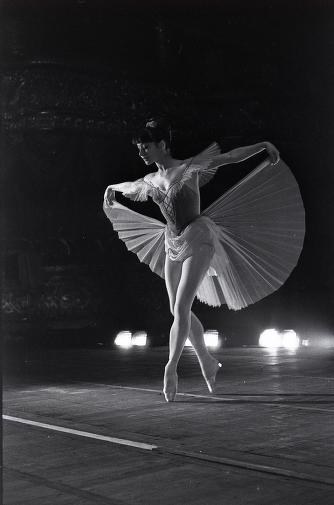
Ekaterina Maximova's "Mazurka".
Unknown artist
- Source:
- Library of Congress
- Rights:
- Public domain — free to use, share and adapt.
- Recorded as:
- Public Domain
Ekaterina Maximova was a ballerina of international standing and the photograph captures a major figure of Soviet ballet at a moment when Bolshoi repertory and training were the dominant model in classical dance worldwide. The image documents not only Maximova's technique but the visual language of theatrical ballet in the mid-twentieth century—the tutu silhouette, the lighting design, and the formal codes of extension and presentation that defined the classical idiom.
What you are looking at
A solitary female dancer in pointe shoes performs against a dark background, lit by soft spotlights at stage level. She wears a classical tutu with a fitted bodice, her upper body tilted back in an extended arabesque or attitude position, with one leg raised high behind her and arms positioned in classical ballet port de bras. The tutu has a distinctive wide, circular silhouette characteristic of mid-twentieth-century ballet costuming. The stark lighting—with pools of light visible at the stage floor—creates dramatic shadow and emphasizes the isolation and formality of the moment. The photograph is black and white, with high contrast that picks out the dancer's figure against the black void of the stage.
The dancing
The dancer stands on one leg en pointe, her supporting leg straight and engaged. Her torso extends backward in a marked line, creating the characteristic curve of Romantic or Classical ballet extension work. Both arms are raised and positioned in the classical frame—one arm extended in line with the raised leg, creating a single long diagonal from fingertips through the body. Her head follows the line of the raised arm, turned away from the camera. The position displays the stretched, elongated silhouette and precise alignment expected in formal classical ballet technique.
The dance depicted
The work is identified in the catalogue as Ekaterina Maximova's performance of a "Mazurka." Maximova (1939–2009) was a principal dancer of the Bolshoi Ballet and a major star of Soviet classical ballet during this period. The image likely documents a solo or featured moment from a ballet that includes a mazurka—a historical Polish court dance that became a standard character dance in nineteenth-century ballet repertory. The pose shown here is not however a mazurka-specific step; it is a sustained classical ballet extension. Either this captures an introduction or coda moment within a mazurka sequence, or the title refers to the music rather than the step vocabulary being performed at this instant.
How it was made
This is a black and white photograph, likely a studio or stage documentation photograph from a ballet performance. The image is identified as originating from the Library of Congress collections. The photographic technique emphasizes theatrical lighting with dramatic spotlighting, suggesting this was taken in a performance or professional documentation context rather than a casual rehearsal snapshot. The high contrast and careful composition indicate a professional theatrical photographer at work, documenting a significant dancer in a significant role.
About this work
This photograph documents Ekaterina Maximova, one of the Bolshoi Ballet's greatest classical dancers, in a moment of sustained extension during a mazurka sequence, captured in 1968. The image shows the dancer in an attitude or arabesque penché, in classical tutu and pointe shoes, isolated against a dark stage with theatrical spotlighting. The photograph is both a record of a specific performance and a study in classical ballet form—the extension, the port de bras, the verticality and control demanded of a prima ballerina at the height of her powers. It belongs in a dance archive as documentation of both a historical dancer and the aesthetic conventions of Soviet classical ballet in the late 1960s.
How to look at it
Look at the moment the photograph arrests: the dancer at the peak of an extended position, not in motion between steps but in the held, sustained extension that demands maximum control and line. The photographer has chosen a moment of stillness within the dance—the counterpart to the peak of a jump or turn in how it displays the dancer's line and power. Notice the geometric clarity of the pose and how the tutu reads as a perfect circle, a design convention of mid-century ballet costuming that frames the dancer's body. The dark background and low theatrical lighting are essential to the image—they isolate the figure and create the abstract, formal atmosphere of classical ballet as it was understood in the Soviet school.
The artist
The photographer is not identified in the catalogue record. The provenance is the Library of Congress, which holds extensive collections of theatrical photography from the mid-twentieth century. It is likely a professional theatre photographer working for a news service, wire agency, or the ballet company itself.
The period
In 1968, classical ballet was entering a period of formal consolidation and international competition. The Bolshoi Ballet was at the height of its influence in the West following the company's historic 1956 tour to London and the defections of major dancers in the early 1960s. Soviet ballet training and aesthetics dominated classical technique internationally. The mazurka as a character dance had been part of ballet repertory since the Romantic era (Giselle, Swan Lake) and remained a vehicle for virtuosity and national character in twentieth-century productions. Maximova's career coincided with the final dominance of the classical Soviet school before contemporary ballet aesthetics began to challenge the formality of extension-based technique.
Where it lives
The photograph is held by the Library of Congress. It is part of the Library's collections of American and international theatrical photography, likely acquired through a news archive or performance documentation source.
Dance in this work
Questions about this work
Who was Ekaterina Maximova?
Ekaterina Maximova (1939–2009) was a principal dancer of the Bolshoi Ballet and one of the leading classical ballerinas of the Soviet era. She was known for her elegant line, brilliant technique, and major roles in the Bolshoi classical and contemporary repertory. She frequently danced with Vladimir Vasiliev and was celebrated internationally following the Bolshoi's Western tours.
What is a mazurka in ballet?
The mazurka is a Polish court dance in 3/4 time that became a standard character dance in nineteenth-century ballet, notably in Swan Lake and Giselle. In ballet, it is performed with sharp accents, turned-out positions, and a characteristic bouncing action. It represents Polish national character and provides contrast to the flowing classical vocabulary.
What position is the dancer in?
The dancer is in an attitude or arabesque extension en pointe, with one leg raised high behind her, the supporting leg straight and fully turned out, and the arms in classical port de bras. This is a sustained extension position that requires great strength and control and is used in ballet to display the dancer's line and flexibility.
Why is the background so dark?
The dark background is theatrical stage lighting design, using spotlights to isolate the dancer against the void of the stage. This is a standard convention of theatrical dance photography and also of mid-century classical ballet staging, which emphasizes the formal presentation of the dancer's body rather than narrative context.
More dance artwork





