39 works in this view — arrow keys or swipe to move between them.
Dance in Art
The polka fashions
Unknown artist
- Medium:
- Lithograph
- Dance:
- Polka
- Era:
- Late 1800s (Victorian Ballroom)
- Source:
- New York Public Library
- Rights:
- Public domain — free to use, share and adapt.
- Recorded as:
- public_domain
The polka was one of the first dances to be embraced simultaneously across Europe and North America, making it a marker of globalized leisure culture and commercial fashion networks. For historians of dance, this image documents how the polka was performed in ballroom settings and how it functioned socially—not as folk spectacle but as refined couple-dancing within a carefully stratified social scene. The work also demonstrates how dance imagery in the 19th century was inseparable from fashion: the dance itself is secondary to the dress.
What you are looking at
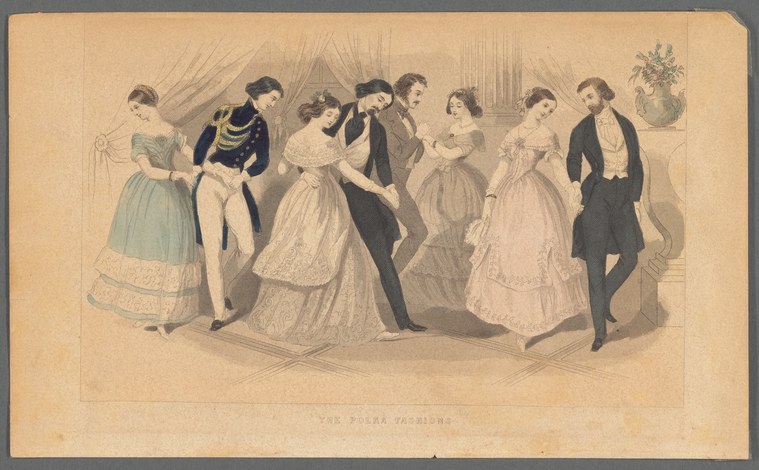
A fashionable social gathering depicted in a hand-colored lithograph shows eight figures arranged in a loose group in an interior space suggested by vertical drapery behind them. At the center, a couple performs the polka: a gentleman in military dress uniform with a dark jacket and gold braiding dances with a woman in a voluminous white gown with layered skirts. Around them, five other figures in evening dress—women in pale silk gowns with tiered skirts and men in dark coats—observe or participate in the social moment. The composition has the lightness of a fashion plate: the figures are elegantly proportioned with refined features, the women's skirts rendered with delicate hatching to suggest the weight and volume of fabric, and the whole scene suffused with an air of genteel leisure. The pale cream-colored paper and soft tonal treatment give the work an intimate, ephemeral quality.
The dancing
The central couple stands in closed ballroom hold, the man's right arm around the woman's waist and her left hand resting on his shoulder—the frame characteristic of 19th-century social dance. The man's posture is upright and guiding; the woman's weight appears lifted, her body turned into the hold, her abundant skirt displaced by the momentum of the step. The other figures are positioned as witnesses and potential partners, some gesturing toward the couple, their stances relaxed and conversational. The overall impression is of controlled, upright carriage and elegant restraint in movement rather than exertion.
The dance depicted
This is the polka, the fashionable couple-dance that swept European and American ballrooms from the 1840s onward. The polka was a lively 2/4 time dance of Bohemian origin, characterized by a hop-step pattern and rapid turning, and it became emblematic of mid-to-late 19th-century social dancing. The title 'The Polka Fashions' suggests the work is as much about the sartorial spectacle—the woman's white silk gown with its hooped skirt, the man's dress uniform—as about the dance itself. The image records not the moment of vigorous turning but rather a composed presentation of the dance: the figures are styled, posed, and arranged for admiration, as if the dance were primarily an occasion for displaying fashionable dress to society.
How it was made
This is a hand-colored lithograph, a reproductive technique that allowed rapid multiplication of fashionable images for middle-class consumption. The artist drew the design on a specially prepared stone, which was then inked and printed; hand-coloring was applied afterward to add subtle gradations of tone and the pale hues of silk and skin. Lithography was the dominant medium for fashion imagery, satirical commentary, and social documentation in the 19th century because it could combine fine detail with a painterly softness and could be produced in series. The technique implies this work was made for a broad audience—likely fashionable subscribers to print series, readers of illustrated periodicals, or customers of print shops—rather than as a unique object.
About this work
This is a hand-colored lithograph recording the polka as a fashionable social dance in the mid-to-late 19th century. The work captures the polka not as a folk dance or as vigorous movement, but as an occasion for elite display—of military rank, of refined deportment, of the latest in women's silhouette and skirt construction. The couple in the center performs in closed ballroom hold, surrounded by elegantly dressed witnesses, all posed with the composed refinement expected of polite society. The work sits at the intersection of fashion documentation and dance record: it tells us what the polka meant to the urban middle and upper classes who danced it—a marker of sophistication, an emblem of continental style, a stage for sartorial display.
How to look at it
Look at the silhouettes: the woman's dress is characteristic of the 1860s–1870s, with a tight bodice, dropped shoulders, and a skirt that extends in tiers from the waist, supported by crinolines or bustles. The man's military coat is rendered with precise attention to braiding and rank insignia. The artist has chosen to freeze the moment not at the height of a turn, but in a composed, presentational pose—neither static nor obviously mid-step. Notice how the couple's hold is correct but not dynamic: this is a dance as displayed to society, not as danced in private or in moments of abandon. The surrounding figures gaze at the couple, positioning them as the center of admiration; the whole scene is arranged like a tableau on a social stage.
The period
The polka emerged in Bohemia in the 1830s and became a sensation in European ballrooms by the 1840s; it reached North America by mid-century and dominated fashionable dancing through the 1880s. It represented a break from earlier couple-dances like the waltz in that it was faster, more playful, and less formally regimented. The polka coincided with the expansion of the print market and the rise of fashion plates as a primary medium for circulating images of elite dress and behavior. By the 1860s–1880s (the likely date of this work based on the silhouettes and the style of the military uniform), the polka was already established and somewhat conservative—a standard feature of balls and assemblies rather than a novelty. The image reflects the visual conventions of mid-Victorian fashion documentation: the emphasis on graceful line, the careful rendering of textile texture, and the arrangement of figures to display dress from multiple angles.
Where it lives
The work is held in the New York Public Library collection, cataloged as a lithograph from the late 19th century. It is one of thousands of similar fashion and social scene prints that circulated in the United States and Europe during the second half of the 19th century, often as part of series or periodical publications.
Dance in this work
Questions about this work
What is the polka and who danced it?
The polka is a lively 2/4-time couple-dance of Bohemian origin that became fashionable across European and American ballrooms from the 1840s onward. It was danced by the urban middle and upper classes at balls, assemblies, and formal social events. Unlike some earlier dances, the polka was associated with fun and playfulness rather than rigid formality, though it was still danced with proper ballroom posture and in closed hold.
Why is the dress so much larger than modern ball gowns?
The voluminous skirt was fashionable from the 1850s through the 1880s and was supported by stiff petticoats, crinolines, or a framework called a bustle. This silhouette was a sign of wealth (it required yards of silk fabric and multiple layers of support) and of leisure (the wearer could not do manual labor). The skirt's size was central to the aesthetic display of the dance—the woman's skirt would swing and ripple with movement, making the dance itself partly a display of the dress.
Is this a portrait or a general scene?
This is a generic social scene rather than a portrait. It depicts the polka as a fashionable dance in general, not a specific occasion or named individuals. The work is part of a genre of 19th-century fashion and social documentation: images produced in series or periodicals to show readers how the fashionable classes dressed and behaved.
What is a lithograph and why was it used for fashion images?
A lithograph is a print made from a stone or metal plate. The artist draws on the stone with a greasy crayon, then the stone is wetted and inked—the ink adheres to the drawn areas but not to the wet areas. Lithography allowed artists to create multiple copies quickly and cheaply, and the technique could capture fine detail and tonal subtlety. This made it ideal for fashion documentation: publishers could print hundreds of copies and distribute them to paying subscribers or sell them in print shops, making fashionable images accessible to a broad audience.
More Polka artwork