49 works in this view — arrow keys or swipe to move between them.
Dance in Art · 1897
Cupid and Psyche
Unknown artist
- Source:
- Library of Congress
- Rights:
- Public domain — free to use, share and adapt.
- Recorded as:
- Public Domain
Stage photographs like this are among the only direct evidence we have of how ballet was actually performed in the late nineteenth century, before film. They show costume, body carriage, spatial relationships, and the scale of theatrical production—information that cannot be recovered from written records or notation alone. This particular image, if it documents a performance of a Cupid and Psyche ballet, contributes to the history of mythological ballets and the roles that were central to a dancer's career in that period.
What you are looking at
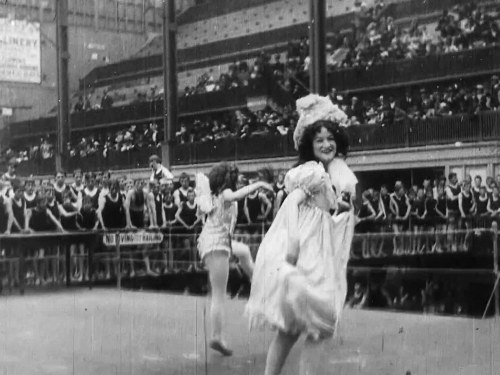
A woman in a white Regency or early 19th-century gown with puffed sleeves and a low bodice dances in the center of an indoor theatrical space. She wears an elaborate white feathered or ostrich-feather headdress and carries her arms in a graceful, extended position characteristic of classical ballet. The stage is surrounded by tiered seating packed with spectators, suggesting a substantial theatrical venue or ballroom. The composition centers on the soloist, whose figure is isolated against the dark background of the auditorium, emphasizing her as the focal point of performance. The image is rendered in black and white, showing the theatrical lighting and spatial relationships clearly.
The dancing
The dancer stands in an upright, elongated posture with arms lifted and extended, palms downward in a position that suggests classical ballet vocabulary. Her torso appears vertical and engaged, her weight balanced on what may be en relevé (on the balls of the feet), though the photograph does not resolve footwork clearly. The single dancer occupies the center ground, unpartnered, performing for an audience whose presence frames and contains the dancing figure. Her head is held high, gaze directed away from the viewer, in the formal, dignified bearing expected of a leading dancer of the period.
The dance depicted
The costume, posture, and theatrical context strongly suggest Romantic-era classical ballet, likely from the first half of the nineteenth century. The white dress, feathered headdress, upright carriage, and arm positions are consistent with ballet blanc repertory. Without additional documentation, the specific role—whether this represents Psyche from a ballet on the myth of Cupid and Psyche, or another work—cannot be confirmed from the image alone. The theatrical scale and formality of dress suggest this is a principal dancer performing a solo or substantial featured role in an evening of theatrical dance.
How it was made
This is a black-and-white photograph, likely a stage photograph or documentary image from a theatrical performance. The image quality and composition suggest either an archival theatrical photograph or a reproduction of one. The medium allows precise documentation of costume, spacing, and the theatrical architecture, but the photographic moment freezes only a single instant and cannot convey the continuity of the movement or the music that accompanies it. Stage photographs of this era are often the only surviving visual record of performances that were never notated.
About this work
This is a stage photograph documenting a performance of a dancer in classical ballet costume and technique, dated 1897 and catalogued as 'Cupid and Psyche.' The work shows a solo female dancer in the formal, upright bearing and extended arm positions of Romantic ballet, performing in a substantial theatrical venue before a full house. The image is a document of theatrical practice at the end of the nineteenth century, when ballet in Europe and North America was still rooted in the aesthetic and vocabulary of the Romantic era, and photography was becoming the primary means of preserving ephemeral performance.
How to look at it
Attend to the posture and arm position: the upright spine, the lifted ribcage, the extended arms with palms downward and fingers articulated are the markers of ballet training and aesthetic choice. Note the costume—the white gown and feathered headdress are not accidental ornament but genre markers of classical ballet and the Romantic repertory. The photograph captures the dancer in what appears to be a sustained pose or a moment of arrival within a larger movement phrase, presenting the dancer not as active motion but as a composed, formal image: this reflects both the aesthetic of ballet at the time and the technology of still photography.
The artist
The photographer is not recorded. Stage photography in the 1890s was a developing technology, and photographers working in theaters often went uncredited in archival documentation. Such images were made both for theatrical records and for sale to the public as souvenirs of celebrated performances and dancers.
The period
In 1897, classical ballet was in transition. The Romantic era (1830s–1860s) had established the aesthetic of the white ballet, the female soloist, and the ethereal, weightless ideal that this photograph exemplifies. By the end of the century, that vocabulary was being preserved as a classical foundation while new choreographic movements—including the radical innovations of Sergei Diaghilev's Ballets Russes, which would debut in 1909—were beginning to challenge it. In the 1890s, theaters still featured Romantic-era ballets (Swan Lake premiered in Russia in 1895), and the training and aesthetics of ballet remained grounded in the principles visible in this photograph.
Where it lives
This image is catalogued in the Library of Congress collections and is dated 1897. The catalogue record offers no information about the performer, the theater, or the specific production documented. The source attribution to the Library of Congress suggests it is part of an American institutional collection or derives from materials held there.
Dance in this work
Questions about this work
Is this a photograph or an engraving?
This is a photograph, most likely a black-and-white stage photograph from the 1890s. The image quality and tonal range are consistent with photographic printing of that era. Photographs were the standard documentary medium for theater by this period, though earlier dance imagery was often recorded through engravings and lithographs.
What is 'Cupid and Psyche' in ballet history?
Ballets based on the classical myth of Cupid and Psyche were common in the nineteenth century, particularly as vehicles for displaying classical ballet technique and the ethereal aesthetic that characterized Romantic ballet. Without additional information, we cannot identify which specific production or choreography this photograph documents, or which dancer performed the role.
What does the feathered headdress tell us?
The elaborate feathered headdress (likely ostrich feathers) was a signature costume element of classical and Romantic ballet, worn by principal dancers performing roles in the white ballet repertory. It signaled both the formality and fantasy of the genre—suitable for a mythological or supernatural character. Such headdresses were expensive and were associated with roles of prominence.
Why was she photographed in this pose?
The pose appears to be a moment of sustained balance and formal presentation rather than a fleeting moment of motion. This may reflect both the movement vocabulary of ballet at the time and the practical need of the photograph to hold a pose long enough for exposure. Stage photographers often asked performers to hold key positions for the camera, which means this image may not represent an actual moment from the performance but a posed documentation of the role.
More dance artwork





