49 works in this view — arrow keys or swipe to move between them.
Dance in Art
Ancient dancing
Unknown artist
- Medium:
- Source:
- New York Public Library
- Rights:
- Public domain — free to use, share and adapt.
- Recorded as:
- public_domain
This image documents an important moment in how European culture imagined classical dance: not from historical sources, but through the lens of contemporary neoclassical aesthetics. For historians of dance representation, the print reveals what 18th-century artists thought ancient dancers should look like—graceful, isolated, and decorative—and how prints like this shaped educated viewers' understanding of antiquity long before archaeological evidence could correct those misconceptions.
What you are looking at
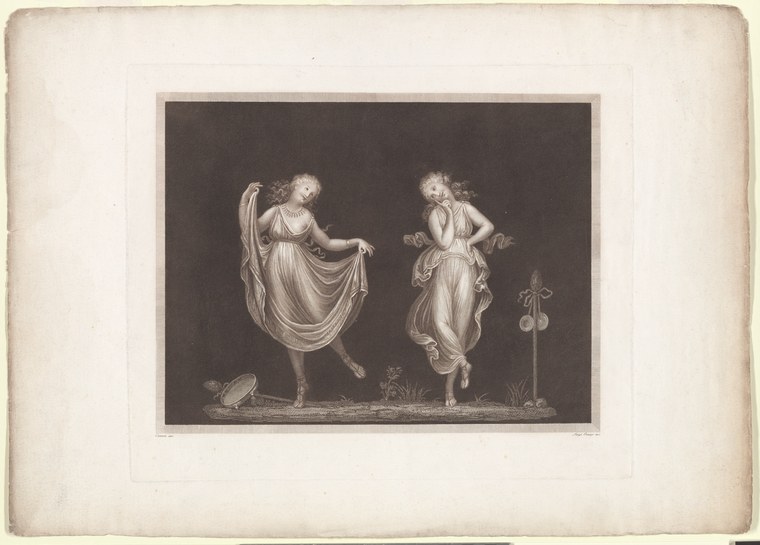
Two female figures in classical dress float against a dark ground, their bodies weightless and ethereal. The figure on the left wears a long chiton caught mid-swirl, her body angled in profile as one arm extends upward and backward, the other drawing the drapery of her garment. She appears to be in motion, possibly turning. The figure on the right stands more upright, also in a draped gown, with her weight shifted and both arms raised with a graceful articulation. Between and around them lie scattered classical attributes: a lyre or similar stringed instrument rests on the ground to the right, along with what appears to be a small rocky outcrop or altar form on the left. The figures cast no shadows and appear suspended in a timeless space—the engraving technique and dark background give the scene the quality of a classical relief or vase painting translated into a print. The composition is austere and archaeological, suggesting these are meant to represent dancers from antiquity or an imagined classical past.
The dancing
Both figures demonstrate a classical contrapposto weight distribution, with one leg supporting and the other released. The left figure's arm gesture is expansive and lyrical, suggesting rotation through the upper spine; the raised arm reaches upward and back in what may be part of a turning figure or celebratory pose. The right figure's arms are held higher and more symmetrically, with elbows bent and palms facing outward in a pose of presentation or blessing. Neither figure engages a partner or assumes a social dance position; the space between them is formal and disconnected. The drapery on both figures is rendered with classical attention to flow and fold, suggesting bodies in motion rather than static poses, though the movement reads as more abstract and decorative than functional.
The dance depicted
This appears to be a print in the neoclassical tradition, likely 18th or 19th century, depicting imagined classical Greek or Roman dancing. The pose and iconography—the lyre, the lack of theatrical costume beyond classical dress, the archaeological precision—suggest these may be Terpsichore (muse of dance) or generic representations of antique dancers performing in isolation or in a sacred/ceremonial context rather than a ballroom or stage performance. The artist's approach is antiquarian and artistic rather than documentary; the poses convey grace and fluidity but do not reference any specific dance technique recognizable from the historical record. This is a work of imaginative reconstruction of classical antiquity filtered through neoclassical aesthetic values.
How it was made
This is an engraving or possibly a stipple engraving, identifiable by the fine cross-hatching and tonal gradation that creates depth and form against the dark background. The technique allows the artist precise control over drapery rendering and the subtle modulation of the figures' bodies. Engravings of this type circulated widely in educated society as prints, serving both as artworks in themselves and as illustrations for literary or antiquarian texts. The dark ground—whether created through heavy inking or as part of the design—is unusual for engraving and suggests either a specialized technique or a deliberate choice to evoke the appearance of classical vase painting or relief sculpture.
About this work
This engraving presents two classical female figures in idealized poses against a dark ground, their identities suggested by scattered classical attributes like a lyre. The work belongs to the neoclassical revival of the 18th and 19th centuries, when European artists mined ancient Greece and Rome for subjects and aesthetic models. It is part of a tradition of antiquarian prints meant to both educate viewers about the classical past and to present that past as a source of refined artistic beauty. The catalogue title—simply 'Ancient dancing'—reflects how these works functioned: as generalized evocations of classical culture rather than precise historical documentation. The print circulated as part of the dissemination of neoclassical taste through reproductive graphics, accessible to a cultured middle-class audience.
How to look at it
Observe the asymmetry in the two poses: the left figure is captured mid-motion, with her drapery swirling and her weight shifted, while the right figure appears more static and presentational, frontal and symmetrical. This pairing suggests the artist understood dance as something with states—activity versus rest, movement versus display—rather than a continuous action. Notice how the lyre and rocky ground anchor these figures to 'antiquity' iconographically, even though nothing in the poses or technique references any actual ancient source. The dark background is key: it removes the figures from any social or theatrical context and places them instead in a timeless, imaginary space where classical beauty exists for its own sake.
The period
This print was created during the height of the neoclassical movement in Europe, when artists and intellectuals looked to Greco-Roman antiquity as a corrective to what they saw as the excesses of baroque and rococo style. In dance history specifically, this was the era of the ballet d'action—narrative ballet emerging in the mid-18th century—yet images like this represent a different impulse: not storytelling ballet but an antiquarian fantasy of how 'the ancients' might have danced in isolation or in sacred contexts. The engraving's style and circulation through prints meant it likely influenced visual taste across multiple media, including the actual design of costumes and poses for neoclassical ballet. The work reflects the broader 19th-century hunger for archaeological knowledge and the assumption that visual art could reconstruct history accurately.
Where it lives
The work is held in the New York Public Library collection, which indicates it entered an American institutional collection by the 19th or early 20th century. The catalogue records are sparse, suggesting it arrived as part of a broader acquisition of prints rather than as a specifically identified work. Its holding in a major research library rather than a museum of fine art reflects its status as a reproductive print—a vehicle for the dissemination of artistic and antiquarian knowledge rather than a unique work by a master.
Questions about this work
Are these real Greek or Roman dances?
No. This is an imaginative reconstruction by a neoclassical artist, not a record of actual ancient dance. The artist invented poses that looked classical and graceful to a contemporary European eye, using costume and attributes (the lyre, the draped gown) as signals of antiquity. Actual evidence of ancient dance—from vase paintings, sculpture, and texts—is fragmentary and often ambiguous, and this print does not claim to be based on it.
Why is the background so dark?
The dark ground is unusual for engravings and may have been created through heavy inking or a specialized technique. It serves an aesthetic purpose: removing the figures from any recognizable social or theatrical space and presenting them as timeless, ideal forms. It evokes the appearance of ancient pottery or relief sculpture, reinforcing the work's claim to be 'classical.'
Was this print meant to teach people how to dance?
No. This is an art print meant to cultivate taste and to present classical antiquity as a source of beauty and refinement. It may have circulated in scholarly or artistic contexts and could have influenced costume design for neoclassical ballets, but it was not a dance instruction manual or a documentary record.
More dance artwork